


Stuart Scuba · Corrective Lens Guide
How to Choose a Prescription Scuba Mask
Seeing a whole turtle is nice. Being able to read your computer when it swims past is even better. Start by figuring out what you need to see clearly underwater, then find a mask that fits and can take the right correction.
Distance, close-up or both?
If the reef and your buddy look fuzzy, tell us you need help with distance. If you can see the reef but can’t easily read the pressure gauge, computer, slate or camera screen, you may need a near-vision solution. If both are tricky, ask about a distance correction with a near-vision segment. Bring your current prescription and ask an eye-care professional what correction is suitable for you.
Three ways to get a clearer view
Drop-in corrective lenses
These replace the original windows in specific masks. They can make sense for a straightforward correction if the manufacturer offers the power you need. Check the model number and left/right lens availability before you buy.
Near-vision segments
A reading segment can help with the gauge or camera without taking over your distance view. Bring the equipment you need to read so you can check segment placement and viewing distance.
Custom prescription lenses
Ask an optical provider about custom options if you have significant astigmatism, a stronger or complex prescription, or different needs for each eye. Ask how any bonded lens affects space and the mask’s cleaning instructions.
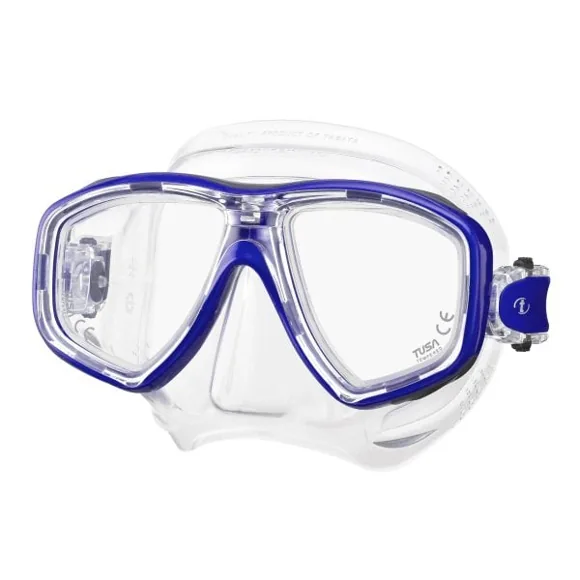
A real example: TUSA Freedom Ceos
The Freedom Ceos M-212 accepts compatible TUSA MC-7500 corrective lenses and BF-7500 reading lenses. The specific lens choices will depend on your correction and availability. Ask for the exact mask and lens codes before you order. Other brands use different systems.
What to bring to the fitting
- Your current prescription, including any near-vision addition. Bring your old mask if you already use one.
- Your dive computer or gauge. If photography is the reason for the upgrade, bring that screen too.
- Your hood and a sense of the conditions you dive in, including whether you need to read a screen in low light.
- Your trip dates, so there’s time to confirm lens availability and practice with the finished setup.
Ask how you’ll correct your vision if you lose or damage the primary mask. At minimum, plan how you’ll see on the surface. If you need correction underwater to dive safely, plan an appropriate fitted backup too.
Frequently asked questions
Do I use the numbers from my glasses prescription to order online?
Use your prescription as the starting point and ask your eye-care professional or optical fitter to help select the right correction. Available stock lens steps and compatible mask models vary.
Do prescription lenses make the mask fit differently?
Some custom lenses can sit closer to your face. Check lash clearance, field of view and near-segment position on the finished mask before relying on it.
Can I add reading lenses to my existing mask?
It depends on the mask and the optical solution. Bring the exact model so we can help you decide which options to discuss with your optical fitter.
Can I clean a prescription mask the same way as my old mask?
Check the mask maker’s and optical provider’s instructions. Bonded lenses, coated glass and anti-fog films can need different products and handling.




