


Faulkner’s Cup Coral
Tubastraea faulkneri · Dendrophylliidae · Colonial coral · Galápagos Islands Fish ID
How to identify it
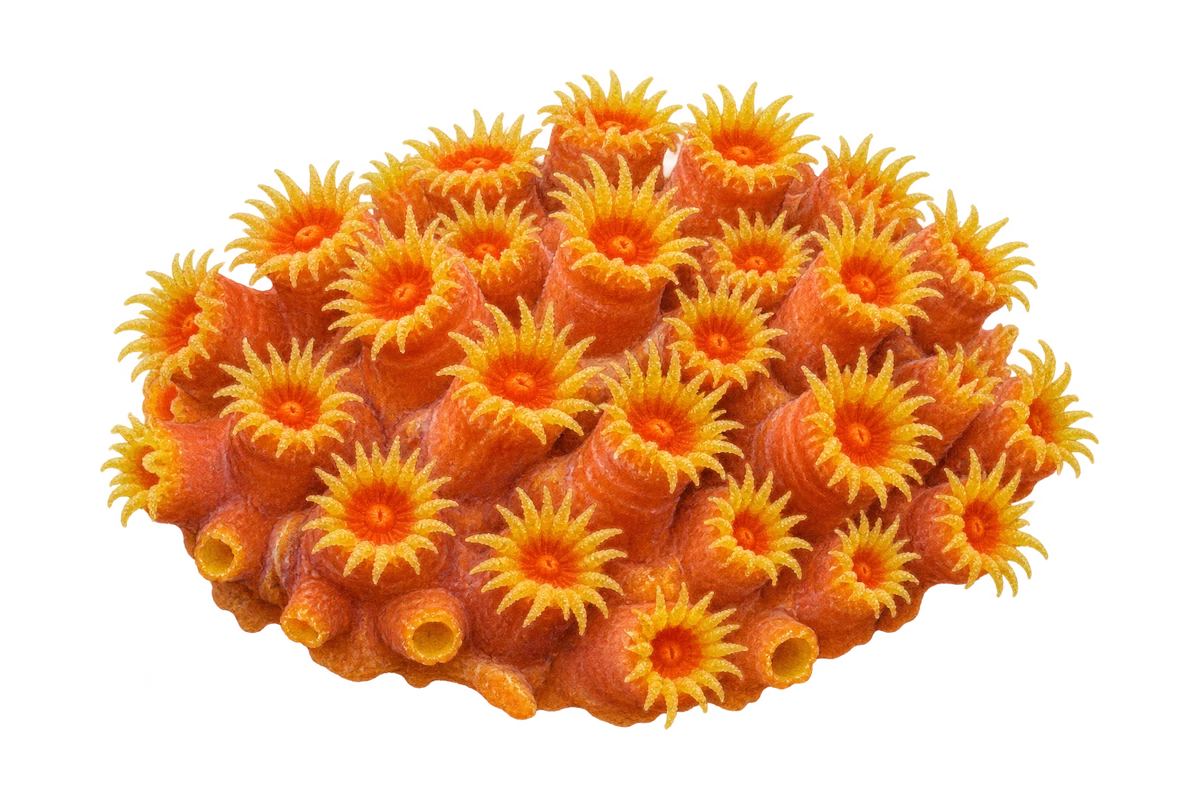
In the expedition’s underwater photograph, amber, bright yellow and orange polyps look like a tight patch of little suns. The separate tubes are the home of individual polyps in the same colony.
Learn to observe reefs without touching
SDI Coral Conservation is the place to start if you want to learn about coral habitats and how to observe them responsibly.
Start with the colony’s outline and the pattern of its coral cups. Look from a position where you can keep your fins and camera clear of the colony.
- Keep your fins and camera clear: Advanced Buoyancy Control focuses on trim, weighting and hovering.
- Build a broader skill set: Advanced Adventure introduces several specialties, including deep diving and navigation, with opportunities to refine buoyancy.
- For deeper recreational dives already in your plans: Deep Diver focuses on planning depth and managing breathing gas. It’s not needed to identify coral on a shallow dive.
- Record the details: Underwater Photography covers lighting and still-image composition. Underwater Video covers framing and steady footage. Use either without resting gear on the reef.
Galápagos Islands records
Documented Galápagos record: Gardner Island, Floreana, Baltra, Playa Negra (Isabela), Santa Fe. A record does not guarantee a sighting.
Fun facts
- The CDF describes it growing on cave ceilings and under rocky overhangs at local sites.
- The local expedition photograph shows separate extended yellow and amber tentacle crowns.
- The Smithsonian revision distinguishes it from T. coccinea using the hard corallites, not just tentacle color.
- A single compact colony contains many separate living polyps.
- The CDF records it locally from 6 to 17 m and describes it as uncommon.
- Its living tissues can hide the hard cup walls; the taxonomic skeleton plate reveals how the individual cups fit together.
Explore and learn
Use the published corallite structure and local context, not bright orange alone: several sun corals share that look.




