

South Florida fish guide / Deep-bodied & oval / Medium: 6–18 inches
Queen Angelfish
Holacanthus ciliaris · A blue-and-gold reef resident with a crown worth looking for.
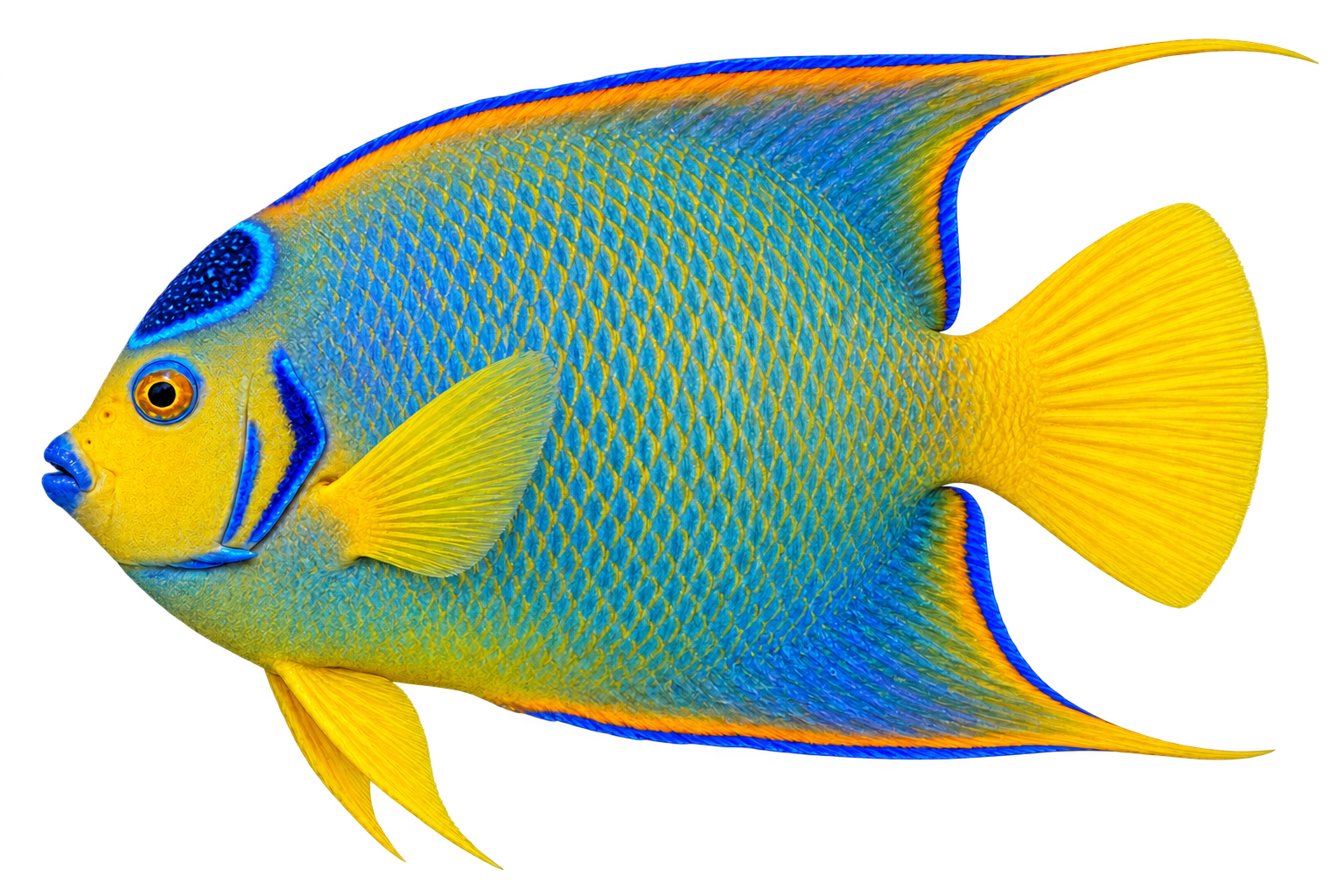
Spot the queen: three clues
- The crown: a dark blue forehead spot, ringed and speckled with brilliant blue.
- The tail: yellow throughout, rather than just edged in yellow.
- The silhouette: a tall, flattened oval body with long trailing dorsal and anal fins.
REEF lists a typical size of 8–14 inches, with a maximum of 18 inches. Look at markings and body shape as well as size: a small fish may be a juvenile, and underwater distance can mislead your estimate.
Where might a South Florida diver see one?
Queen angelfish are part of the western Atlantic reef community, including Florida reef habitats. Look close to reef structure, corals, sponges and sea fans rather than expecting an open-water schooling fish. The wider species range extends from Bermuda through the Caribbean to Brazil.
The Florida Museum describes habitat from shallow reefs to about 230 feet (70 metres). That is a biological range, not a dive recommendation. Stay within your training, certification, conditions and dive plan. A species being present in the region never guarantees an encounter on a particular trip.
What is on the menu?
Sponges make up most of the adult diet. Queen angelfish also eat other marine invertebrates and some algae and plankton. Their small, protrusible mouth and brush-like teeth help them pick food from reef surfaces. Watch from a respectful distance and you may notice repeated, deliberate nips at the reef.
Size and body shape
This is a deep-bodied fish compressed from side to side, with a rounded head and one continuous dorsal fin. Adults can reach about 18 inches (45 centimetres). In this guide, the adult belongs in the deep-bodied and oval group and the medium, 6–18-inch size band. These are browsing aids, not taxonomic categories or fixed limits for every individual.
Daily habits: solo, paired and curious
Adults are usually seen alone or in pairs, moving around reef structure. They can be shy, yet sometimes pause to inspect a diver. Give the fish room to choose its distance. Hover clear of the bottom, keep fins away from fragile habitat and never chase, corner, touch or feed marine life.
Mating and the next generation
Pairs rise into the water and release eggs and sperm for external fertilization. The eggs float in the water column, and the larvae begin life away from the reef before settling. The Florida Museum describes adults paired throughout the year, which may suggest a lasting bond; it does not establish that every pair mates for life.
Young queen angelfish look strikingly different from adults: a dark blue body, bright blue curved bars and a yellow tail gradually give way to the blue-and-yellow adult pattern.
A young fish with a cleaning job
Juveniles can establish cleaning stations, removing parasites from larger fish. It is a memorable change in lifestyle: the little cleaner eventually becomes an adult whose diet is dominated by sponges. Watch quietly rather than approaching a station or interrupting the interaction.
Queen or blue angelfish?
The blue angelfish, Holacanthus bermudensis, is a close look-alike. On an adult, the queen's blue-ringed crown and all-yellow tail are especially useful clues. Juveniles are harder: queen angelfish have curved blue body bars, while the blue angelfish's bars are straighter. The two species can hybridize, so not every individual fits a simple checklist.
Three quick facts for your next dive briefing
- The "crown" is a color marking, not a raised structure.
- Juveniles and adults can look so different that color alone is a poor starting point.
- A fish that eats mostly sponges may have begun its reef career cleaning other fish.
Try the identification challenge
Identify the featured fish Browse by body shape and size
Sources and image notes
Identification and size: REEF: Queen Angelfish. Habitat, range, feeding, reproduction, juveniles and look-alikes: Florida Museum: Queen Angelfish. Reviewed November 8, 2026.
The illustration emphasizes adult identification marks and is not a specimen record, local sighting or substitute for a photographic field guide.
Your surface-interval essentials
Check the Stuart Scuba Weather Center · Play scuba trivia
Weather and wildlife vary. Confirm current conditions, trip requirements and departure details with the operator.
Plan Your Next Dive with Stuart Scuba
Dive With Us
Explore upcoming local charters and choose a dive that fits your experience.
Before you book
Check the individual listing for departure time, requirements and availability.
Travel With Us
Find upcoming dive adventures and start planning your next trip.
Plan your trip
Review dates, inclusions and trip details on the travel calendar.
Stay Connected with Stuart Scuba
 Follow pageShare
YouTube
SubscribeWatch & shareFollow on InstagramView & share post
Follow company news, training updates, and dive stories.
Follow on LinkedInGoogle Reviews
See Stuart Scuba’s current Google rating and review count below. Open the listing in Google Maps to browse customer reviews.


