


Philippines Reef Fish Field Notes 4: Visayas and Dauin
Identify fish documented by divers at Apo Island or off Dauin. A record from a past survey does not guarantee what you’ll see on a given dive.
Browse all Philippines Fish ID entries · Explore the Atlantis Philippines dive trip · Meet the Tomato Clownfish
Gillblotch Filefish
Pervagor janthinosoma · Monacanthidae
How to recognize it: Start with the dark blotch around the gill opening, just ahead of the pectoral-fin base. A male can also show blue around the snout and along the lower flap of the body.
What to watch for: Look on lagoon or seaward reefs. Wait for the fish to turn: a view of the gill area is more useful than relying on tail color alone.
Philippines records: Divers have recorded this species at Apo Island. Sightings vary by site and conditions.
Razor Wrasse
Cymolutes torquatus · Labridae
How to recognize it: Look for a narrow, blade-like side profile. A fish seen over bare sand can vanish before you get a second look.
What to watch for: It can dive into sand when threatened. Search sandy lagoon and reef-flat habitat visually and leave the sand undisturbed if the fish slips out of sight.
Philippines records: Divers have recorded this species at Apo Island and off Dauin. Sightings vary by site and conditions.
Ringed Pipefish
Dunckerocampus dactyliophorus · Syngnathidae
How to recognize it: Alternating dark and pale rings run across the slender body and down the snout. The red tail is bordered above and below by white, and usually has one to three pale spots near its center.
What to watch for: Look around sheltered reef crevices without reaching in. The tail pattern can help separate similar ringed pipefish, so a glimpse of the body bands alone is not enough.
Philippines records: Divers have recorded this species at Apo Island. Sightings vary by site and conditions.
Pacific Glasseye
Heteropriacanthus carolinus · Priacanthidae
How to recognize it: The enormous eye is the first clue, but also look for spotted dorsal and anal fins and a broadly rounded tail. The body can look red, pinkish silver or mottled.
What to watch for: Look beneath reef ledges by day. These fish may come out to feed around dusk. Do not substitute a western Atlantic glasseye image, even if it is labeled with an older scientific name.
Philippines records: Divers have recorded this species at Apo Island. Sightings vary by site and conditions.
Dogtooth Tuna
Gymnosarda unicolor · Scombridae
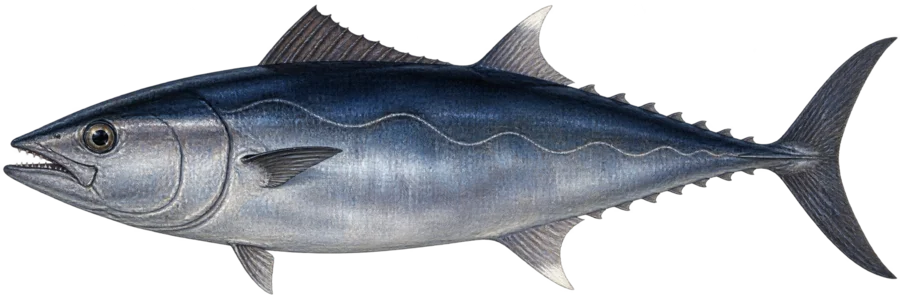
How to recognize it: Look for a muscular, mostly unmarked fish with a dark blue-black back and silvery underside. The leading edge of its first dorsal fin can look dark; rows of spots or stripes are not part of the usual pattern.
What to watch for: Keep one eye on the water beyond the reef. Dogtooth tuna pursue small schooling fishes, including jacks and fusiliers. A passing silhouette is more likely than a close look at its namesake teeth.
Philippines records: Divers have recorded this species at Apo Island. Sightings vary by site and conditions.
Greyface Moray
Gymnothorax thyrsoideus · Muraenidae
How to recognize it: Look for a silvery white iris set in a pale to purplish snout. Fine brown freckling gives the rest of the body a much different texture from its face.
What to watch for: When only the head is visible in reef cover, the pale iris and contrast at the snout are more informative than the eel's apparent size. Watch without putting a hand near the opening.
Philippines records: Divers have recorded this species at Apo Island. Sightings vary by site and conditions.
Dick’s Damsel
Plectroglyphidodon dickii · Pomacentridae
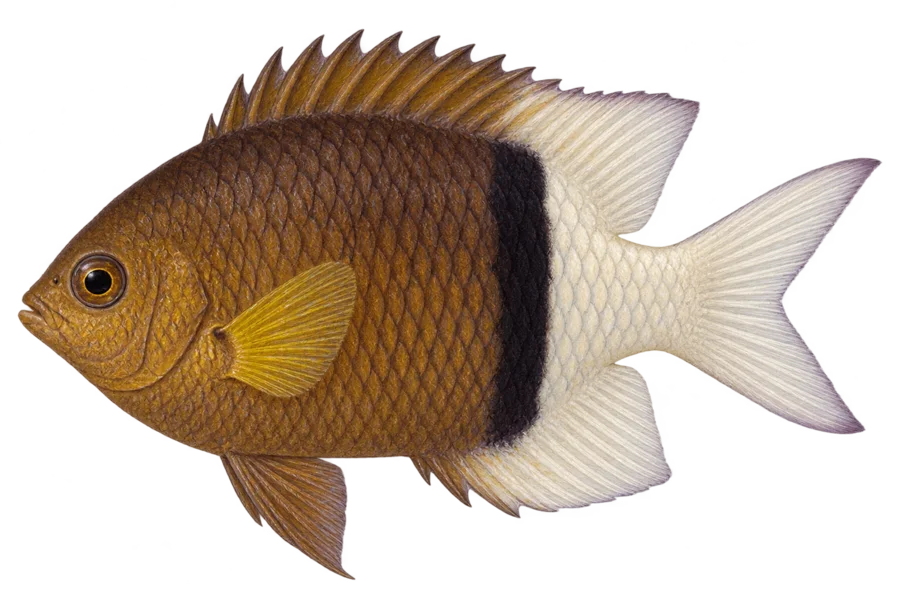
How to recognize it: A black bar crosses the rear of the dusky body, leaving the tail base and tail cream or white. A similar Johnston's damsel has a yellower tail and a wider rear bar.
What to watch for: Look near branching coral in clear reef areas. This damsel may shelter among branches, so wait for it to move rather than reach toward its cover.
Philippines records: Divers have recorded this species at Apo Island. Sightings vary by site and conditions.
Pacific Crowned Toby
Canthigaster axiologus · Tetraodontidae
How to recognize it: Look for brown saddles with lively blue or yellow markings nearby. In this fish the saddles do not continue onto the belly, unlike those on a Blacksaddle Toby.
What to watch for: Check open sand and rubble alongside reefs. A side view showing the belly as well as the saddles can settle an identification that color alone cannot.
Philippines records: Divers have recorded this species at Apo Island. Sightings vary by site and conditions.
Blackvent Damsel
Dischistodus melanotus · Pomacentridae
How to recognize it: Look for a large black patch just before the anal fin. The upper head is brown and the pale lower head can carry fine pink lines and flecks.
What to watch for: Check shallow coastal reefs and lagoons. A fish on its own is not unusual; a clear view of the belly shows the key field mark.
Philippines records: Divers have recorded this species at Apo Island. Sightings vary by site and conditions.
Yellow-lined Snapper
Lutjanus rufolineatus · Lutjanidae
How to recognize it: On the pinkish body, look for roughly ten fine yellow lengthwise lines, yellowish fins and a relatively large eye. A dark mark below the soft dorsal can occur, but not every individual has it.
What to watch for: Use the whole pattern when several striped snappers pass together. The count and arrangement of the fine lines are more helpful than the presence of a dark spot alone.
Philippines records: Divers have recorded this species at Apo Island. Sightings vary by site and conditions.
Orangetail Filefish
Pervagor aspricaudus · Monacanthidae
How to recognize it: Look for a cooler gray-blue front grading to yellow-orange near the rear and tail. Small marks across the head and body can look like dashes rather than round dots.
What to watch for: The color varies. Check both the dash marks and the transition to orange before separating it from similar filefish that also have warm-colored tails.
Philippines records: Divers have recorded this species at Apo Island. Sightings vary by site and conditions.
Bloch's Bigeye
Priacanthus blochii · Priacanthidae
How to recognize it: Look for the large eyes and a pinkish-red body that can appear mottled with silver. Fine dark marks on the soft dorsal, anal and tail fins can help distinguish it from bigeyes with numerous spots on the pelvic fins instead.
What to watch for: Look near rocky or reef shelter. Big eyes and red coloration identify the general group more readily than the species, so wait for a view of the fins.
Philippines records: Divers have recorded this species at Apo Island. Sightings vary by site and conditions.
Bridled Cardinalfish
Pristiapogon fraenatus · Apogonidae
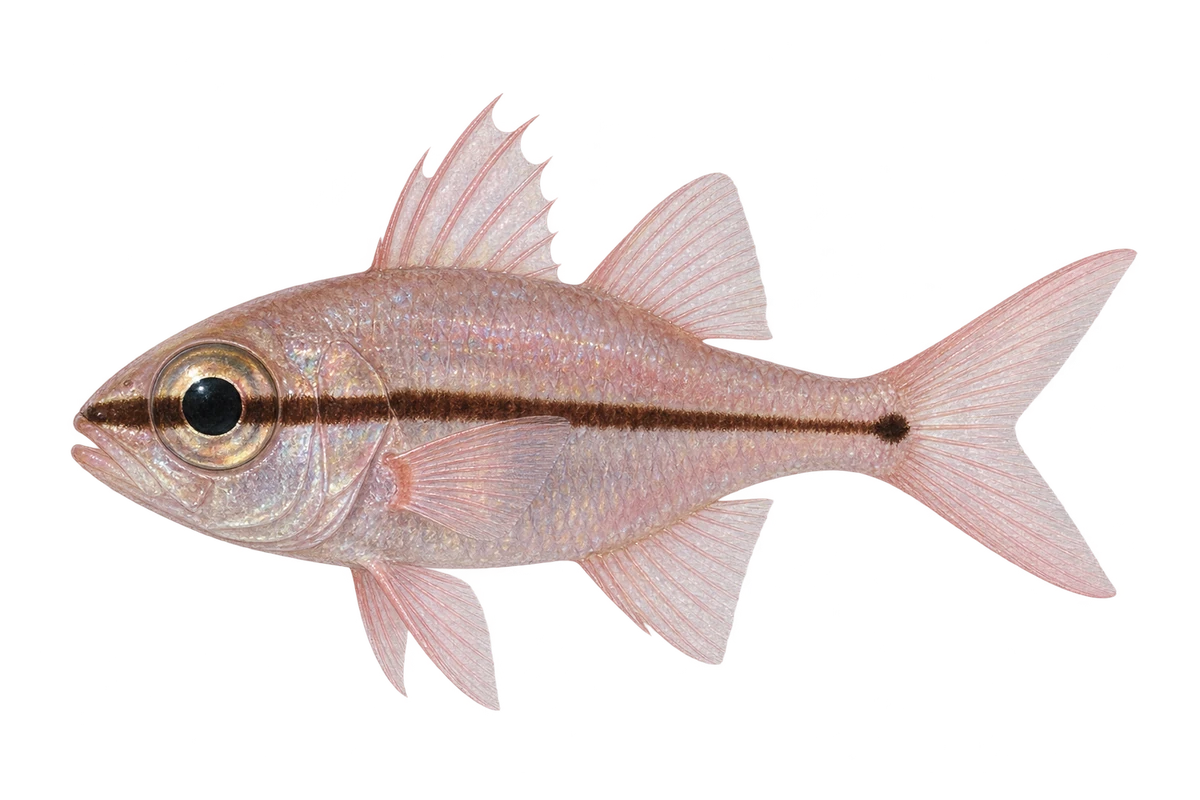
How to recognize it: Look for a dark central stripe that narrows toward the tail and fine pale lines around it near the eye. A separate dark dot sits at the center of the tail base.
What to watch for: The pink-silver body can flash as the fish turns. Wait for a side view to see whether the tail-base dot is separate from the stripe.
Philippines records: Divers have recorded this species at Dauin Pura Vida House Reef / Luca Sanctuary. Sightings vary by site and conditions.
Golden Rabbitfish
Siganus guttatus · Siganidae
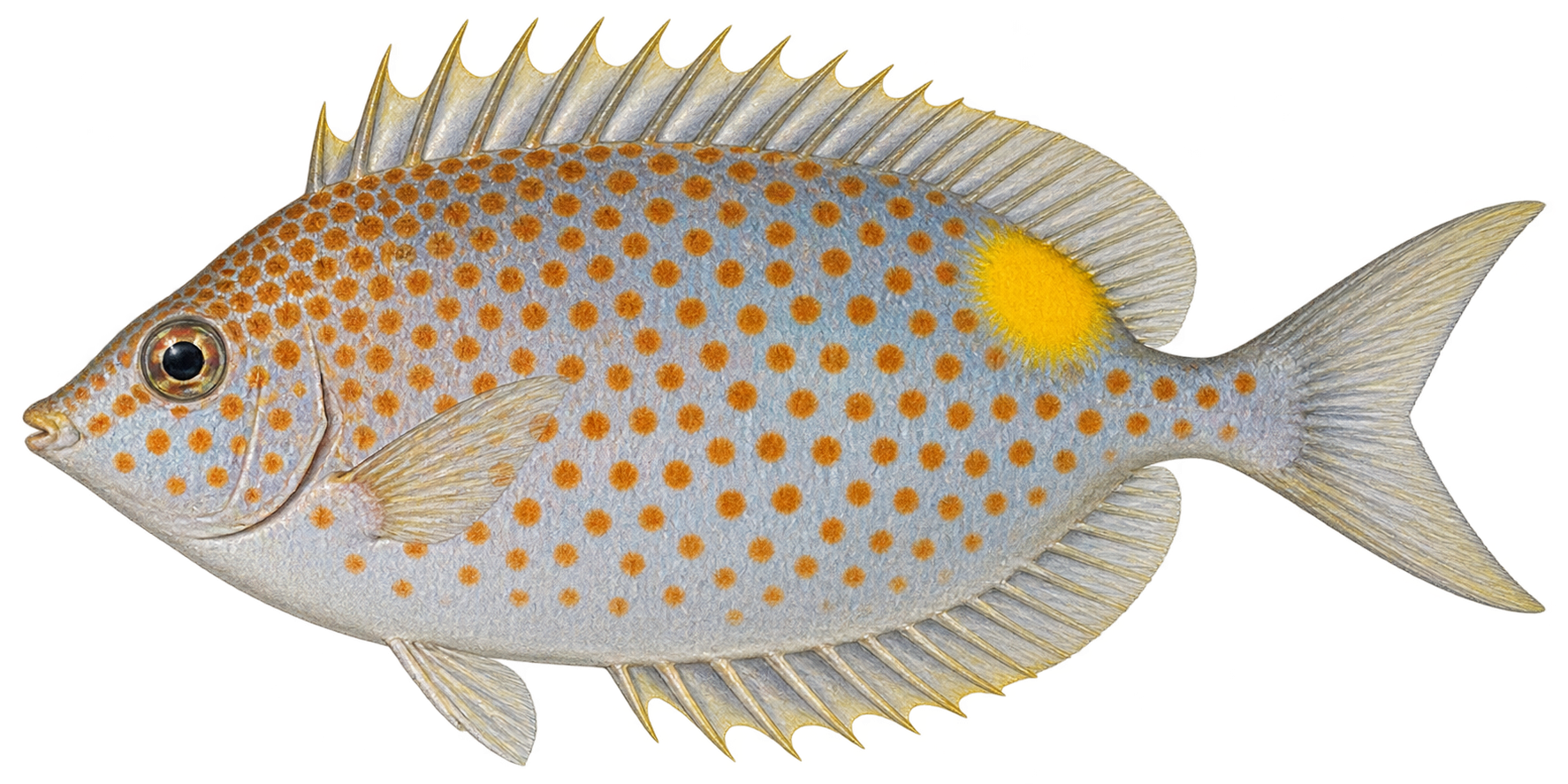
How to recognize it: Orange to bronze spots cover the sides, but the standout field mark is a much larger bright yellow patch under the rear of the dorsal fin.
What to watch for: It also occurs in shallow coastal habitats near seagrass and mangroves, including brackish water. Check the yellow saddle rather than relying only on the spotted body.
Philippines records: Divers have recorded this species at Dauin Pura Vida House Reef / Luca Sanctuary. Sightings vary by site and conditions.
Striped Threefin
Helcogramma striata · Tripterygiidae
How to recognize it: Three narrow pale-blue stripes run lengthwise on this little red fish, with a row of pale spots between the middle and lower stripes. Its dorsal fin is divided into three distinct sections.
What to watch for: The fish is small enough to miss on a first pass. Pause for a side view and count complete stripes, rather than treating every red threefin as this species.
Philippines records: Divers have recorded this species at Dauin Pura Vida House Reef / Luca Sanctuary. Sightings vary by site and conditions.
Two-barred Soapfish
Diploprion bifasciatum · Serranidae
How to recognize it: Look for a narrow black bar through the eye and a much broader dark band crossing the body. The remaining color ranges from pale to bright yellow.
What to watch for: Compare where each bar crosses the fish rather than judging from yellow and black alone. A clear flank view also reveals the large mouth and grouper-like outline.
Philippines records: Divers have recorded this species at Dauin Pura Vida House Reef / Luca Sanctuary. Sightings vary by site and conditions.
Practice with the SDI Reef Fish Identification course · Explore International Group Dive Travel with Stuart Scuba




