

South Florida fish guide / Fan-finned & spiny / Medium: 6–18 inches; some adults exceed 18 inches
Lionfish
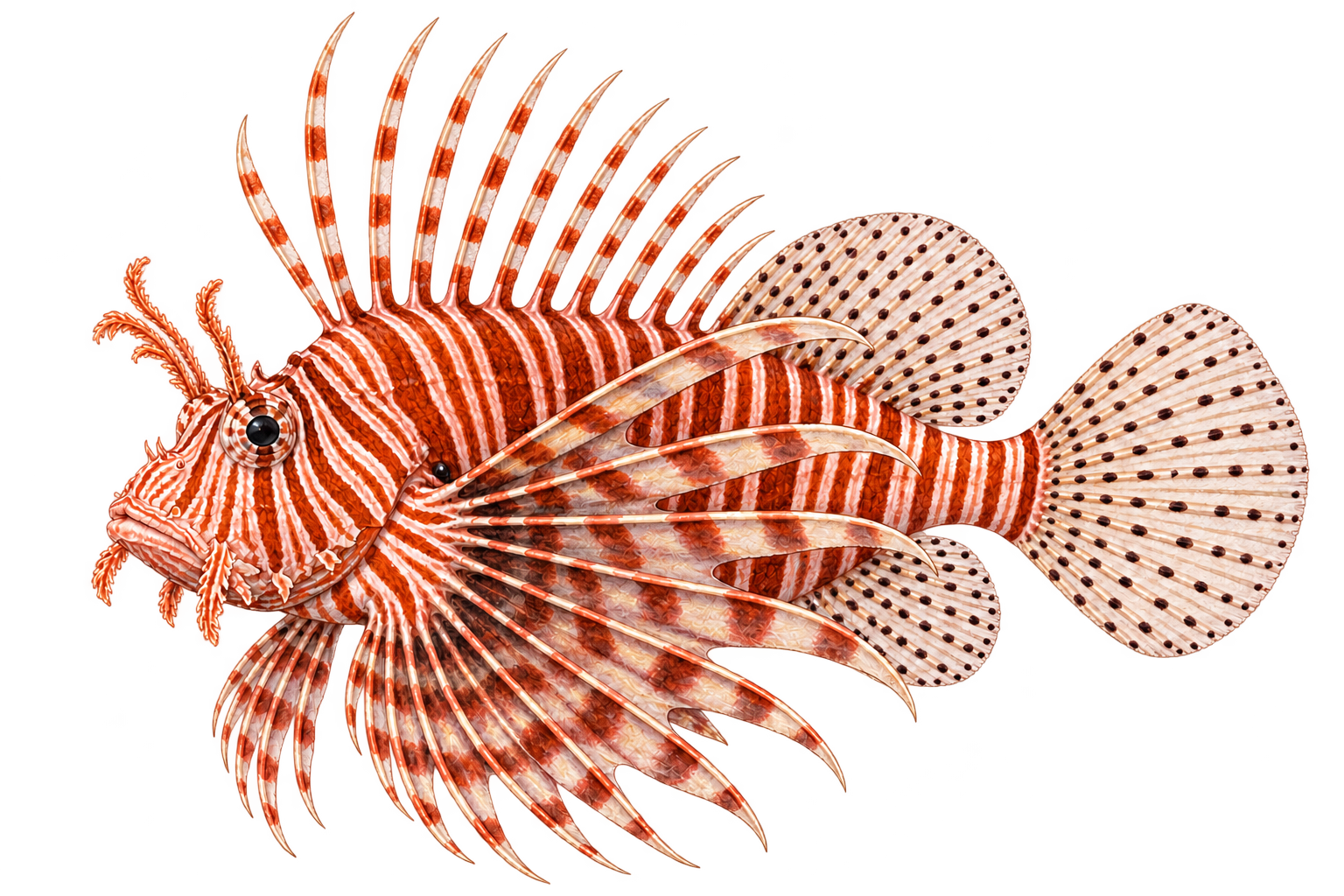
Lionfish · Pterois volitans / Pterois miles · Invasive lionfish complex
A striped body, a crown of spines and spreading fins make lionfish memorable. Look beyond the striking outline: those broad pectoral fins also help this predator hunt.
How to recognize a lionfish
Look for reddish-brown and pale bands, fleshy projections around the head, fan-shaped pectoral fins and separated dorsal spines. These features are useful for recognizing the invasive lionfish group. They are not enough to confidently separate its two closely similar species during a casual dive.
Size
FWC describes fish around 12–15 inches long, with individuals exceeding 18 inches in the invaded range. Juveniles can be much smaller. Size alone will not establish the species.
Feeding and hunting
Lionfish eat small fishes and crustaceans. They can spread their pectoral fins while slowly approaching and cornering prey. Watch from a respectful distance rather than trying to make a fish perform for a camera.
Habitat and range
Native to the Indo-Pacific, these lionfish are invasive in the southeastern United States, Caribbean and Gulf of Mexico. Reefs and wrecks are familiar habitats, but lionfish also use seagrass, mangrove and other warm-water environments.
Daily habits
A lionfish may shelter under a ledge or in a crevice by day. However, Atlantic lionfish also move and feed in daylight, so “night hunter” is not a rule for every encounter.
Mating and reproduction
Females release floating gelatinous egg masses. In warm conditions spawning can occur roughly every four days, and reproduction can continue year-round in the Atlantic. Early maturity and repeated spawning help explain how populations can expand quickly. UF/IFAS reports maturity in males as small as about 4 inches and females around 7 inches; these are life-history observations, not a reliable way to sex an individual on a dive.
Look-alikes
Red lionfish (P. volitans) and devil firefish (P. miles) are extremely difficult to distinguish visually. This profile deliberately uses both names rather than assigning a species from an illustration.
A detail worth remembering
The showy pectoral fins are not the venomous spines. FWC identifies venomous spines on the dorsal, pelvic and anal fins. Never use that distinction as an invitation to handle a fish.
Safety and responsible observation
Do not touch or crowd a lionfish. Its spines can inflict a painful venomous sting, including through accidental contact. Seek medical attention if stung. Removal should be undertaken only with appropriate training, equipment and current local rules.
Image note: AI-generated illustration, not an underwater photograph. It shows broad appearance only; fin and spine counts are not reliable in the artwork.
Sources and further reading
Try this fish identification challenge · Browse the fish guide
Your surface-interval essentials
Check the Stuart Scuba Weather Center · Play scuba trivia
Weather and wildlife vary. Confirm current conditions, trip requirements and departure details with the operator.
Plan Your Next Dive with Stuart Scuba
Dive With Us
Explore upcoming local charters and choose a dive that fits your experience.
Before you book
Check the individual listing for departure time, requirements and availability.
Travel With Us
Find upcoming dive adventures and start planning your next trip.
Plan your trip
Review dates, inclusions and trip details on the travel calendar.
Stay Connected with Stuart Scuba
 Follow pageShare
YouTube
SubscribeWatch & shareFollow on InstagramView & share post
Follow company news, training updates, and dive stories.
Follow on LinkedInGoogle Reviews
See Stuart Scuba’s current Google rating and review count below. Open the listing in Google Maps to browse customer reviews.


