


← Back to South Florida Fish ID
High-Hat Drum (Top Hat)
Pareques acuminatus · Sciaenidae
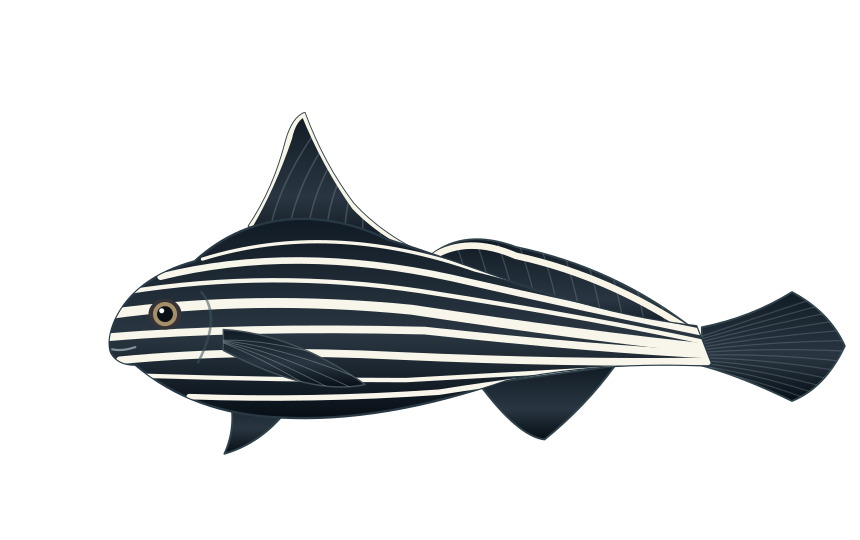
A small reef drum with a tall front dorsal fin and long horizontal stripes. In a historical Jupiter Inlet survey, this species was called “Top Hat.”
One fun thing to know
That tall front dorsal may be the first thing you see when the fish is half hidden.
I saw this and want to share
How to identify it
- A vertically tall but lengthwise-striped reef drum with a pronounced forward dorsal fin.
- Dark, broad longitudinal bands with narrow lines between them.
- Look for a pale stripe inside the soft dorsal edge.
Where to look
In South Florida, historic records include Jupiter Inlet and Lake Worth Lagoon. It also occurs in parts of the Caribbean, including Cuba. Similar striped drums occur elsewhere in the Caribbean, so a regional tag is not a guarantee for a particular island or dive site. Look beneath shaded reef ledges and along rubble near sand.
How the high-hat changes as it grows
Small juveniles are pale with bold black marks and an elongated front dorsal fin. Their separate tail fin may also be pointed or filament-like. As the fish matures, the front dorsal becomes less exaggerated and lighter lines divide the dark body into many narrow stripes.
Size
Up to about 10 in (25 cm).
What it eats
Crustaceans, worms and other small prey near the bottom.
Behavior
Mostly nocturnal, sheltering near ledges by day.
Reproduction
The cited Florida occurrence and ID references do not establish a Florida spawning season.
Look-alikes
The spotted drum develops white spots on its rear fins. The cubbyu is a separate species despite the old survey also using that name for the high-hat. Compare a full side view rather than relying on the nickname.
Can you collect or eat it?
Florida lists this fish in its recreational marine-life rules. Observe without collecting and check the current rules and local restrictions.
Check current Florida saltwater rules and posted rules at your site.
Practice spotting the differences
Look along the sides, not just at the tall front dorsal fin: a high-hat has dark stripes running lengthwise, with narrower lines between the broad ones. The SDI Reef Fish Identification course is a good way to practice comparing these marks with the bolder bands of a young spotted drum. The SDI Underwater Photographer course can help you capture a useful side view without crowding the fish.
Diver surveys at Blue Heron Bridge report high-hats as a two-species group, so a bridge sighting does not, by itself, resolve the species. If you plan a shore dive, start with our Phil Foster Park access guide and Blue Heron Bridge tide chart.
Make your next dive happen
Dive with Stuart Scuba · Train with us · Travel with us · Shop with us



