

Fish identification archive / Spotted drum
Spotted drum
Eques punctatus
Fun facts for your next surface interval
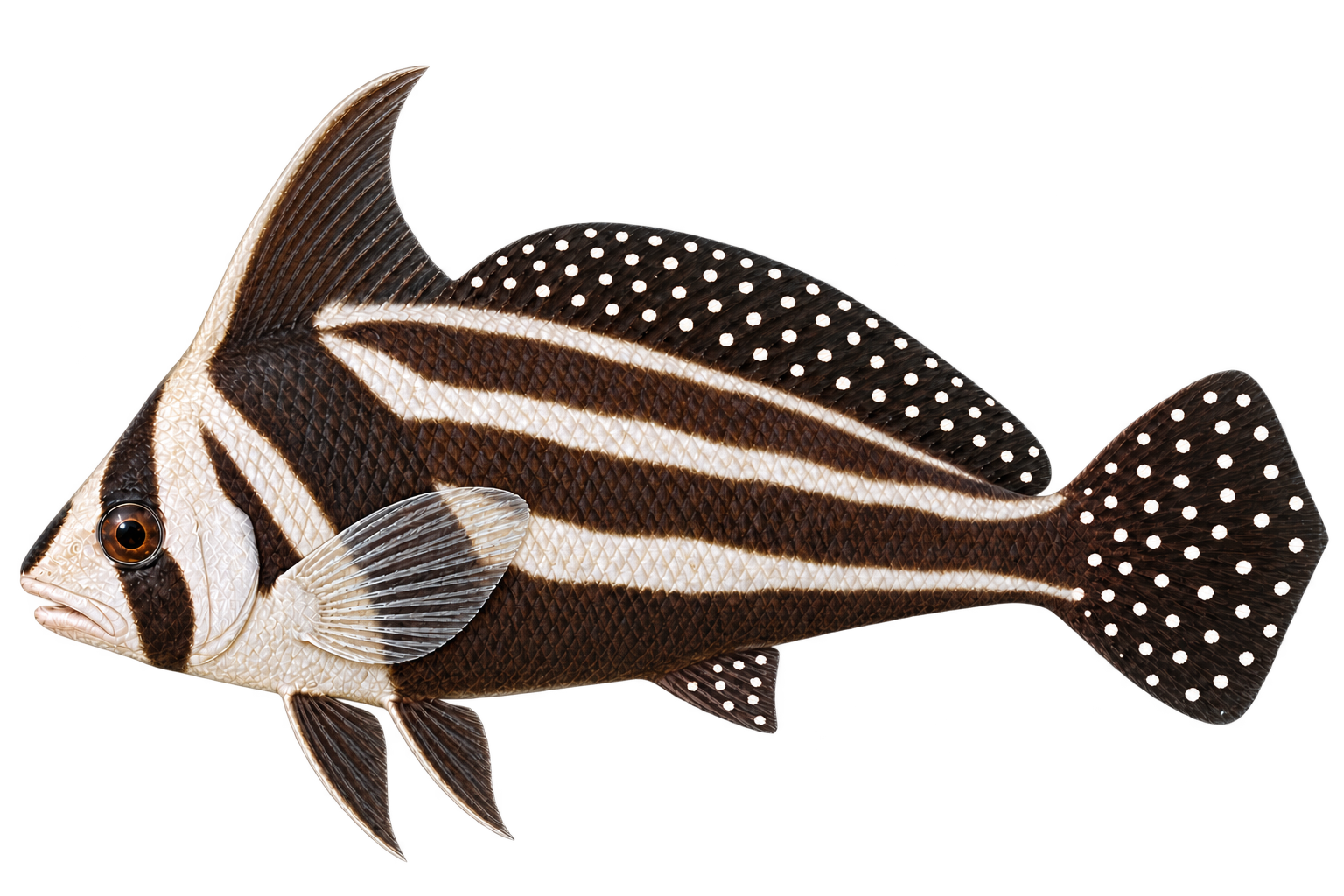
- Polka dots at the back: adult spots are concentrated on the dark rear dorsal and tail fins.
- A nose for identification: young fish have an oval snout mark that helps separate them from young jackknife fish.
- Quite a hat: the unusually long first dorsal is taller than the head length.
Florida and local context
Reported in REEF diver surveys at Blue Heron Bridge (WPB), Phil Foster Park. Cumulative survey records document occurrence, not a guaranteed encounter or present-day abundance.
Documented regional presence is not a guarantee of an encounter or a measure of how common this animal is at your dive site.
How to recognize this animal
A spotted drum combines an exceptionally tall first dorsal fin with a white body crossed by three broad black bands. One band passes through the eye, another slopes from the nape toward the pelvic area, and the last bends rearward into a stripe toward the tail base. In adults, the dark rear dorsal and tail fins carry conspicuous pale spots. The body is deepest forward and narrows sharply toward the tail.
Size and life stages
The reviewed Smithsonian account gives 25 cm, roughly 10 inches, as maximum length. A juvenile is not just a miniature spotted adult: its exaggerated outline accompanies three bold bands, an oval dark mark on the snout and a black pectoral stripe. The conspicuous adult spotted rear fins are therefore not required on the youngest fish.
Habitat and where to look
Coastal reefs are the documented habitat, including rocky and coral structure. Records span 4–105 m. That range combines observations across the species' distribution and should not be read as a typical recreational encounter depth. A sheltered fish may show only its dorsal streamer, so wait for an unobstructed view before deciding which drum it is.
Range and local context
Smithsonian describes a western Atlantic range from the Gulf of Mexico to Brazil, with mapped records supporting Florida Keys and southeast Florida occurrence. These records support inclusion in a South Florida guide, not a guaranteed local sighting. Eques punctatus is used here; the older name Equetus punctatus remains a search synonym for the same species. Reported in REEF diver surveys at Blue Heron Bridge (WPB), Phil Foster Park. Cumulative survey records document occurrence, not a guaranteed encounter or present-day abundance.
What is on the menu?
Recorded food includes bottom-associated worms, mollusks and crustaceans, as well as small fishes. Its overhanging snout and relatively small, horizontal mouth differ from the large gape of a grouper. The source establishes a carnivorous diet but does not quantify which prey dominates at a Florida dive site.
Daily habits and behavior
The body and fin pattern are especially useful to watch as the fish turns. A head-on view can hide both the slant of the body bands and the spotted posterior fins. Keep notes on whether it remains beside structure or moves into open bottom, but do not turn a single movement into a claim about local activity schedules or social organization.
Mating and the next generation
The species data identify pelagic eggs and larvae. These early stages occupy the water column, unlike a clutch visibly attached to a rock. The reviewed evidence does not establish a South Florida spawning calendar, clutch size or lasting pair bond. A pair of banded fish near the same shelter is not sufficient evidence of courtship.
Look-alikes and identification traps
Jackknife fish is the main comparison: adults lack the spotted rear-fin pattern and their rear dark stripe continues through the tail. Small juveniles demand more care. The spotted drum's oval snout mark and dark pectoral stripe contrast with the jackknife's narrow snout line and clear pectorals. Highhats instead have multiple lengthwise stripes across the body.
Observe without disturbing
Use a side photograph that includes the tail and both dorsal sections, without flushing the fish from its refuge. For juveniles, take a brief, well-focused image rather than repeatedly approaching for a closer look. Do not touch fins or reposition animals for a comparison shot. Log the observed markings rather than relying only on the familiar common name.
Harvest, protection and eating safety
No food harvest or spearing; restricted live aquarium collection only
Yellow means collection or harvest is conditional on current rules and location. It is not permission to harvest or an assurance that the fish is safe to eat.
This color is a qualified summary, not permission to collect or a guarantee that a particular catch is safe to eat. Read the current rules and health guidance below.
Can it be hunted or harvested?
Spotted drum is covered by Florida’s marine-life rules: Named high-hat/Jackknife-fish/Spotted Drum/Cubbyu category, with historical genus Equetus in FWC wording. Recreational collection requires a saltwater license unless exempt, live landing and continued live support using a suitably sized circulating, aerated or oxygenated system. Five of this species within 20 marine-life organisms per person daily; two-day possession ten of this species within 40 total. No recreational sale. No species-specific size limit shown in FWC’s marine-life tables.
Florida seasons and areas
No species-specific annual closed months are listed for this live-collection category. Florida marine-life rules also apply in federal waters. Collection is prohibited inside the designated Blue Heron Bridge dive-site boundary, throughout Biscayne National Park and for this listed group at John Pennekamp Coral Reef State Park. Check the precise capture position, jurisdiction and transit route. Keys sanctuary preservation, conservation, research and restoration zones can override general allowances. Within the designated Western Dry Rocks boundary, fishing is closed April 1–July 31; continuous transit requires fish and gear properly stowed. Biscayne’s designated bonefish pre-spawning area prohibits fishing and fish possession March 1–May 31, with a properly stowed continuous-transit exception. These are mapped area rules, not statewide closures.
Can it be speared?
No. Live-only requirements and the authorized hand/net/slurp-gun methods exclude recreational spearing. No quinaldine.
Is it safe to eat?
Not a food-harvest species under these live-only rules. Do not convert aquarium collection permission into an edible/safe badge. No blanket safe-to-eat assurance. Consult current Florida DOH advice for the exact fish, capture water and consumer, particularly pregnancy, nursing and children; this guide does not establish a species-specific meal allowance. Legal harvest and normal appearance do not establish food safety.
FWC still uses Equetus for these common-name categories. This review maps the explicitly named highhat/spotted drum/jackknife fish to the candidate modern Pareques/Eques names; it does not extend this category to all Sciaenidae. Obtain an editorial/legal crosswalk confirmation before publishing fine legal text.
Blue Heron Bridge is an observation site: marine-life harvest is prohibited within the designated dive-site boundary. A local occurrence record is not permission to collect or spear.
Before you act: This recreational overview is not permission to collect or spear at your dive site. Confirm the species, date, management area, state or federal waters, gear, licenses and current local closures. Identification artwork cannot establish an identification or guarantee seafood safety.
Official rules and health guidance
- FWC recreational marine life
- FWC marine-life taxon and Pennekamp applicability; commercial quotas NOT adopted
- FAC marine-life designation rule index
- NOAA Keys sanctuary zones
- FWC Western Dry Rocks closure
- FWC Biscayne National Park regulations
- FWC spearing restrictions
- Florida DOH fish consumption guidance
- Florida DOH seafood poisoning
Reviewed 2026-11-11. Rules and advisories can change; check the linked authorities before harvesting or eating.
Sources and review
Reviewed 2026-11-11.
Make your next dive happen
Dive With Us
Explore local charters and plan a dive suited to your experience.
View dive calendarTrain With Us
Build your fish identification, buoyancy and diving skills.
Explore trainingTravel With Us
Discover upcoming dive adventures and trip details.
Explore dive travelShop With Us
Browse equipment for your diving and ask our team for help choosing.
Explore dive gearReview current dates, availability, prices, inclusions and requirements on each listing before booking or buying.
Call us now
Ask about marine life identification
Marine Life Identification
Ask about dates, prerequisites or your next step. An inquiry does not reserve a place. Please provide your own contact details; do not include medical, payment or a child's personal information.
We use these details to respond to your inquiry. This form does not sign you up for marketing.
Explore more with Stuart Scuba
Open Water course options · Advanced Adventure training · Technical training · Professional training · All courses · Local dives · Dive trips · Facebook · Instagram · YouTube
Your surface-interval essentials
Questions for Stuart Scuba? info@stuartscuba.com
Check the Stuart Scuba Weather Center · Play scuba trivia
Weather and wildlife vary. Confirm current conditions, trip requirements and departure details with the operator.
Plan Your Next Dive with Stuart Scuba
Dive With Us
Explore upcoming local charters and choose a dive that fits your experience.
Before you book
Check the individual listing for departure time, requirements and availability.
Travel With Us
Find upcoming dive adventures and start planning your next trip.
Plan your trip
Review dates, inclusions and trip details on the travel calendar.
Stay Connected with Stuart Scuba
 Follow pageShare
YouTube
SubscribeWatch & shareFollow on InstagramView & share post
Follow company news, training updates, and dive stories.
Follow on LinkedInGoogle Reviews
See Stuart Scuba’s current Google rating and review count below. Open the listing in Google Maps to browse customer reviews.



