

South Florida fish guide / Sharks / Large: over 18 inches
Blacktip Shark
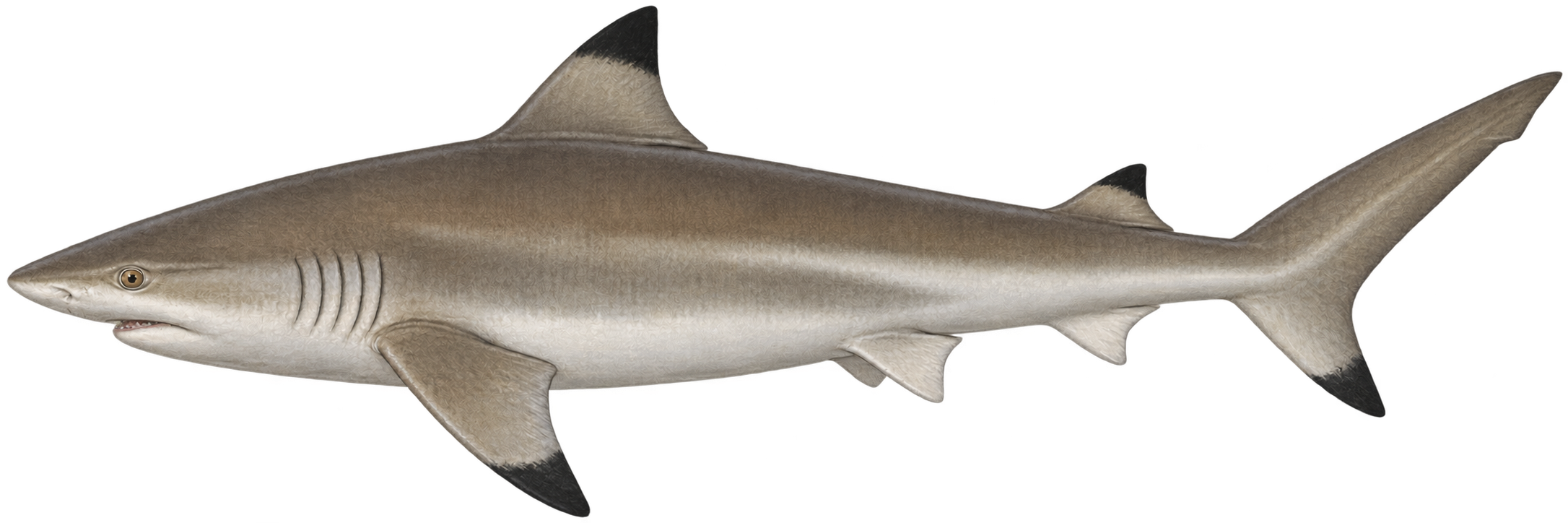
Blacktip shark · Carcharhinus limbatus
Dark fin tips are a useful starting clue, but the whole shark matters. Body shape, fin position and the pale anal fin help distinguish the Atlantic blacktip from other coastal sharks.
How to recognize a blacktip shark
Look for a pointed snout, gray to brown upper body, pale belly and dark tips on several fins. The anal fin is usually unmarked. Fin-tip markings can fade with age or be difficult to see underwater, so avoid identifying a shark from a single dark fin.
Size
Florida Museum gives an average adult length of about 5 feet (1.5 meters). Larger individuals occur, and published size limits vary by source and population. Use several identification features rather than estimating length alone.
Feeding and hunting
Small schooling fishes are important prey. Blacktips also eat other fishes, squid and crustaceans. A feeding shark may leap clear of the surface and rotate before re-entering the water.
Habitat and range
This coastal shark occurs around beaches, bays, river mouths, estuaries and reefs. In U.S. Atlantic waters it is common from Virginia through Florida, and seasonal movements can take it farther north. VIMS describes migrations reaching Cape Cod and large migrating schools.
Daily habits and seasonal movement
Blacktips can gather in groups, with males and females often schooling separately outside mating periods. FWC notes large schools during annual migrations. A migration description is not a forecast or a guarantee of sharks on a particular Stuart dive.
Mating and reproduction
NOAA Fisheries reports mating from March through June and a pregnancy of roughly 11–12 months. Females give birth to live pups in shallow nursery areas; mothers then leave while juveniles remain. NOAA reports average litters of about three pups in the Atlantic and four to five in the Gulf, rather than a single litter size for every population.
Look-alikes
Spinner sharks are the key comparison. Their anal fin generally develops a black tip, whereas the blacktip's is usually pale. Young animals and poor views can complicate this clue. The blacktip reef shark, C. melanopterus, is a different species; its name should not be substituted here.
A detail worth remembering
Spinning does not automatically mean “spinner shark.” Both blacktips and spinner sharks can leap and turn while feeding. Behavior can guide your attention, but it cannot replace visible identification features.
Safety and responsible observation
Give sharks room and follow the dive team's briefing. Do not touch, chase, corner or feed wildlife. Keep the encounter observational, and never use a species identification as a guarantee that close contact is safe.
Image note: AI-generated educational illustration, not an underwater photograph or evidence of a local sighting.
Sources and further reading
Try this fish identification challenge · Browse the fish guide
Your surface-interval essentials
Check the Stuart Scuba Weather Center · Play scuba trivia
Weather and wildlife vary. Confirm current conditions, trip requirements and departure details with the operator.
Plan Your Next Dive with Stuart Scuba
Dive With Us
Explore upcoming local charters and choose a dive that fits your experience.
Before you book
Check the individual listing for departure time, requirements and availability.
Travel With Us
Find upcoming dive adventures and start planning your next trip.
Plan your trip
Review dates, inclusions and trip details on the travel calendar.
Stay Connected with Stuart Scuba
 Follow pageShare
YouTube
SubscribeWatch & shareFollow on InstagramView & share post
Follow company news, training updates, and dive stories.
Follow on LinkedInGoogle Reviews
See Stuart Scuba’s current Google rating and review count below. Open the listing in Google Maps to browse customer reviews.


