


Fish identification archive / Raja Ampat
Zebra Shark
Stegostoma tigrinum
Raja Ampat field guide
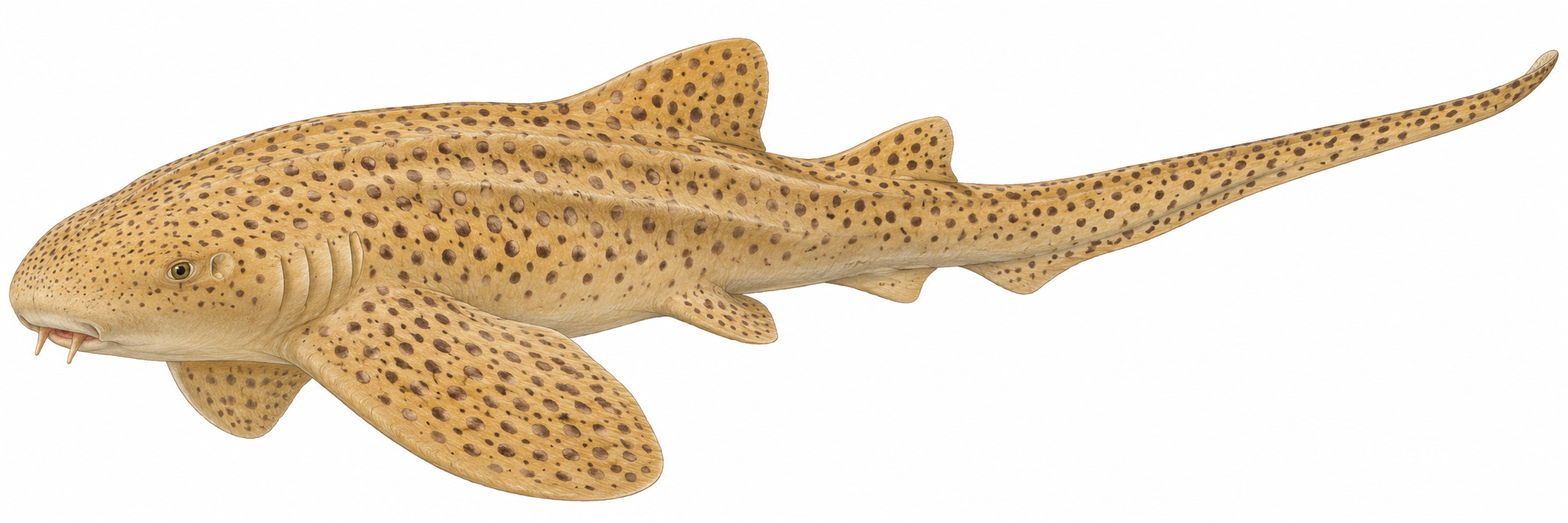
Six things worth knowing
- Stripes give way to spots. Young zebra sharks have pale stripes on a dark body. The familiar adult pattern is dark spots on a lighter body.
- A tail nearly half its length. The tail fin can be almost as long as the rest of the shark, which is useful when spots are difficult to see.
- Five lengthwise ridges. Prominent ridges run lengthwise along its back and sides. The shape is a useful clue alongside the markings.
- Egg cases with fibers. Females lay dark egg cases. Fibers help attach them to material on the seafloor.
- Snails and other small prey. It hunts close to the bottom, taking mollusks, crustaceans, and small fishes.
- An unusual aquarium record. Aquarium researchers have genetically documented young developing from unfertilized eggs, a process called parthenogenesis.
How to identify it
Adults have dark spots on a pale tan body; youngsters carry pale bands on a dark background.
Habitat and where to look
Coral and rocky reefs and adjacent sandy areas.
Daily habits and behavior
Often rests on sand by day and feeds at night.
What is on the menu?
Mostly snails and bivalves, with crustaceans and small fishes also eaten.
Mating and the next generation
Lays tough egg capsules anchored by fibrous attachments.
Look-alikes and identification traps
The names zebra shark and leopard shark can refer to this same species at different life stages. Older references use Stegostoma fasciatum.
Try this observation
Observe the resting shark without touching it or trying to make it swim.
Raja Ampat occurrence
Recorded in Raja Ampat; sightings depend on site, conditions and careful observation. This guide does not imply that every site, itinerary or season offers the same chance of an encounter.
Observe, do not disturb
Keep a respectful distance, leave the animal an unobstructed route and follow your dive guide. Do not touch, feed, chase or collect wildlife. Identification does not establish permission to harvest or food safety; Florida harvest labels do not apply to this Indonesian guide.
Build your shark ID skills
Practice reading the silhouette, fin marks, and behavior with Stuart Scuba’s SDI Shark Awareness course. If you want to build broader reef-dive skills, Advanced Adventure is a useful course to explore. A resting shark is best watched without approaching or blocking its path.
Sources and review
Reviewed November 18, 2026.
Make your next dive happen
Dive With UsTrain With UsExplore the Raja Ampat tripShop With Us
Questions? (772) 600-8288 or info@stuartscuba.com.




