


Fish identification archive / Raja Ampat
Yellowtail Coris
Coris gaimard
Raja Ampat field guide
Two things to tell your dive buddy
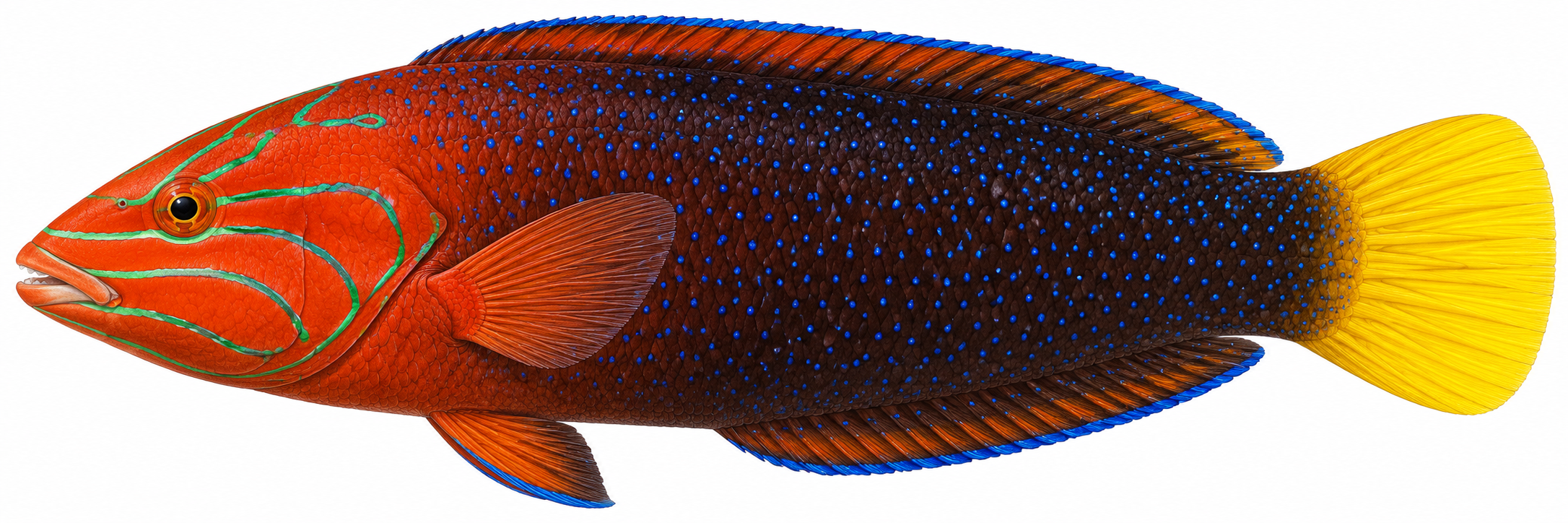
- This is a lesson in life-stage identification: a juvenile and adult can look like two unrelated fishes. The white-saddled youngster gradually becomes the blue-spotted, yellow-tailed adult.
- Its feeding is decidedly hands-on, or rather mouth-on: the wrasse can turn rocks to expose hidden prey, including sea urchins.
How to identify it
Adults have blue-spotted dark bodies and yellow tails; juveniles are orange-red with black-edged white saddles.
Habitat and where to look
Sand, rubble and coral in lagoons, seaward reefs and outer reef flats.
Daily habits and behavior
Forages over the bottom, sometimes turning stones to expose prey.
What is on the menu?
Crabs, molluscs, tunicates and other bottom-living invertebrates.
Mating and the next generation
Capable of changing sex; adult and juvenile color patterns differ markedly.
Look-alikes and identification traps
Compare life stages before rejecting an identification: white-saddled juveniles look very different from blue-spotted adults.
Try this observation
Watch a foraging fish without moving any stones yourself.
Raja Ampat occurrence
Recorded in Raja Ampat; regional occurrence is not an itinerary-specific sighting promise. This guide does not imply that every site, itinerary or season offers the same chance of an encounter.
Observe, do not disturb
Keep a respectful distance, leave the animal an unobstructed route and follow your dive guide. Do not touch, feed, chase or collect wildlife. Identification does not establish permission to harvest or food safety; Florida harvest labels do not apply to this Indonesian guide.
The small orange wrasse is not the adult in miniature
Young yellowtail coris have white saddles edged in dark on a bright orange-red body. An older fish can show blue spots and a yellow tail instead. The pale bar just behind the pectoral fin is useful on a terminal-phase male, not on every large fish.
SDI Reef Fish Identification course: Practice keeping age, color phase and species identification separate.
Sources and review
Reviewed November 18, 2026.
Make your next dive happen
Dive With UsTrain With UsExplore the Raja Ampat tripShop With Us
Questions? (772) 600-8288 or info@stuartscuba.com.




