


← Back to South Florida Fish ID
Yellowfin Grouper
Mycteroperca venenosa · Serranidae
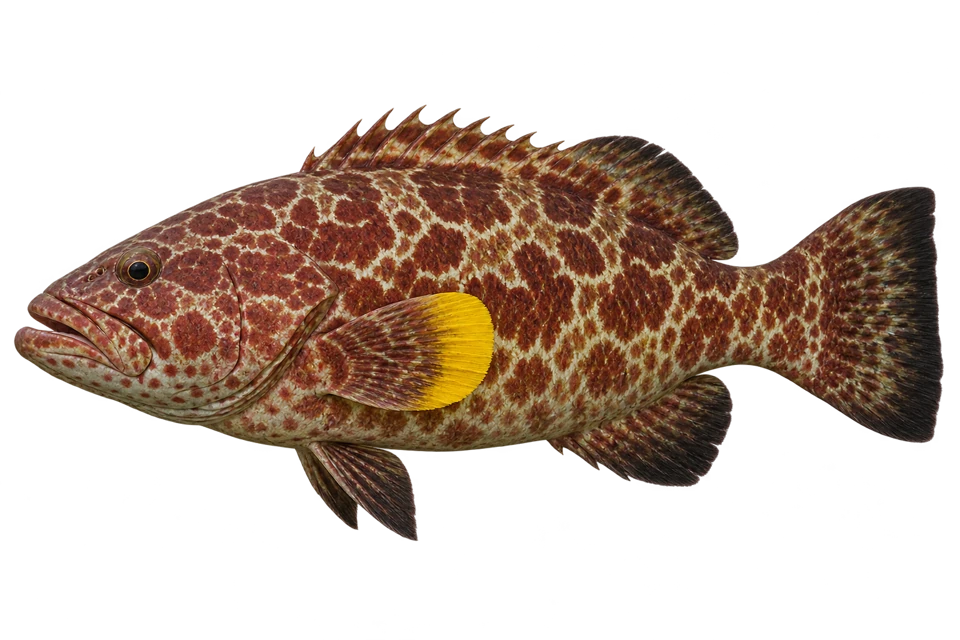
Look past the mottled sides: the outer third of the side fin turns abruptly bright yellow.
One fun thing to know
The yellow in its name belongs on the pectoral fin, not the tail.
How to identify it
- Sturdy grouper outline with a jutting lower jaw.
- Dark reddish-brown spots and blotches surrounded by pale, wavy markings.
- Outer third of the pectoral fin sharply yellow; outer edges of soft dorsal, anal and tail fins dark.
Where to look
Adults usually use reefs, sometimes mud bottom; juveniles can be found in seagrass.
Size
39.4 in (100 cm). Published upper size; measurement type not specified.
What it eats
Eats fish and also takes crustaceans and cephalopods.
Behavior
Wait for the fish to spread a pectoral fin. A folded fin can hide its best identification feature.
Reproduction
Eggs and larvae occur in open water; the bridge record is not evidence of a local spawning aggregation.
Look-alikes
Black Grouper lacks the bold yellow outer third of the pectoral fin. Compare the fully spread side fin rather than only the body mottles.
Can you collect or eat it?
Enjoy watching it and leave it in the water. This guide does not verify species-specific harvest or food-safety rules. Check the current rules for the exact location, species and method before taking anything, and never collect where prohibited.
Check Florida’s current saltwater rules
Field references
- Smithsonian Shorefishes reference 1
- REEF field survey reference 2
- Florida Fish and Wildlife Conservation Commission reference 3
- Florida Fish and Wildlife Conservation Commission reference 4
I saw this and want to share
Make your next dive happen
Dive with Stuart Scuba · Train with us · Travel with us · Shop with us



