


Fish identification archive / Raja Ampat
Whitetip Reef Shark
Triaenodon obesus
Raja Ampat field guide
Six things worth knowing
- It can breathe while resting. Unlike sharks that must keep swimming to move water over their gills, the whitetip reef shark can pump water over them while lying still.
- Day shift off, night shift on. Daytime often finds these sharks resting. At night they become more active and search for food.
- Built for tight spaces. Its slim body helps it reach fish hiding in narrow reef cracks.
- A mixed reef menu. It eats more than fish. Crustaceans and mollusks also turn up in its diet.
- Small litters. Females give birth to live pups, with documented litters of roughly one to five.
- A Galápagos commute. In one saltwater channel off Santa Cruz, tagged sharks used the inner area more by day and the outer area more at night.
How to identify it
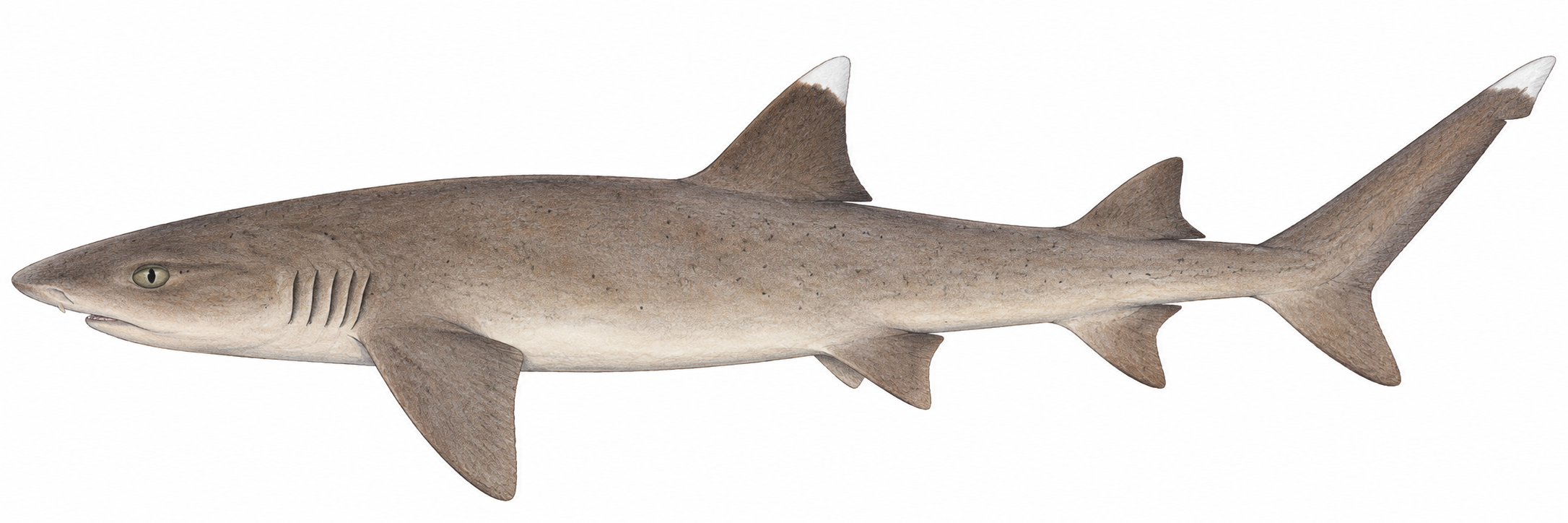
A slender grey shark with a very short, broad snout. White marks tip the first dorsal fin and upper tail lobe; the second dorsal fin is relatively large.
Habitat and where to look
Clear-water coral reefs, with daytime resting places in caves, beneath ledges and on sandy patches.
Daily habits and behavior
Often rests during daylight and hunts actively after dusk, probing reef crevices for prey.
What is on the menu?
Fishes, octopuses and crustaceans such as lobsters and crabs.
Mating and the next generation
Females give birth to live pups; reported litters contain one to five.
Look-alikes and identification traps
Oceanic whitetip sharks have much broader, rounded dorsal and paddle-shaped pectoral fins. Silvertip sharks are heavier-bodied, with a much smaller second dorsal fin relative to the first. A white fin tip alone is not enough.
Try this observation
Watch from outside the shelter. Do not enter a cave or move closer to make a resting shark swim.
Raja Ampat occurrence
Recorded in Raja Ampat; a regional record is not a promise of a sighting on a particular dive. This guide does not imply that every site, itinerary or season offers the same chance of an encounter.
Observe, do not disturb
Keep a respectful distance, leave the animal an unobstructed route and follow your dive guide. Do not touch, feed, chase or collect wildlife. Identification does not establish permission to harvest or food safety; Florida harvest labels do not apply to this Indonesian guide.
A shark can rest and still breathe
Look for a slender body and bright tips on the first dorsal fin and upper tail. A whitetip reef shark can pump water over its gills while resting. A shark lying under a ledge is not an invitation to lean into its shelter.
The species is documented in Raja Ampat and the Galápagos. Compare it with other sharks in the Raja Ampat fish guide or learn to separate similar outlines in the SDI Reef Fish Identification course.
Build your shark ID skills
Practice reading the silhouette, fin marks, and behavior with Stuart Scuba’s SDI Shark Awareness course. Advanced Adventure is a way to practice broader reef skills, not a reason to follow a shark into a crevice or cave.
Sources and review
Reviewed November 18, 2026.
Make your next dive happen
Dive With UsTrain With UsExplore the Raja Ampat tripShop With Us
Questions? (772) 600-8288 or info@stuartscuba.com.




