


Fish identification archive / Raja Ampat
Whitespotted Eagle Ray
Aetobatus ocellatus
Raja Ampat field guide
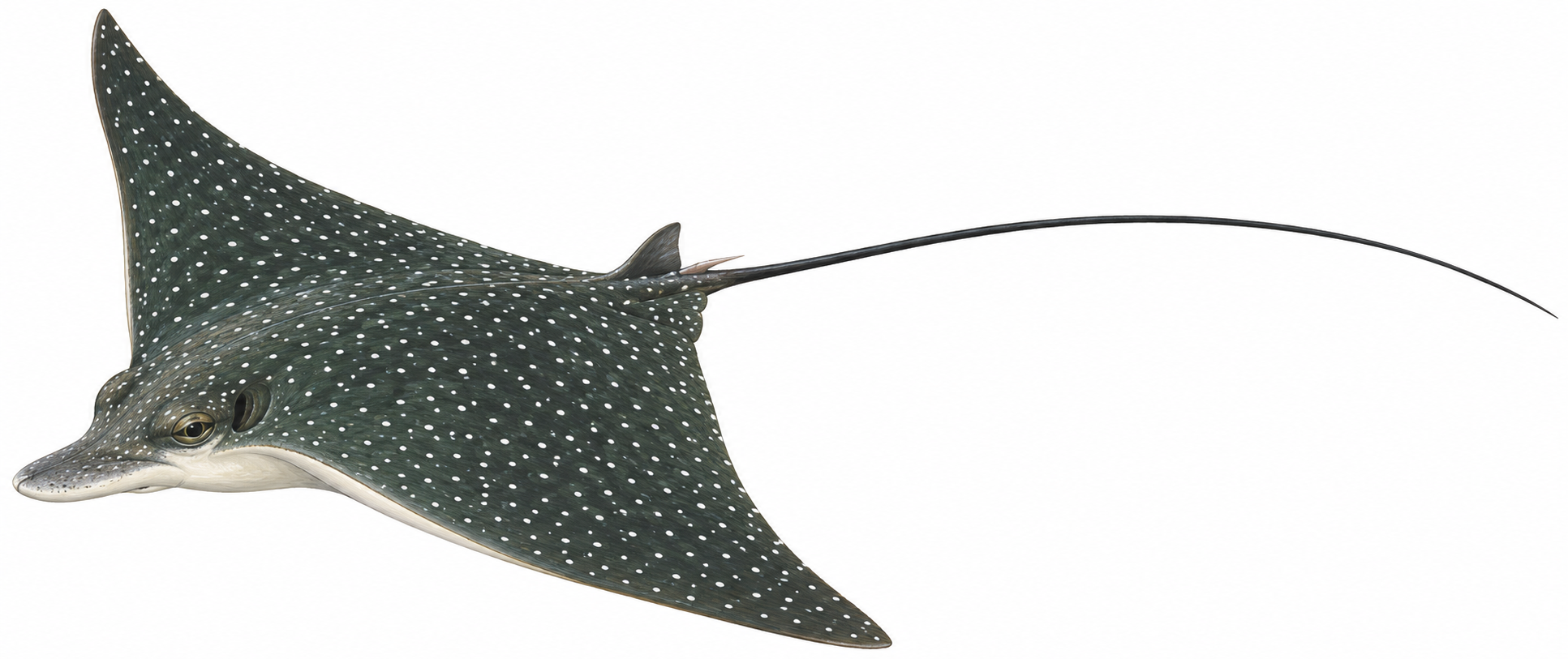
Two things to tell your dive buddy
- Flattened tooth plates crush hard prey.
- The wings are enlarged pectoral fins.
How to identify it
Diamond-shaped disc, projecting flattened snout and white spots on a dark back; a long tail bears defensive spines.
Habitat and where to look
Coastal and open waters, often near coral reefs.
Daily habits and behavior
Can occur alone or in schools; may dig for buried prey.
What is on the menu?
Mostly hard-shelled molluscs and crabs.
Mating and the next generation
Live-bearing, with small litters and additional maternal nourishment after the initial yolk supply.
Look-alikes and identification traps
Distinct from Atlantic Aetobatus narinari, a name formerly applied broadly to spotted eagle rays.
Try this observation
Watch its route from a distance without intercepting it.
Raja Ampat occurrence
Recorded in Raja Ampat; sightings depend on site, conditions and careful observation. This guide does not imply that every site, itinerary or season offers the same chance of an encounter.
Observe, do not disturb
Keep a respectful distance, leave the animal an unobstructed route and follow your dive guide. Do not touch, feed, chase or collect wildlife. Identification does not establish permission to harvest or food safety; Florida harvest labels do not apply to this Indonesian guide.
Sources and review
Reviewed November 18, 2026.
Make your next dive happen
Dive With UsTrain With UsExplore the Raja Ampat tripShop With Us
Questions? (772) 600-8288 or info@stuartscuba.com.




