


Fish identification archive / Whip Eel
Whip Eel
Bascanichthys scuticaris
Fun facts for your next surface interval
- Its dorsal fin begins on the head, ahead of the gill opening: a useful anatomical clue on an otherwise minimalist fish.
- The nearly transparent, compressed larva looks remarkably unlike the cylindrical adult.
How to recognize it
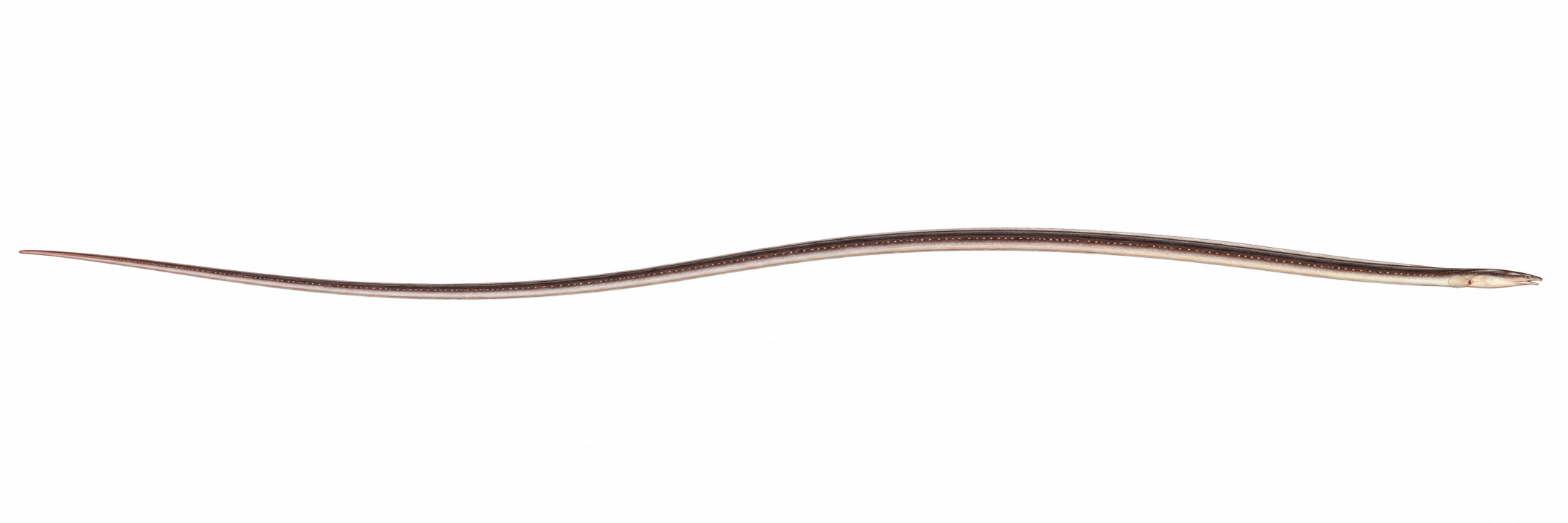
An exceptionally thin, cylindrical eel with tiny eyes and minute pectoral fins. Dark upper surfaces fade into a pale underside; small pale dots follow the lateral-line pores. The blunt tail tip lacks a fin.
West Palm Beach occurrence
Verified in the Florida Museum Lake Worth Lagoon checklist; this establishes local occurrence, not abundance or a guaranteed sighting.
Habitat
Sandy bottoms, beaches and sand near grass beds; recorded at 1–46 m.
Behavior: watch what it does
A soft-bottom specialist rather than a conspicuous reef-wall moray.
What it eats
Bottom-dwelling worms and crustaceans.
Reproduction
Has a leptocephalus larval stage. Spawning and eggs remain poorly described.
Similar animals and identification limits
Other slender snake eels require careful comparison of the head, pectoral fins and dorsal-fin origin; color alone is insufficient.
A better underwater observation
Photograph the head and fin origins without touching or excavating the eel.
Observe responsibly
Documented local presence is not a promise of a sighting or a statement of abundance. Do not chase, handle, feed or disturb wildlife. This identification guide is not permission to collect or harvest, and it does not establish food safety. Check current rules and protected-area boundaries for your exact location.
I saw this
Share the guide with your dive buddies. Review your caption before posting.
Nothing posts automatically. Sharing does not record a verified sighting.




