


Viper Moray
Enchelycore nigricans · Muraenidae · Moray eel · Cayman Islands Fish ID
How to identify it
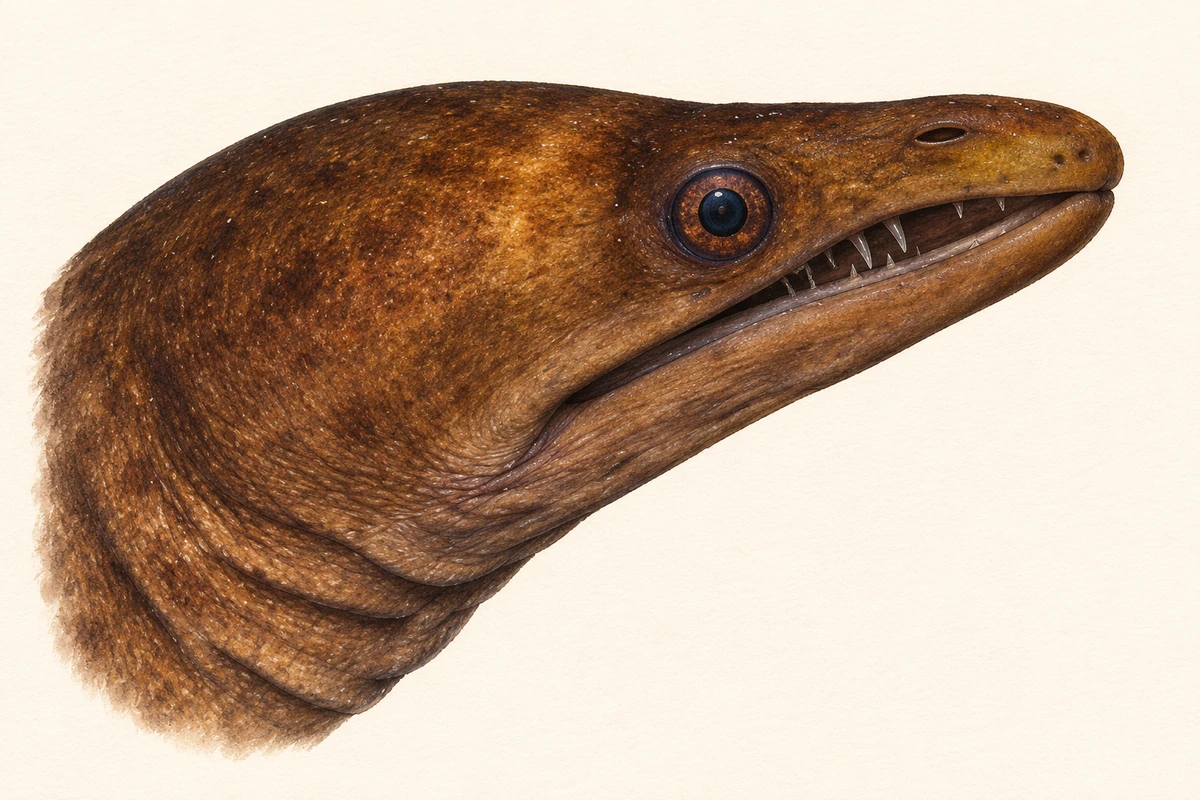
Even with the jaw tips together, you can see teeth through the curved gap. A large individual is usually dark brown, so check its muscular head and the strongly bowed jaws before calling it a viper moray.
Chestnut morays have similarly bowed jaws but are generally slimmer, with little pale rings around the pores along both jaws. Use those marks rather than deciding from teeth alone.
Cayman Islands records
Tarpon Reef, Cayman Brac, in pooled REEF diver surveys.
A documented record does not guarantee an encounter on your dive.
Fun facts
- Its jaws meet at the tips. The gap farther back is normal anatomy, not a display or injury.
- Smaller fish can have pale, irregular patches, while larger ones are often nearly solid brown.
- A youngster can have a pale iris where a big adult has a dark one.
- The long slit well ahead of the eye is a nostril. There is also a forward nostril shaped like a little tube.
- An upper row includes a few long fangs spaced between much smaller teeth.
- The dorsal fin starts around the gill opening, well forward on the body.
See more on your next dive
Give the eel a clear route back into its crevice. Never put your hand or camera against its face.
Underwater Photography · Explore Stuart Scuba group dive trips




