


← Back to South Florida Fish ID
Two-clawed Prawn
Brachycarpus biunguiculatus · Palaemonidae
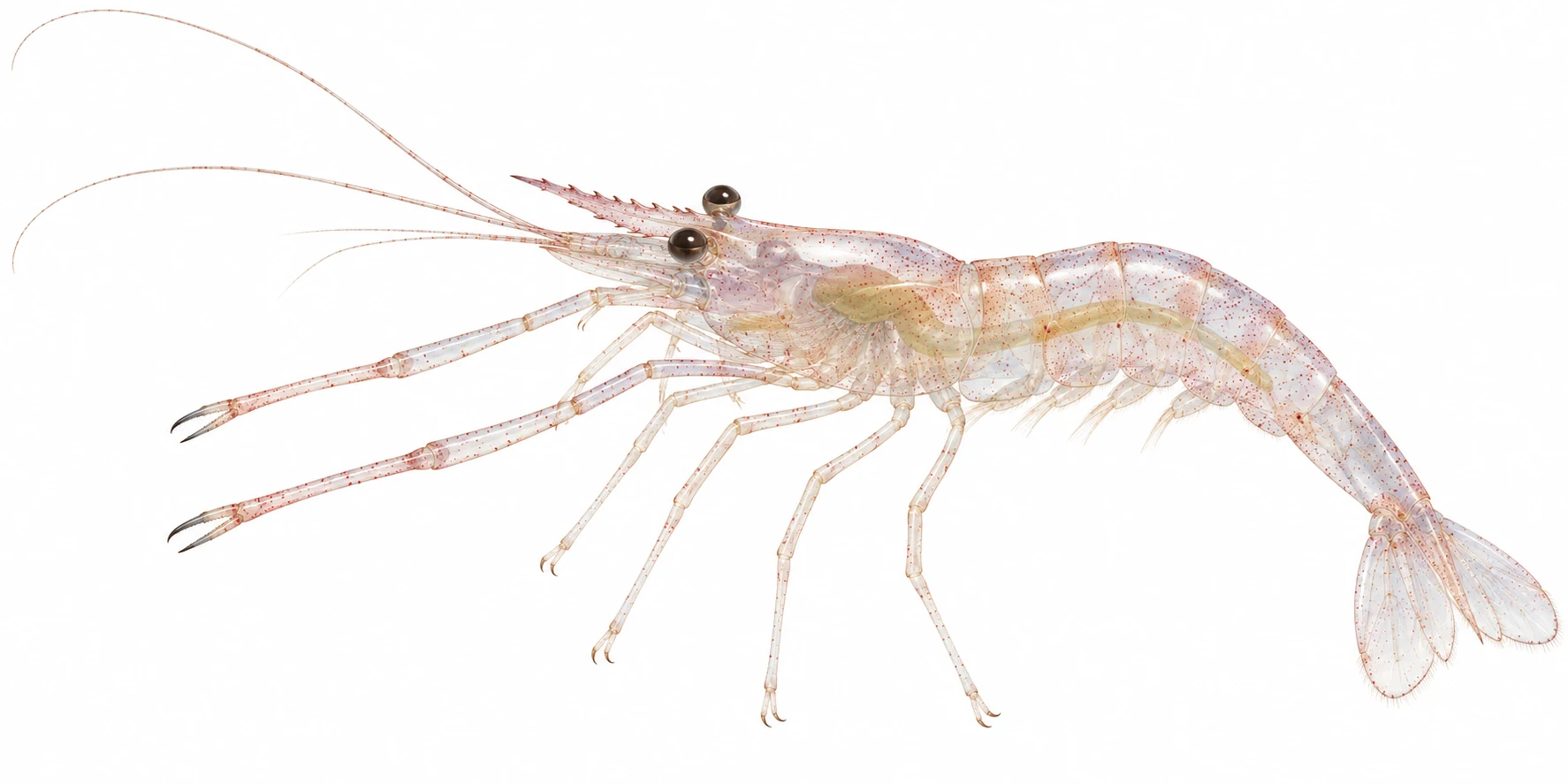
This reef prawn has enlarged second claws and walking feet whose tiny details are more useful than body color.
Fun facts
- Its second pair of claw-bearing legs does the heavy lifting in identification: they’re noticeably bulkier than the first pair.
- On the small claws, the wrist segment is longer than the pincer; on the large claws, the proportions flip.
- The tips of the walking legs have two tiny hooks. You’ll usually need a sharply focused macro image to see them.
- Its rostrum is the pointed projection between the eyes. It’s a useful clue, but plenty of other shrimps have one too.
- Survey divers in Brazil photographed this species by day and by night. A dark hiding place doesn’t mean it only appears after sunset.
- Galápagos marine records place it around four islands, from Floreana to Wolf. Its small size makes it easy to swim right past.
A close photo taken without moving the shrimp is more useful than a guess at its color. Learn to get a steadier shot with our Underwater Photographer course.
I saw this and want to share
To share this guide with a dive buddy, copy the page link.
How to identify it
- Conspicuous second pair of claw-bearing legs
- Pointed rostrum in front of the eyes
- Two minute terminal hooks on walking legs, usually a macro-level feature
Where to look
It occurs in the western Atlantic and has been recorded off Elliott Key in about 5 m (16 ft) of water.
Size
Only a few centimeters long; use a close photo rather than size alone.
What it eats
Its exact diet in the wild is not well established.
Behavior
Look into crevices or shaded recesses and photograph the visible animal without reaching into its shelter.
Reproduction
Its breeding season in South Florida is not well established.
Look-alikes
Other palaemonid shrimps have an extended rostrum and large front claws. Do not assign a species from those features alone.
Can you collect or eat it?
CC: Observe and leave in place. Stuart Scuba conservation recommendation, not blanket legal protection.
Check current species and site rules before collecting. This guide does not establish permission to collect.
Make your next dive happen
Dive with Stuart Scuba · Train with us · Travel with us · Shop with us



