


Floreana Cup Coral
Tubastraea floreana · Dendrophylliidae · Colonial coral · Galápagos Islands Fish ID
How to identify it
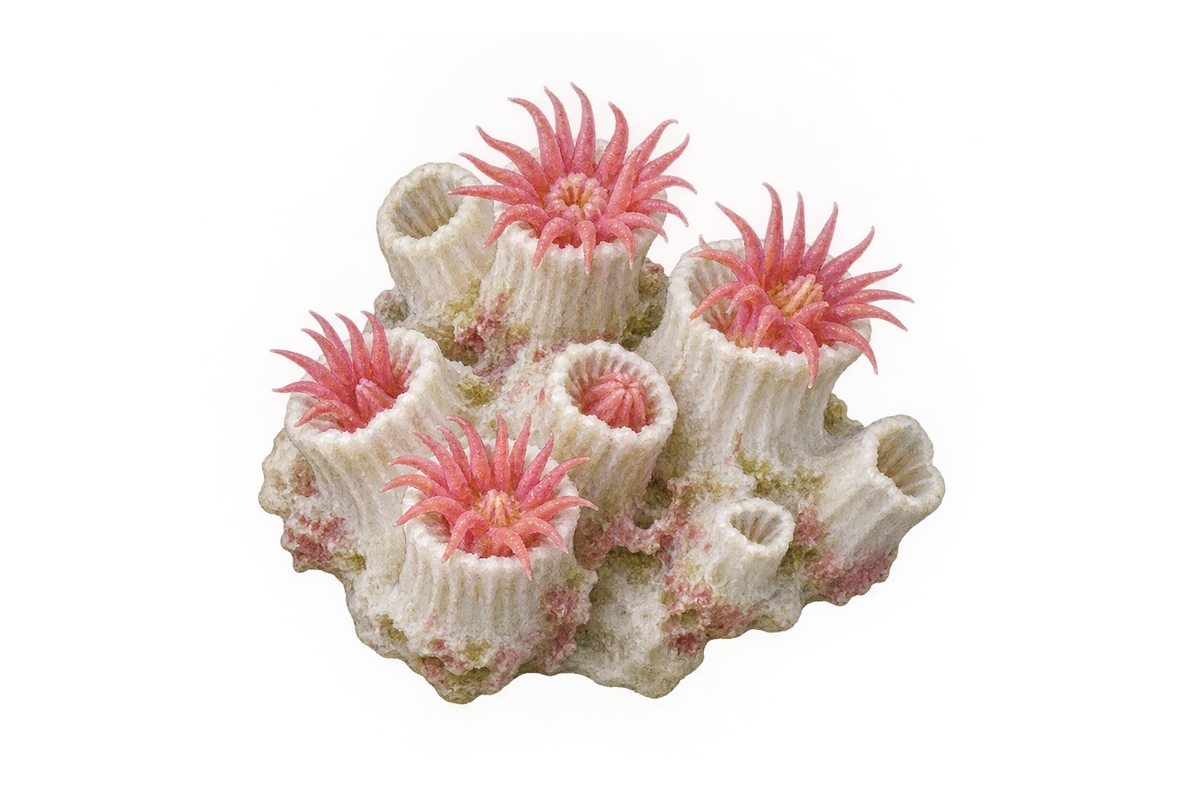
Look for a compact patch of tiny, crowded cups with living polyps that can be bright pink. A close side view shows how high the cups rise from their shared base. Treat this as a rare coral, not a feature to expect on a dive.
Compare the small cups with the larger, thicker cups of Tagus Cove cup coral. Pink alone is not enough to identify it.
Learn to observe reefs without touching
SDI Coral Conservation is the place to start if you want to learn about coral habitats and how to observe them responsibly.
Start with the colony’s outline and the pattern of its coral cups. Look from a position where you can keep your fins and camera clear of the colony.
- Keep your fins and camera clear: Advanced Buoyancy Control focuses on trim, weighting and hovering.
- Build a broader skill set: Advanced Adventure introduces several specialties, including deep diving and navigation, with opportunities to refine buoyancy.
- For deeper recreational dives already in your plans: Deep Diver focuses on planning depth and managing breathing gas. It’s not needed to identify coral on a shallow dive.
- Record the details: Underwater Photography covers lighting and still-image composition. Underwater Video covers framing and steady footage. Use either without resting gear on the reef.
Galápagos Islands records
Documented Galápagos record: Caleta Iguana, Isabela; Gardner Island off Española; off Floreana; Buccaneer Cove, Santiago. This does not guarantee a present-day sighting. A record does not guarantee a sighting.
Fun facts
- Living Floreana cup coral can be bright pink, while its underlying skeleton is white.
- The skeletal cups are only about 4–6 mm across.
- Individual cups can project a few millimeters to about a centimeter above the shared base.
- The cups sit close together but belong to separate polyps.
- Identified specimens include Gardner Island off Española and Caleta Iguana on Isabela.
- A Pinzón specimen once assigned to this species was later reidentified as Tagus Cove cup coral.




