


Fluted Giant Clam
Tridacna squamosa · Cardiidae · Giant clam · Palau Fish ID
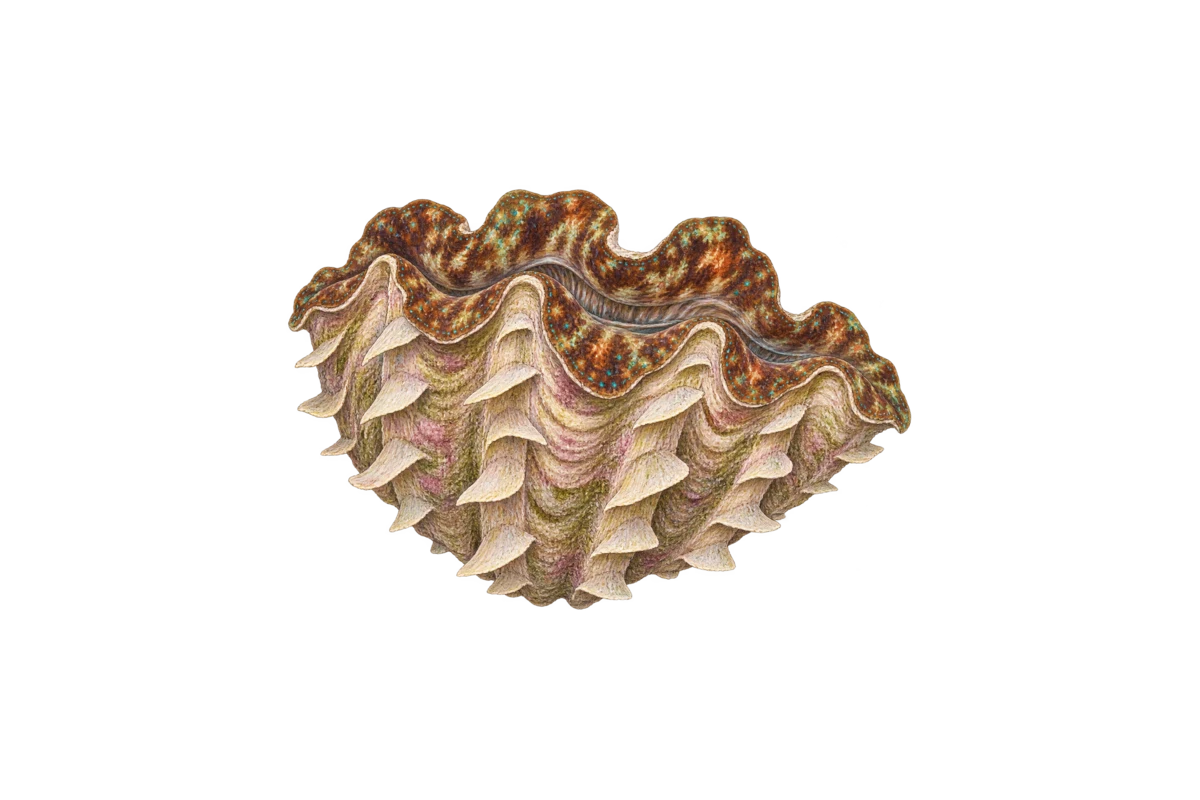
If the shell looks as if somebody built it out of overlapping scales, you’re on the right track. The fluted giant clam is known for the broad projections on its shell. For this ID, the shell tells a better story than the brilliant mantle.
How to recognize it
Look along the raised ribs on the outer shell. Broad, leaflike scales project out in rows. They are part of the hard shell, not moving fins or tentacles. On a living animal the soft mantle often spreads over the lip, so an oblique view may reveal scales that a straight-down view hides.
Where to look in Palau
Palau reef researchers counted this species in their 11-site survey. It was one of the three species they found most often. On a guided dive, look for the outline where brightly lit rubble and hard reef meet. Don’t move pieces of reef to make the shell easier to see.
Size and life stages
Reference accounts put the shell at roughly 16 inches (40 cm) at the upper end. That is shell length, not how far the living tissue can extend across the opening. Use the scales as the main cue, not size alone.
What it does all day
The clam can feed on particles from the water and also benefits from photosynthetic algae in its tissues. Lab work found that light changed the activity of the shell-building tissue. Field work in the Coral Triangle found that conditions such as water clarity matter to how it gets energy and grows.
The next generation
A young clam does not hatch as a little scaled adult. Palau cultivation researchers reared larvae in the lab and grew juveniles outdoors in flowing sunlit seawater. Their work documents stages divers usually don’t get to see.
Look-alikes
The smooth giant clam lacks those showy, leafy scales. A true giant clam has heavy folds, but deep folds and leaflike scales aren’t the same thing. Get a good look along an exposed shell before judging from the mantle pattern.
Try this on your next dive
Try framing the shell and the mantle together without putting fins near the reef. The extra angle helps you remember whether the feature you saw was a solid projection or only a fold of tissue. If you can hover without drifting onto the reef, you can compare shell scales with mantle folds without crowding the clam. That’s a practical reason to try SDI Advanced Buoyancy Control.
Six things to notice
- Fluted and scaly refer to the same leaflike shell structures.
- Those scales grow on raised ribs along the valves.
- Photosynthetic partners can help supply the clam with energy.
- An experiment found that light affected a calcium transport protein in its shell-facing tissue.
- Growth studies found that water clarity can change how important light and particle feeding are.
- Palau researchers have raised both larvae and juveniles of this exact species.
Keep looking through the Palau Fish ID guide, or explore our international group dive trips.




