


Noah’s Giant Clam
Tridacna noae · Cardiidae · Giant clam · Palau Fish ID
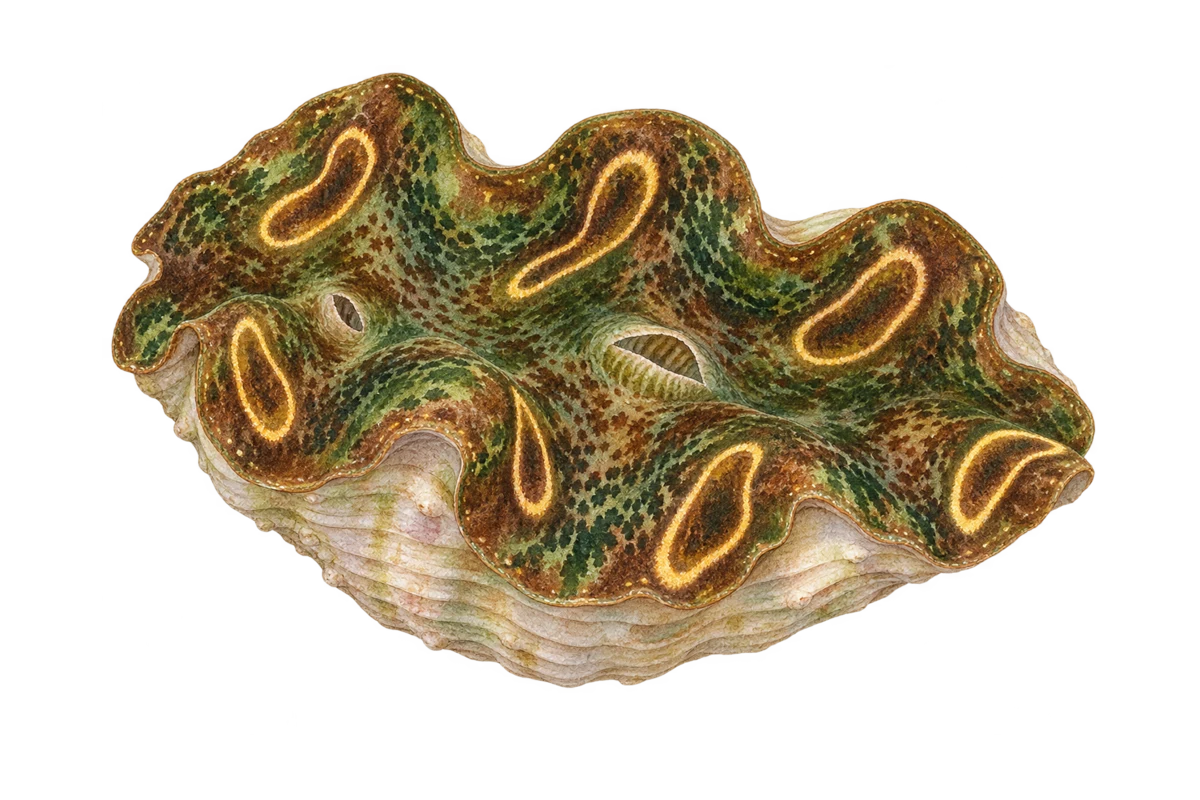
If it looks like somebody drew little teardrops on the mantle, you’re paying attention to the right detail. But even a good clue isn’t a permission slip to name every clam from a blurry photo.
How to recognize it
Look near the mantle edge for teardrop or oval markings outlined in white or pale gold. Unlike the small giant clam’s usual pattern, the tiny light-sensitive organs do not form a neat continuous row. Check both clues together.
Where to look in Palau
A Palau reef census recorded Noah’s clam as a species distinct from the small giant clam. The researchers reported it as the first documented Palau record. That’s not a new arrival claim.
Size and life stages
Reported shell length reaches about 10 inches (25 cm). Measure the shell, not the wider mantle when it spreads out.
What it does all day
It takes food particles from water and gets additional nutrition from photosynthetic algae living in its tissues. The mantle is the soft part displaying the colors and markings.
The next generation
Young giant clams begin as drifting larvae. Adult mantle markings are useful in the field, but don’t try to identify younger animals by shell ribs alone.
Look-alikes
The small giant clam is the big look-alike. Both can have shades of blue, brown and green. Researchers have found variation in the mantle patterns, so a pretty teardrop alone is not final proof.
Try this on your next dive
Take a wide shot first, then get a clearly focused edge photo only if you can hold position without touching the reef. Your logbook can say “possible Noah’s clam” if you’re not sure. If you want practice bringing home the details in a photo, try the SDI Underwater Photographer.
Six things to notice
- The teardrop pattern gave it another nickname: teardrop giant clam.
- It spent years grouped with the small giant clam.
- Scientists used living mantle features and genetic evidence to separate the two.
- The first documented Palau record came from a reef census.
- The pale outlines, not one particular background color, are useful clues.
- Counts of shell ribs overlap with those of the small giant clam.
Keep looking through Palau Fish ID or explore our international group dive trips.




