


Boring Giant Clam
Tridacna crocea · Cardiidae · Giant clam · Palau Fish ID
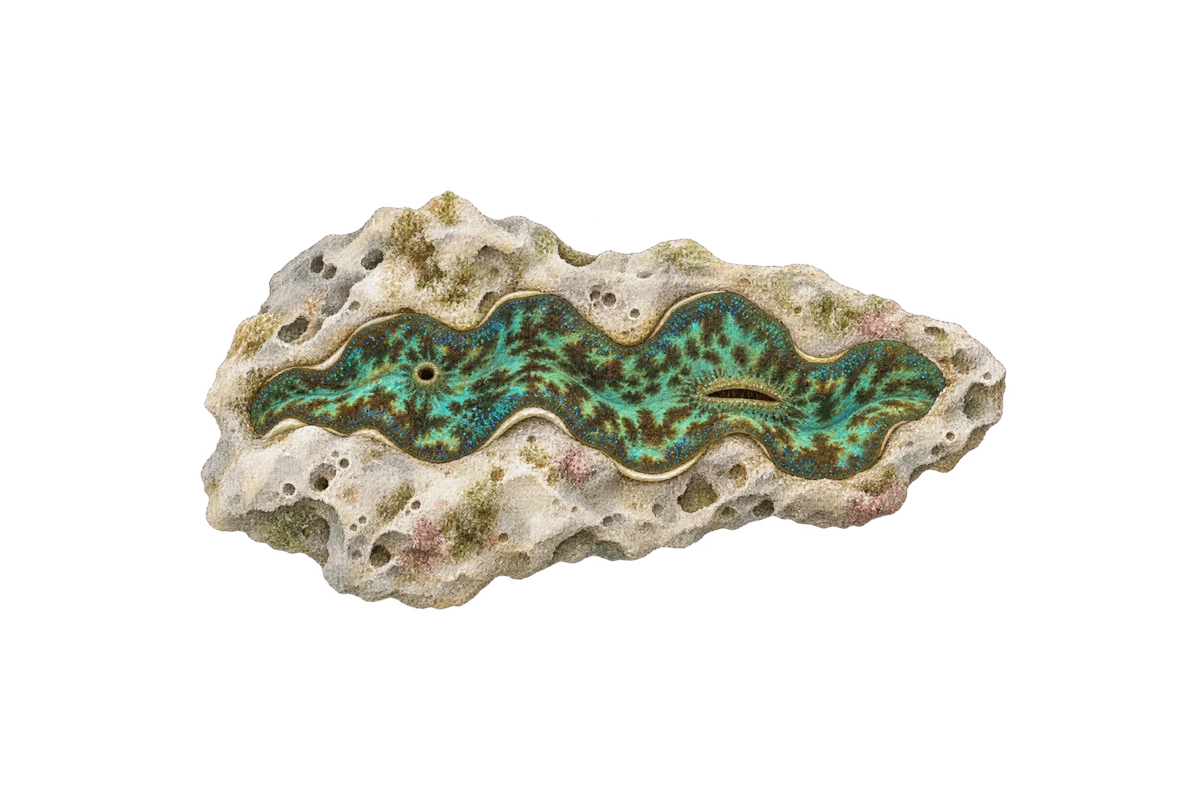
Think of this as the giant clam that moved into the reef instead of setting up on top of it. You may see only a colorful ribbon of living tissue where you expected ordinary rock. Look at the opening from the side before you decide what you’re seeing.
How to recognize it
Follow the exposed rim of the shell. On a well-embedded adult, the rim sits close to the rock and a fleshy, patterned mantle rises between the valves. The mantle is the soft tissue you see first. Its colors vary, so the way the clam sits in the rock is a better starting cue than blue, green or brown alone.
Where to look in Palau
In Palau, a field team recorded this species across its giant-clam survey and found both adults and young clams at Ngermedellim Marine Sanctuary. Scan sunlit hard reef carefully when your guide takes you through suitable habitat. Ask your local guide which reefs are open and suitable.
Size and life stages
Shell lengths can reach about 6 inches (15 cm). Measure that along the shell, not across the visible mantle or the entire hole. A young or deeply embedded animal can look smaller than a full shell would suggest.
What it does all day
Lab researchers found that tissue under the clam helped acidify the rock it touched. Over time, the clam makes room in limestone without needing a shell shaped like a drill. At the exposed end, water passes through openings used for feeding and respiration.
The next generation
Like other giant clams, it starts life as a drifting larva before settling. The exposed adult is the animal you’re likely to notice. Finding small individuals alongside adults tells a survey team more about a reef population than counting large shells alone.
Look-alikes
The small giant clam can also sit partly in the reef. The boring giant clam can embed almost its whole shell. If you cannot see enough of the shell, “giant clam” is an honest ID. Never pry an animal out to check.
Try this on your next dive
Hold steady above the reef and take one photo that shows both the opening and the surrounding rock. If the mantle pulls back, give the clam space. A side-angle reference is more useful than a close-up of color alone. If you want practice framing small reef animals from a respectful distance, try the SDI Underwater Photographer course.
Six things to notice
- This is one of the smallest giant-clam species, despite the name.
- Researchers measured the acidifying activity of the tissue beneath the clam.
- Its rock pocket can hide almost the entire shell.
- Much of the vivid pattern you see belongs to soft mantle tissue.
- Palau surveyors counted 521 individuals of this species, more than any other giant clam in their survey.
- Both small recruits and mature animals were recorded at Ngermedellim.
Keep looking through the Palau Fish ID guide, or explore our international group dive trips.




