


Fish identification archive / Raja Ampat
Tasselled Wobbegong
Eucrossorhinus dasypogon
Raja Ampat field guide
Six things worth knowing
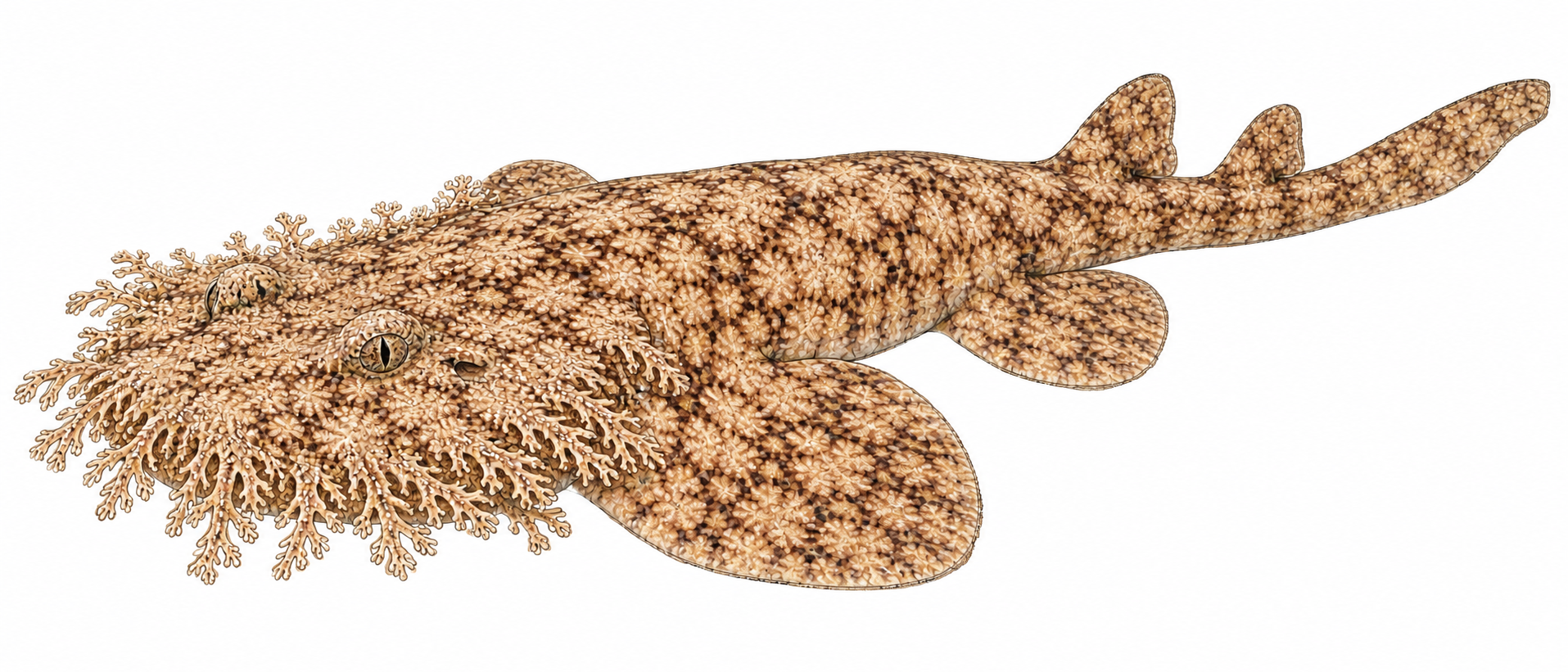
- The beard is part of the camouflage. Its branched skin flaps break up the outline of the head, which already lies flat against the bottom.
- The pattern is a net, not a stripe. Fine dark lines form a mesh across the body, with larger dark spots where the lines meet.
- An ambush, not a chase. It can lie still until prey gets close, then rapidly open its mouth to draw the prey in by suction.
- Some neighbors are dinner. Squirrelfish, soldierfish, and sweepers can share the same shelters and are known prey.
- Shelter by day. Individuals may rest beneath reef ledges or in caves during daylight. Camouflage makes even an exposed shark easy to overlook.
- Pups arrive live. Females give birth to live young. Newborns are around eight inches long.
How to identify it
A broad, flattened carpet shark with an elaborate branching fringe around the head. Dark network-like markings and blotches break up its outline; broad pectoral fins rest close to the reef.
Habitat and where to look
Coral reefs, channels and reef faces, including caves and ledges. Documented from Waigeo in Raja Ampat.
Daily habits and behavior
Often concealed by day and active at night. Camouflage allows it to wait for prey at very close range.
What is on the menu?
Bottom-associated fishes, including squirrelfishes and soldierfishes. A sudden opening of the mouth draws prey inward by suction.
Mating and the next generation
Females give birth to live young rather than laying egg cases.
Look-alikes and identification traps
Other wobbegongs share the flattened carpet-shark shape. Confirm the especially elaborate, branching head fringe rather than relying on colour alone.
Try this observation
Find the eye and then trace the head fringe from a respectful distance. Never put hands or a camera beneath a resting shark.
Raja Ampat occurrence
Recorded in Raja Ampat; a regional record is not a promise of a sighting on a particular dive. This guide does not imply that every site, itinerary or season offers the same chance of an encounter.
Observe, do not disturb
Keep a respectful distance, leave the animal an unobstructed route and follow your dive guide. Do not touch, feed, chase or collect wildlife. Identification does not establish permission to harvest or food safety; Florida harvest labels do not apply to this Indonesian guide.
Look for a fringe where the reef seems to end
The branched tassels along this shark’s head break up an outline that is already hard to see. Look for the fringe and a broad, flattened head together. Try viewing the whole animal from a respectful distance instead of reaching into a ledge.
The tasselled wobbegong is documented from the Raja Ampat area, including Waigeo. The Underwater Photographer course is useful for practicing a composed photograph of a camouflaged animal without closing the distance. Browse the Raja Ampat fish guide for other local shapes to compare.
Build your shark ID skills
Practice reading the silhouette, fin marks, and behavior with Stuart Scuba’s SDI Shark Awareness course. Advanced Adventure is an option for developing broader reef skills. Give a resting wobbegong space and never reach under a ledge to get a better view.
Sources and review
Reviewed November 18, 2026.
Make your next dive happen
Dive With UsTrain With UsExplore the Raja Ampat tripShop With Us
Questions? (772) 600-8288 or info@stuartscuba.com.




