


Tan Hamlet
Hypoplectrus randallorum · Serranidae
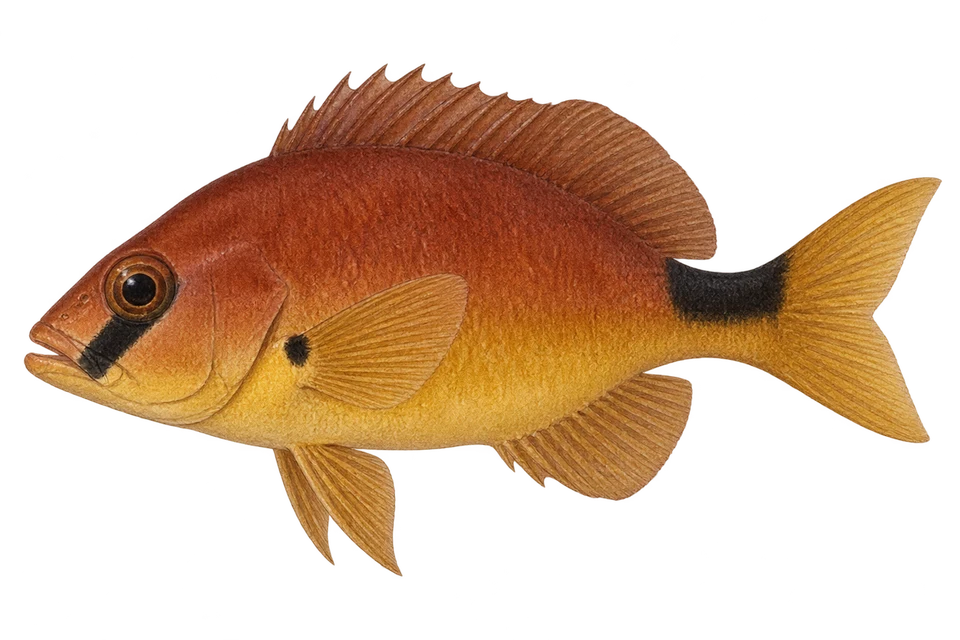
Check three places: beside the mouth, at the base of the side fin and on top of the narrow tail base.
One fun thing to know
The positions of markings are more helpful than the similar outlines of many hamlet species.
How to identify it
- Tan to reddish-brown above and warmer yellow-brown below.
- Oblique dark blotch from below the eye toward the upper jaw.
- Small dark pectoral-base spot and usually a dark saddle atop the tail base.
Where to look
Shallow reef structure. The Smithsonian range account starts in the Keys; the Blue Heron Bridge record comes from the REEF survey.
Local record: This fish has been recorded in REEF surveys at Blue Heron Bridge (Phil Foster Park), Riviera Beach. A local record is not a guarantee of a sighting.
Size: Up to about 5.1 in (13 cm) in the cited account. This is a published upper size, not what to expect on every dive.
What it eats
Small fish and mobile crustaceans are reported prey.
How it behaves
Look along edges and get a full side view to compare the markings.
Reproduction
Eggs and larvae are pelagic; bridge-specific spawning timing is not established.
Look-alikes
Compare Butter Hamlet and other small hamlets. Check the cheek streak, dark pectoral mark and tail saddle rather than yellowish color alone.
Can you collect or eat it?
Enjoy watching it and leave it in the water. This guide does not verify species-specific harvest or food-safety rules. Check the current rules for the exact place, species and method before taking any fish.
Check Florida’s current saltwater rules
Field references
I saw this and want to share
Make your next dive happen
Dive with Stuart Scuba · Train with us · Travel with us · Shop with us



