


Spotted Snake Sea Cucumber
Synapta maculata · Synaptidae · Sea cucumber · Palau Fish ID
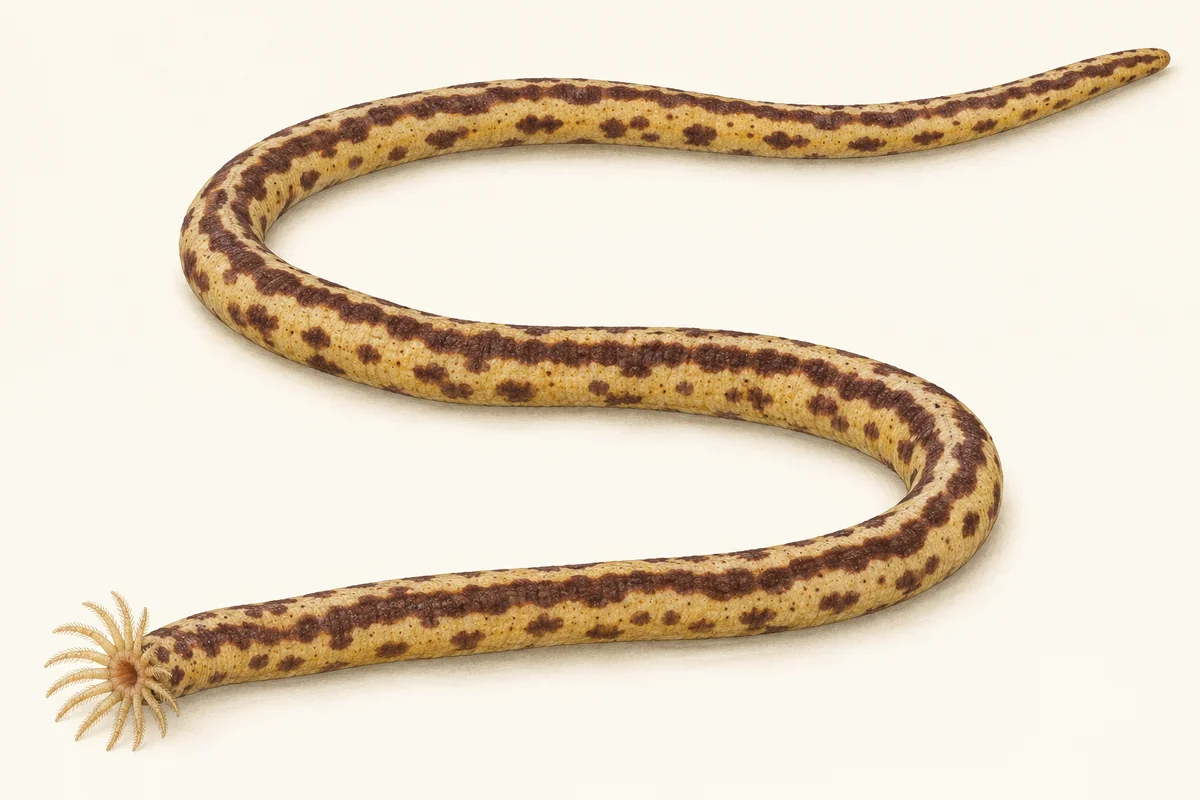
An underwater rope that eats with feathers? Close enough for a first impression. The spotted snake sea cucumber can be astonishingly long, but the best clue is at the end that looks like a tiny feather duster.
How to recognize it
Look for a long, thin, yellow-brown body with broad lengthwise stripes and darker patches. At one end, a ring of fine, featherlike tentacles surrounds its mouth. The other end has no such crown.
Where to look in Palau
Palau surveyors recorded this exact species in Airai and Koror. Look across shallow seagrass or reef rubble in places your guide recommends. It may be out in the open or partly hidden; leave rubble where you find it.
Size and life stages
A stretched adult can approach 6½ feet (2 m). The visible length changes as it contracts and stretches, so an individual can look much shorter without being a juvenile.
What it does all day
Its feathered tentacles gather tiny food particles right off surfaces. Researchers found adhesive areas on the feeding tentacles; think of each one as a reusable dusting cloth rather than a hand that grabs large prey.
The next generation
This is an adult identification guide. Size by itself is a poor test of age because the body can shorten as the animal moves. Focus on the body pattern and feeding crown instead.
Look-alikes
A sea snake has a head and eyes, and an eel has a jaw and fins. This sea cucumber has a feeding crown instead. Other long sea cucumbers can be similar, so confirm the dark lengthwise stripes and patches as well as the tentacles.
Try this on your next dive
Start with a wide photo showing the body, then zoom in for the mouth without disturbing it. For a video, leave the camera still and watch the feeding tentacles work. If you want practice bringing home the details in a photo, try the SDI Underwater Photographer.
Six things to notice
- It can stretch close to the height of a tall adult human.
- The feeding end usually has about 15 feathery tentacles.
- It collects particles off the bottom rather than grabbing fish.
- Some tentacle surfaces are sticky, helping the animal pick up its tiny meals.
- It lacks the walking tube feet familiar from many other sea cucumbers; waves of body contraction move it along.
- Its skin contains tiny anchor-shaped support pieces, much too small to see on a normal dive.
Keep looking through Palau Fish ID or explore our international group dive trips.




