


← Back to South Florida Fish ID
Sunrise Tellin
Tellina radiata · Tellinidae
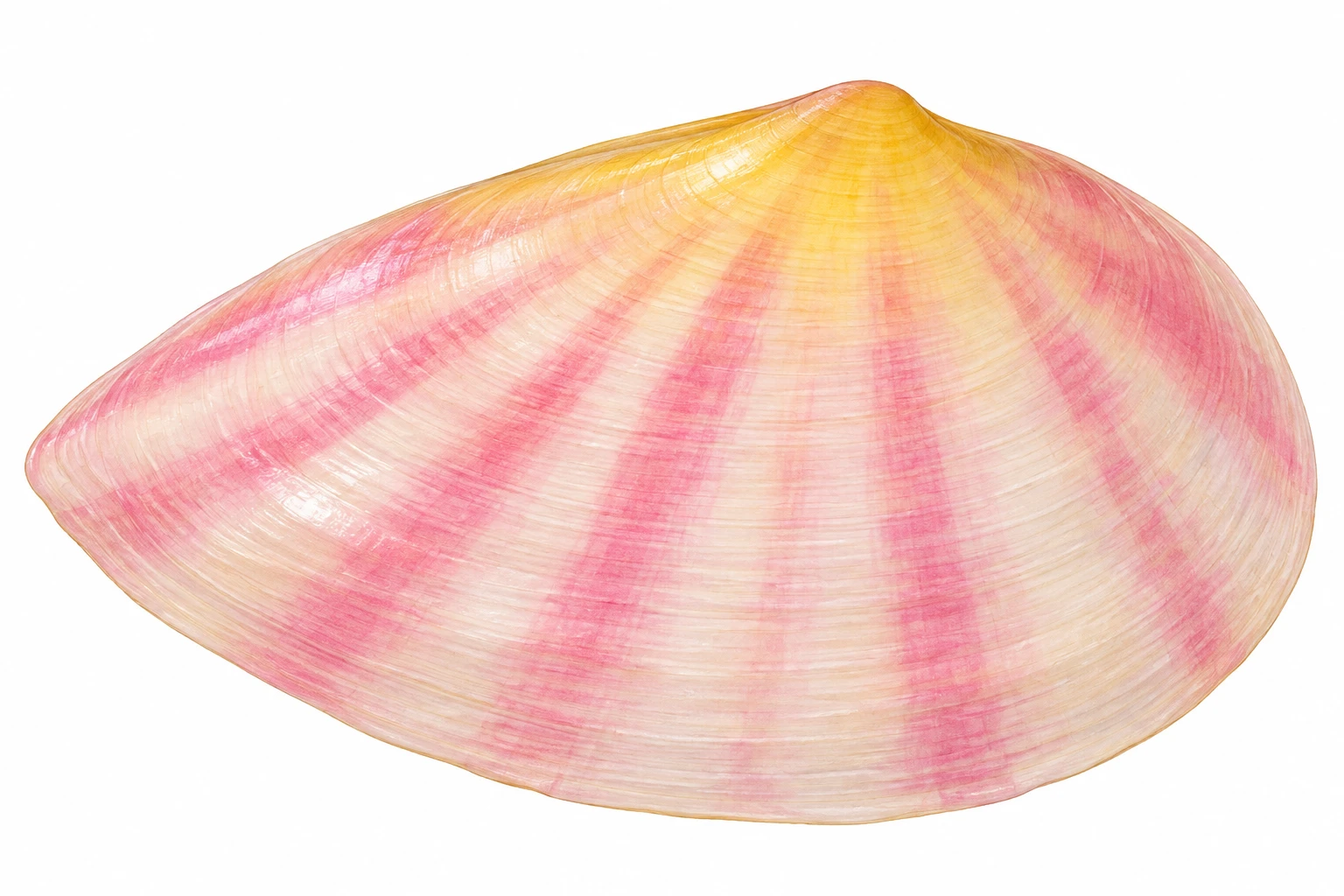
A smooth, flattened shell with rose-colored rays on a pale background is the signature of the sunrise tellin. Follow the rays from the hinge toward the wider shell edge.
One fun thing to know
The shell’s pink rays spread outward from the hinge like rays of sunlight. They can be less obvious on worn or faded valves.
I saw this and want to share
To share this guide with a dive buddy, copy the page link.
How to identify it
- Smooth, polished exterior rather than coarse ribs
- Elongated, flattened shell with ends of different shapes
- Pale background crossed by broad pink rays, often with yellow near the hinge
Where to look
Listed from Hobe Sound National Wildlife Refuge and Coral Cove. It lives on sandy bottom and has been recorded down to about 26 ft (8 m).
Size
About 2.8 in (70 mm) at the upper end of published shell-guide sizes.
What it eats
Tellins glean fine organic particles; their long siphons reach beyond the buried shell. Species-specific feeding proportions were not verified.
Behavior
Lives in sand with its shell mostly concealed. A siphon at the surface generally cannot support a species-level ID on its own.
Reproduction
Marine bivalves commonly develop through free-swimming larvae before settling; Florida spawning dates for this species were not verified.
Look-alikes
Rose petal tellin (Eurytellina lineata) can also be pinkish; compare overall profile, fine sculpture and the pattern of the pink rays. A faded specimen may need expert comparison.
Can you collect or eat it?
Observe and leave in place. Check the Florida Fish and Wildlife Conservation Commission’s shell-collecting rules and local protected-area restrictions before removing a live shell.
Check current species and site rules before collecting. This guide does not establish permission to collect.
Make your next dive happen
Dive with Stuart Scuba · Train with us · Travel with us · Shop with us



