


Squaretail Coral Grouper
Plectropomus areolatus
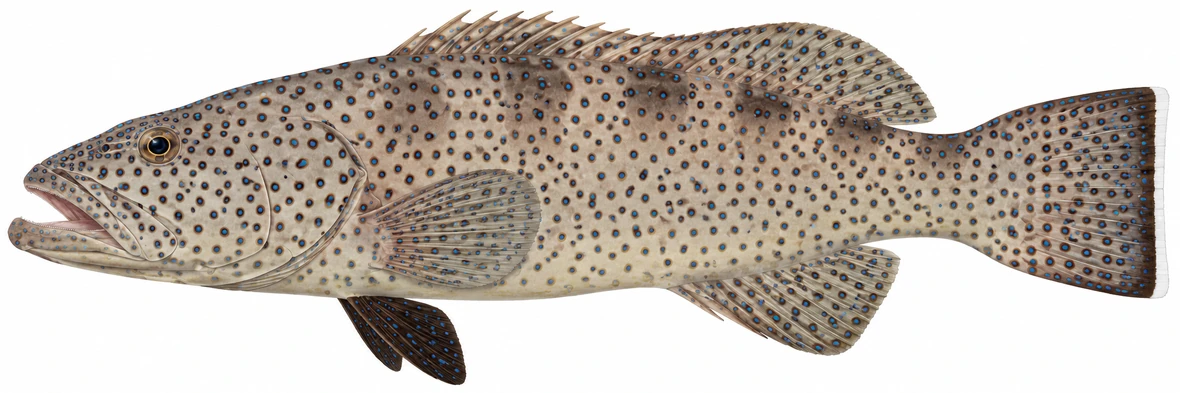
Two details worth remembering
- The square-looking tail is a practical field clue, but use it alongside the dark-rimmed blue spots.
- Spawning aggregations make reef connectivity visible: fish can gather at a particular site while using other reef areas outside reproduction.
How to identify it
An elongated pale grey to whitish coral grouper with dense dark-edged blue spots, sometimes four or five dark back saddles, and a nearly square tail with a fine white rear edge.
Where to look
Coral-rich lagoons and seaward reefs, especially channels along reef fronts. The blue spots and tail outline are more useful than assuming a fish in a channel belongs to this species.
Natural history
Adults feed on fishes.
Forms spawning aggregations. Eastern Indonesian gonad sampling found mature females and males but no bisexual gonads in its limited squaretail sample; do not present sex change as proven by that study.
Look-alikes
The grey phase of blacksaddle coral grouper has a darker head, five back saddles and smaller blue spots. Compare several features, not one saddle.
What to watch for underwater
Try to capture the tail edge and several flank spots sharply without entering the fish’s path or compromising position in current.
Recorded in Raja Ampat
This species has a published Raja Ampat record. A regional record does not guarantee a sighting on a particular dive.
Sources: fishesofaustralia.net.au species reference · Regional survey record · pmc.ncbi.nlm.nih.gov species reference
I saw this and want to share
Back to Raja Ampat Fish ID · Dive Raja Ampat with Stuart Scuba




