


← Back to South Florida Fish ID
Spotted Snake Eel
Ophichthus ophis · Ophichthidae
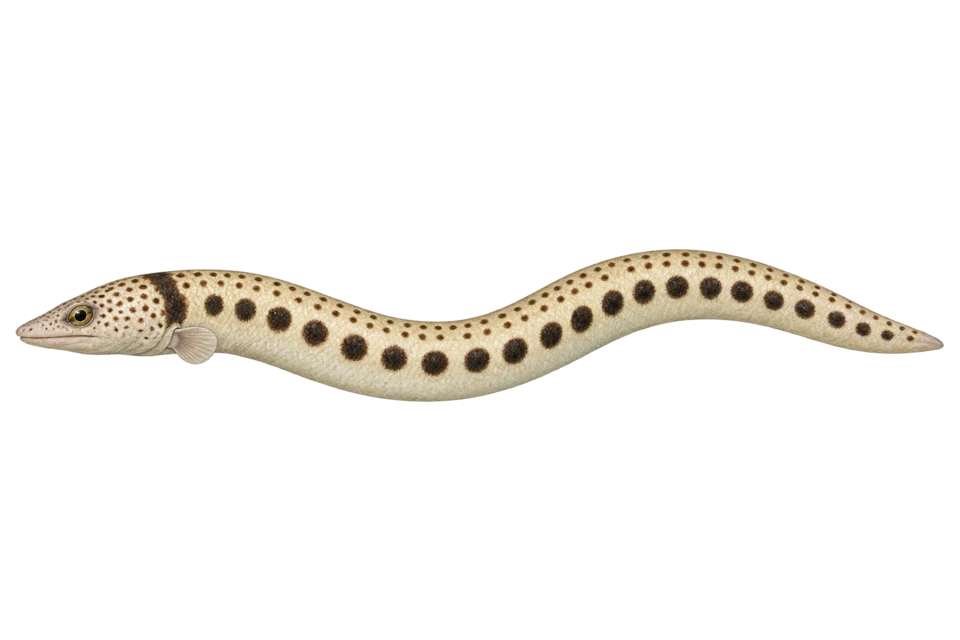
One row of large dark spots down the side and paired smaller dots along the dorsal base are the clues to check.
One fun thing to know
A snake eel can have a long dorsal and anal fin while the very tip of the tail remains finless.
How to identify it
- The cream body carries a row of roughly 20 large mid-side spots.
- Pairs of smaller marks flank the dorsal-fin base; a larger mark sits near that fin’s starting point.
- Look for an elliptical eye, a paddle-shaped pectoral and a blunt finless tail tip.
Where to look
Sandy bottoms with burrows. Recorded in the west Atlantic, including southern Florida; the Blue Heron Bridge survey lists it, but that does not mean it is regularly encountered there.
Size
82.7 in (210 cm). reported length; measurement convention not stated in the cited field account.
What it eats
Takes fish and cephalopods such as small octopus or squid.
Behavior
Look for the head or a stretch of the spotted body at a burrow opening. Do not dig or pull it out.
Reproduction
Eggs and larvae drift in open water. This guide does not establish a local spawning season.
Look-alikes
Spotted Spoon-nose Eel has several irregular rows of large upper-body spots. Look for one prominent row of large mid-flank spots on this fish.
Can you collect or eat it?
Enjoy watching it and leave it in the water. This guide does not verify species-specific harvest or food-safety rules. Check the current rules for the exact location, species and method before taking anything, and never collect where prohibited.
Check Florida’s current saltwater rules
Field references
- REEF field survey reference 1
- Smithsonian Shorefishes reference 2
- Smithsonian Shorefishes reference 3
- fishesoftexas.org reference 4
I saw this and want to share
Make your next dive happen
Dive with Stuart Scuba · Train with us · Travel with us · Shop with us



