


Fish identification archive / Raja Ampat
Spotted Garden Eel
Heteroconger hassi
Raja Ampat field guide
Two things to tell your dive buddy
- Each apparent stalk is a fish occupying its own burrow.
- Juveniles are black rather than adult-patterned.
How to identify it
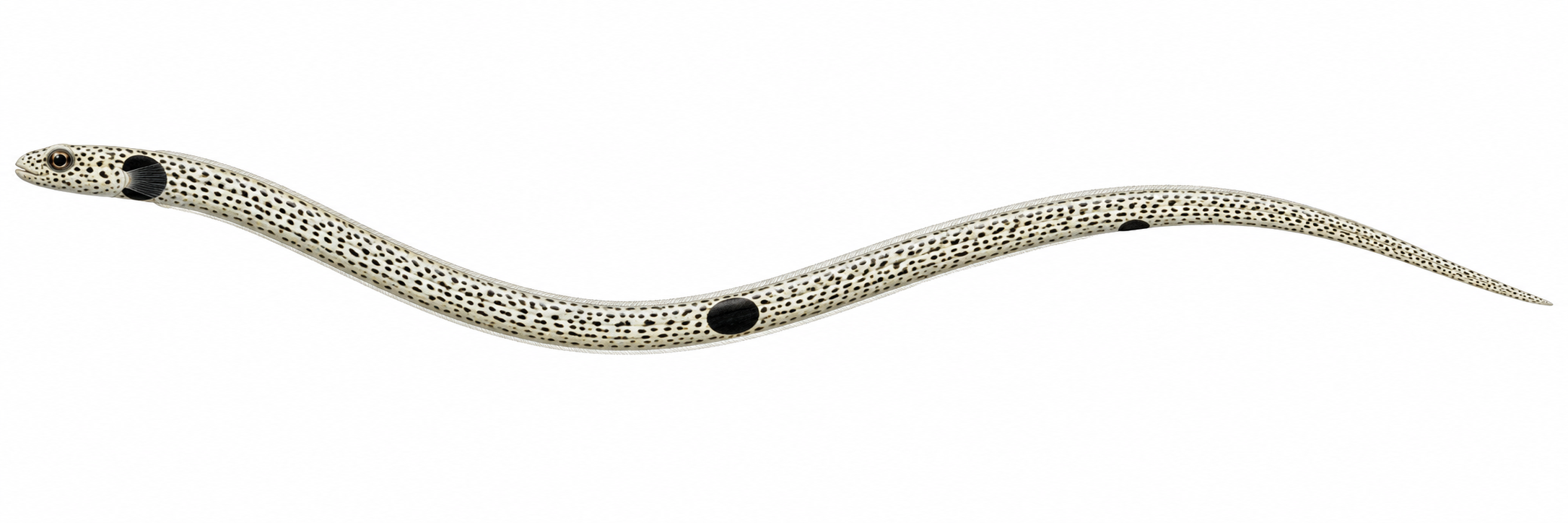
A thin pale eel with fine dark speckling and prominent dark patches around the gill opening and farther along the body.
Habitat and where to look
Sandy and rubble slopes and lagoons, often in colonies.
Daily habits and behavior
Feeds while partly extended from a burrow, retreating when disturbed.
What is on the menu?
Drifting zooplankton.
Mating and the next generation
Neighbours can reach across during spawning; eggs and leaf-like larvae enter the plankton.
Look-alikes and identification traps
Other garden eels share the upright stance. Confirm the large dark patches, not merely the colony’s appearance.
Try this observation
Stop outside the colony and watch the feeding heads orient to the current.
Raja Ampat occurrence
Recorded in Raja Ampat; sightings depend on site, conditions and careful observation. This guide does not imply that every site, itinerary or season offers the same chance of an encounter.
Observe, do not disturb
Keep a respectful distance, leave the animal an unobstructed route and follow your dive guide. Do not touch, feed, chase or collect wildlife. Identification does not establish permission to harvest or food safety; Florida harvest labels do not apply to this Indonesian guide.
Sources and review
Reviewed November 18, 2026.
Find the larger blotches among the small spots
A spotted garden eel is pale and speckled, with much larger dark blotches near the gill opening and farther down the body. The fish may show only part of its length above the sand, so record what you can see without approaching the burrow.
SDI Buoyancy Control can help you stay level above the sand while you observe.
Make your next dive happen
Dive With UsTrain With UsExplore the Raja Ampat tripShop With Us
Questions? (772) 600-8288 or info@stuartscuba.com.




