


← Back to South Florida Fish ID
Spotcheek Blenny
Brockius nigricinctus · Labrisomidae
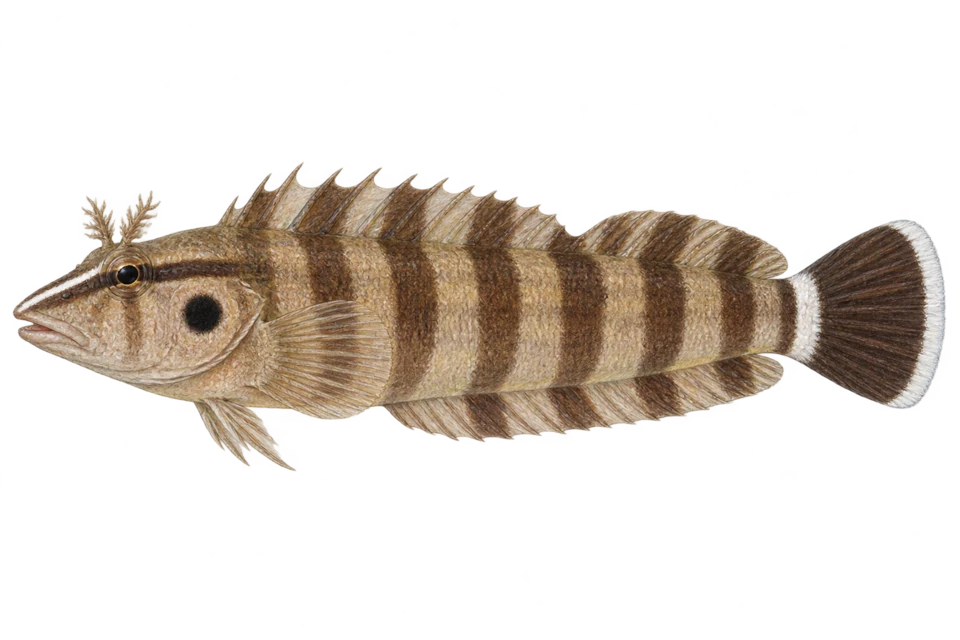
A dark, eye-like cheek spot gives away this little barred blenny.
One fun thing to know
Large males can turn much redder than females or smaller males.
How to identify it
- Prominent black-centered false eyespot on the gill cover
- Six to eight broad dark bars often extend onto the fins
- White stripe down the middle of the snout; dark tail with white band at base and a white outer edge
Where to look
Clear shallow water: rocky tide pools, stones on sand and patch reefs. REEF survey records include occasional observations at Blue Heron Bridge.
Size
2.6 in (6.7 cm). reported maximum; measurement convention not specified.
What it eats
Small prey such as worms, crustaceans and mollusks.
Behavior
Stay still over rock and look for the head and eye tassels first.
Reproduction
Eggs are laid on the bottom or an attached surface; the young drift as larvae.
Look-alikes
Hairy Blenny can also look barred. Check for the cheek mark together with the white snout stripe and the white-edged tail.
Can you collect or eat it?
Enjoy watching it and leave it in the water. This guide does not verify species-specific harvest or food-safety rules. Check the current rules for the exact location, species and method before taking anything, and never collect where prohibited.
Check Florida’s current saltwater rules
Field references
I saw this and want to share
Make your next dive happen
Dive with Stuart Scuba · Train with us · Travel with us · Shop with us



