


Spiny Sea Star
Asteropsis carinifera · Asteropseidae · Star-shaped · Galápagos Islands Fish ID
How to identify it
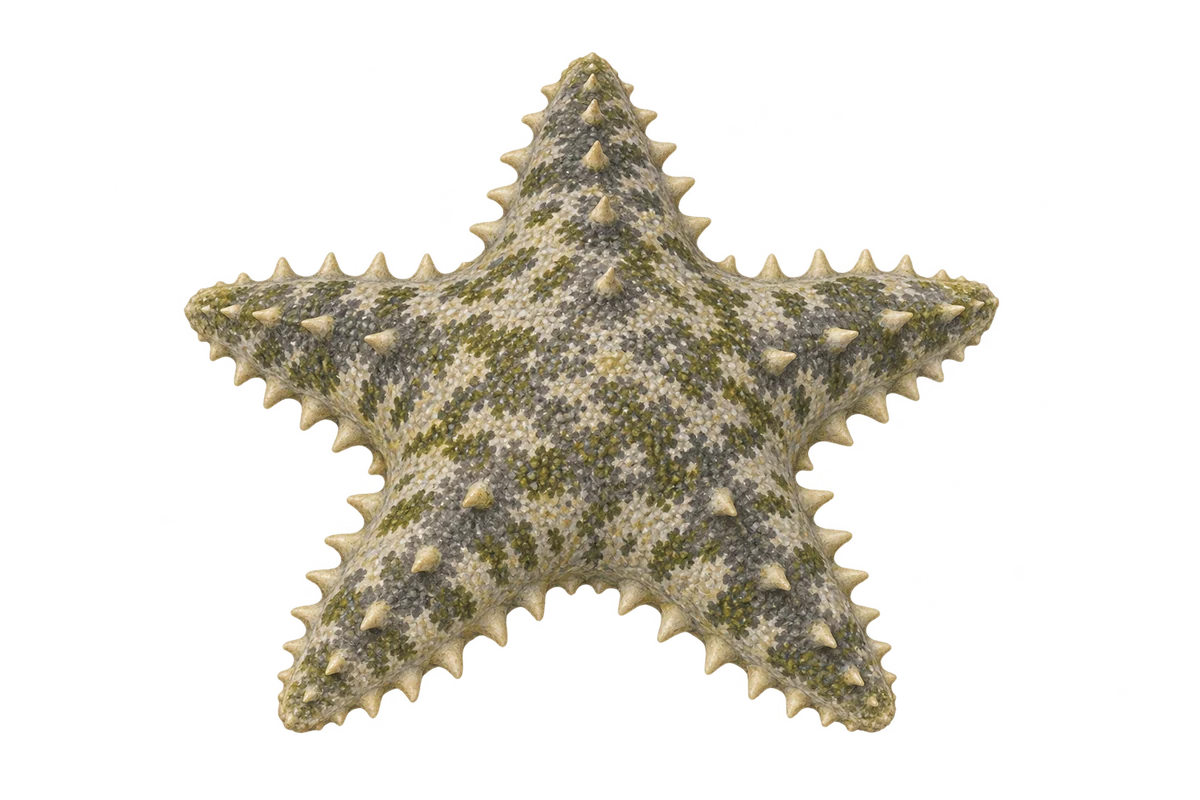
Look for broad arm bases, a leathery surface and a serrated outline. The stout side spines and the shorter ridge of spines along each arm are much better clues than whether it looks gray or green.
Bradley’s sea star is slimmer with more evenly tapering arms. This is also not a long-spined, many-armed crown-of-thorns.
Galápagos Islands records
Documented Galápagos record: Galápagos shallow rocky reefs (survey pooled across the archipelago). A record does not guarantee a sighting.
Fun facts
- Its original scientific description called out spiny arm ridges and a spiny outline.
- A leathery surface partly hides the plates supporting its body.
- The stout spines along the margins can make the arms look saw-edged.
- Blunt spines also form a separate row down the top of each arm.
- The Galápagos rocky-reef transects counted 16, fewer than Bradley’s, cushion or chocolate-chip stars in that survey.
- Named Galápagos records are not the whole range; the CDF also lists several eastern Pacific localities.
Explore and learn
Palau’s reef collections include this species in shallow water. On a rocky reef, look for the saw-edged outline before trying to make sense of its color. Browse Palau Fish ID.
A low-angle photo shows the separate rows of spines along the top and sides of the arms. That’s a useful angle to practice in the SDI Underwater Photographer course if the current and your buoyancy let you stay clear of the reef.




