


← Back to South Florida Fish ID
Snowy Grouper
Hyporthodus niveatus · Epinephelidae
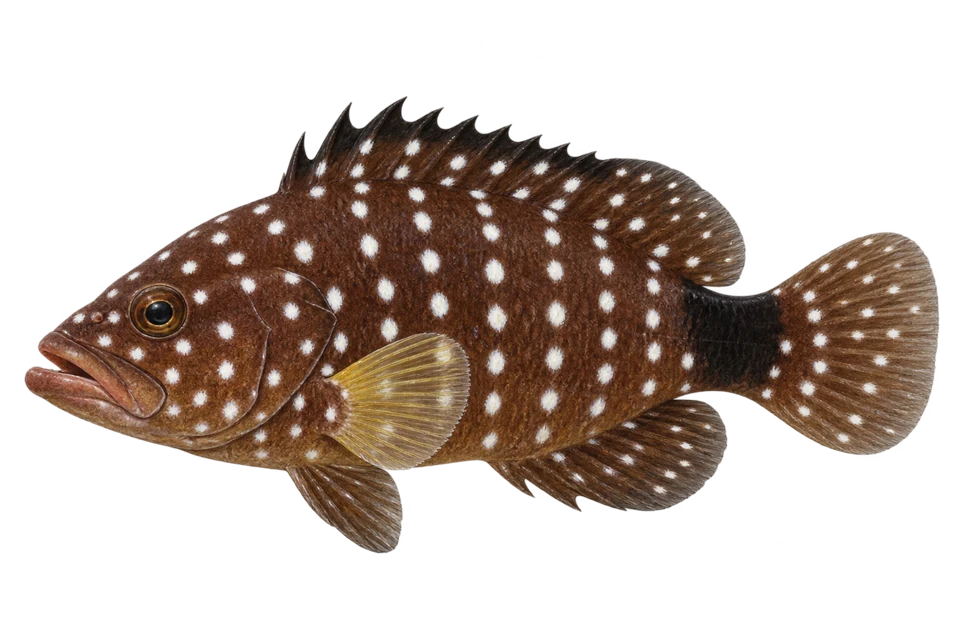
Young fish earn the name with neat rows of white spots and a dark saddle just before the tail.
One fun thing to know
The bright spots that inspire the name stand out on the young, not typically on mature fish.
How to identify it
- The juvenile has bright white spots in vertical rows that extend onto the dorsal fin.
- A dark saddle at the upper tail base extends below the lateral line; the spiny dorsal also has a dark edge.
- Juvenile tails are rounded. Adults are usually mostly dark brown with a squarer or concave tail.
Where to look
Hard bottom from the Florida Keys and beyond. Adults mostly live much deeper than regular recreational dives; young fish can enter shallower water.
Size
48.0 in (122 cm). reported length; measurement convention not stated in the cited field account.
What it eats
Eats fish, crustaceans, mollusks and other bottom prey.
Behavior
A juvenile is more likely than an adult to be encountered shallow. Watch from outside its shelter.
Reproduction
Eggs and larvae drift in open water. This guide does not establish a local spawning season.
Look-alikes
Juvenile Warsaw Grouper can also have pale marks and a dark tail-base saddle. Check the Snowy’s orderly white rows; Warsaw has an unusually tall second dorsal spine.
Can you collect or eat it?
Enjoy watching it and leave it in the water. This guide does not verify species-specific harvest or food-safety rules. Check the current rules for the exact location, species and method before taking anything, and never collect where prohibited.
Check Florida’s current saltwater rules
Field references
- REEF field survey reference 1
- Smithsonian Shorefishes reference 2
- Smithsonian Shorefishes reference 3
- oceansciencefoundation.org reference 4
I saw this and want to share
Make your next dive happen
Dive with Stuart Scuba · Train with us · Travel with us · Shop with us



