


Fish identification archive / Raja Ampat
Sixbar Wrasse
Thalassoma hardwicke
Raja Ampat field guide
Two things to tell your dive buddy
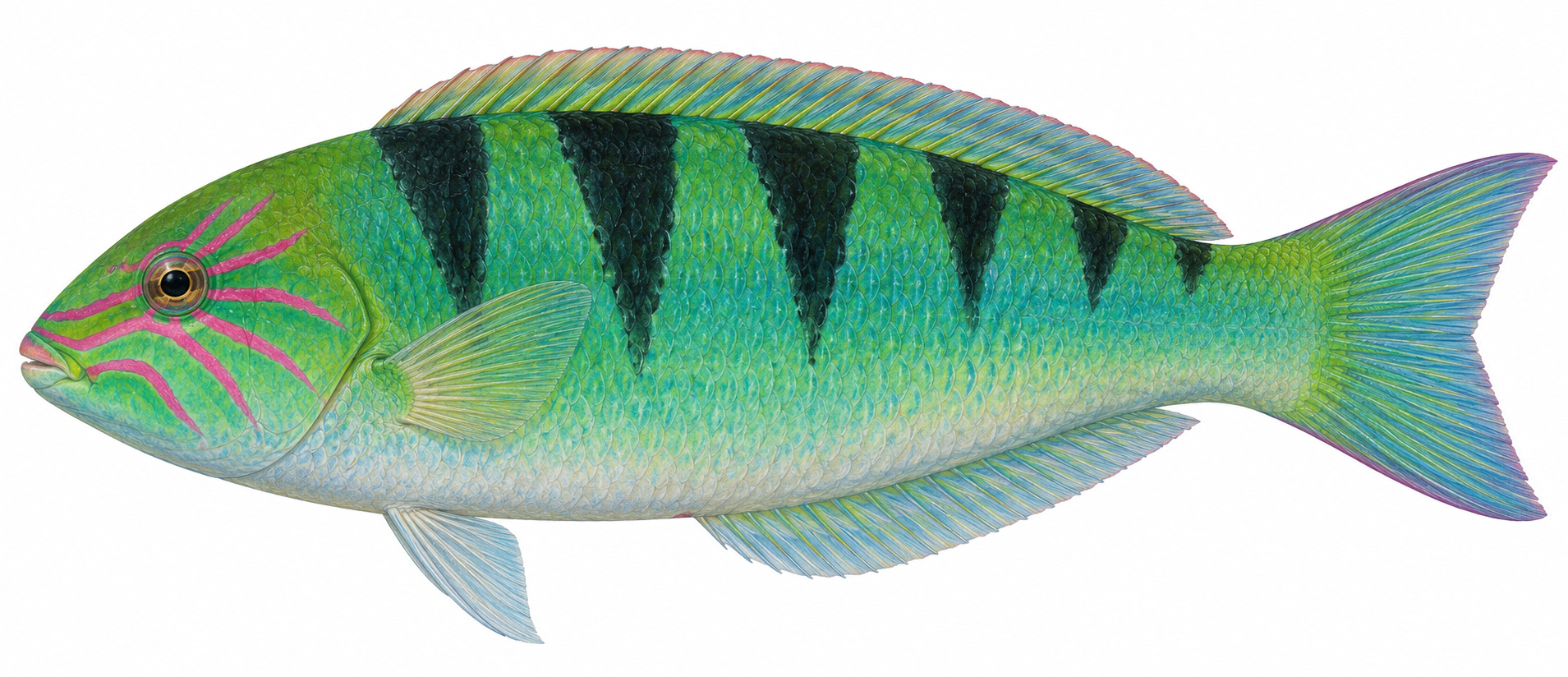
- Count the dark wedges, not just the colors. The bars shorten toward the tail, giving a useful structural clue when underwater light changes the apparent hue.
- This wrasse can change from female to male. The brighter male pattern therefore belongs to a life-history transition, not a separate species.
How to identify it
Greenish body with six dark wedge-shaped bars and pink lines radiating from the eye.
Habitat and where to look
Shallow lagoon and seaward reefs, slopes and drop-offs.
Daily habits and behavior
Occurs alone or in small groups.
What is on the menu?
Crustaceans, fish eggs, small fishes and other small animals, including foraminiferans.
Mating and the next generation
Some females change into males, a pattern called protogyny.
Look-alikes and identification traps
The six wedge-shaped bars become shorter toward the tail; do not identify it from green coloration alone.
Try this observation
Try counting the bars during a natural pause rather than chasing the fish.
Raja Ampat occurrence
Recorded in Raja Ampat; regional occurrence is not an itinerary-specific sighting promise. This guide does not imply that every site, itinerary or season offers the same chance of an encounter.
Observe, do not disturb
Keep a respectful distance, leave the animal an unobstructed route and follow your dive guide. Do not touch, feed, chase or collect wildlife. Identification does not establish permission to harvest or food safety; Florida harvest labels do not apply to this Indonesian guide.
Sources and review
Reviewed November 18, 2026.
Make your next dive happen
Dive With UsTrain With UsExplore the Raja Ampat tripShop With Us
Questions? (772) 600-8288 or info@stuartscuba.com.




