


Fish identification archive / Raja Ampat
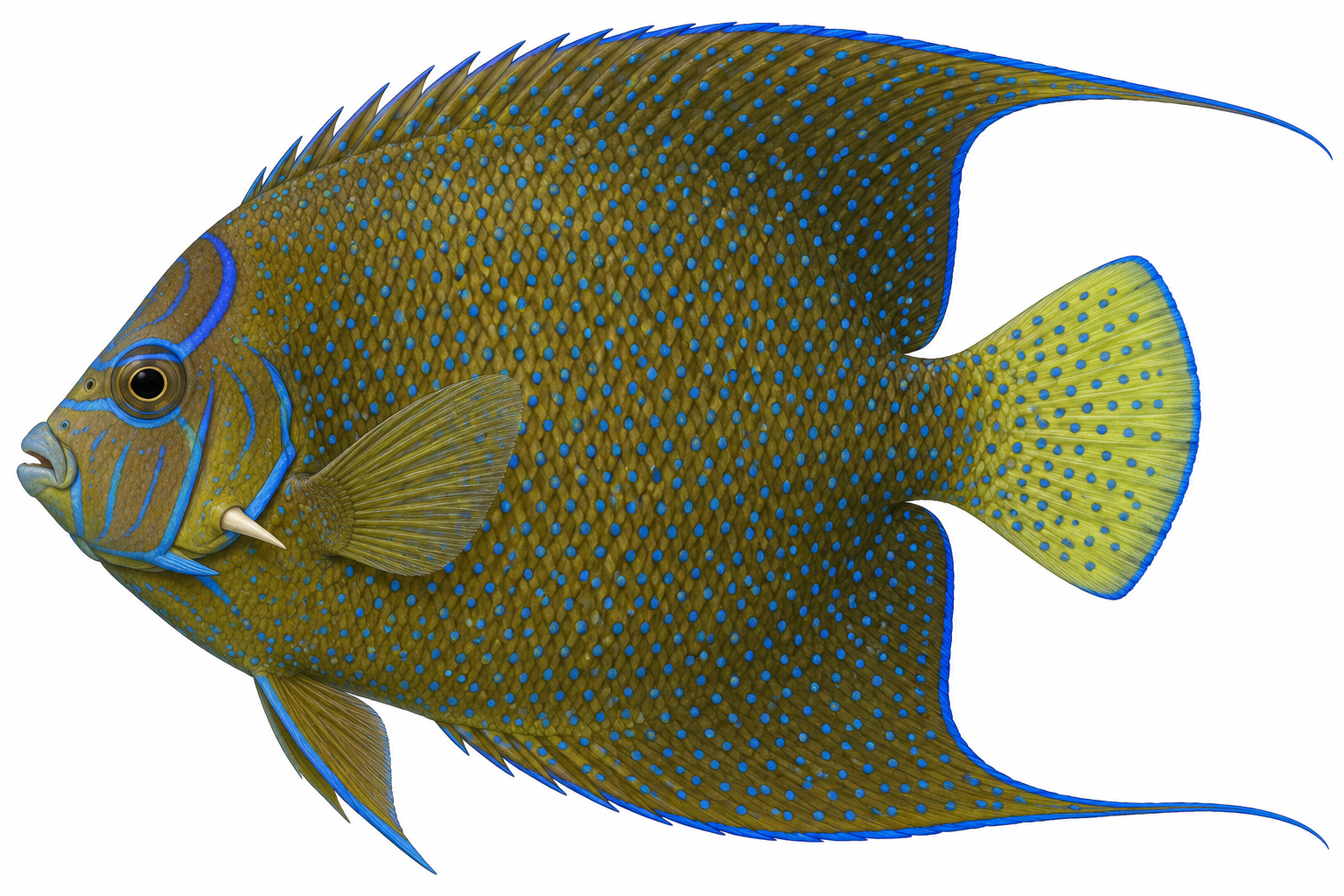
Semicircle Angelfish
Pomacanthus semicirculatus
Raja Ampat field guide
Two things to tell your dive buddy
- The name refers to the juvenile’s half-circle markings rather than the adult’s spots.
- An adult can eat both attached animals and algae; colour does not reveal its diet.
How to identify it
Adult brownish-green with blue body spots and blue-edged fins; juvenile dark with curved blue and white bars, not complete concentric rings.
Habitat and where to look
Coral-rich reefs; juveniles commonly occupy shallow protected areas.
Daily habits and behavior
Usually seen singly or in pairs.
What is on the menu?
Sponges, tunicates and algae.
Mating and the next generation
Look-alikes and identification traps
Juvenile emperor angelfish has complete concentric rings; this juvenile has curved bars without complete rings.
Try this observation
If you find a juvenile, compare open curved bars with the complete rings of a juvenile emperor angelfish.
Raja Ampat occurrence
Recorded in Raja Ampat; regional occurrence does not promise a sighting on a particular dive. This guide does not imply that every site, itinerary or season offers the same chance of an encounter.
Observe, do not disturb
Keep a respectful distance, leave the animal an unobstructed route and follow your dive guide. Do not touch, feed, chase or collect wildlife. Identification does not establish permission to harvest or food safety; Florida harvest labels do not apply to this Indonesian guide.
The young fish has open arcs, not a closed ring
A young semicircle angelfish has pale bands that curve backward but do not close into the complete ring seen on a young emperor angelfish. The adult looks different again, with a speckled side and blue accents around the eye and gill cover.
SDI Reef Fish Identification course: Learn to compare the shapes of the bands before relying on how bright they look underwater.
Sources and review
Reviewed November 18, 2026.
Make your next dive happen
Dive With UsTrain With UsExplore the Raja Ampat tripShop With Us
Questions? (772) 600-8288 or info@stuartscuba.com.




