


← Back to South Florida Fish ID
Sand Drum
Umbrina coroides · Sciaenidae
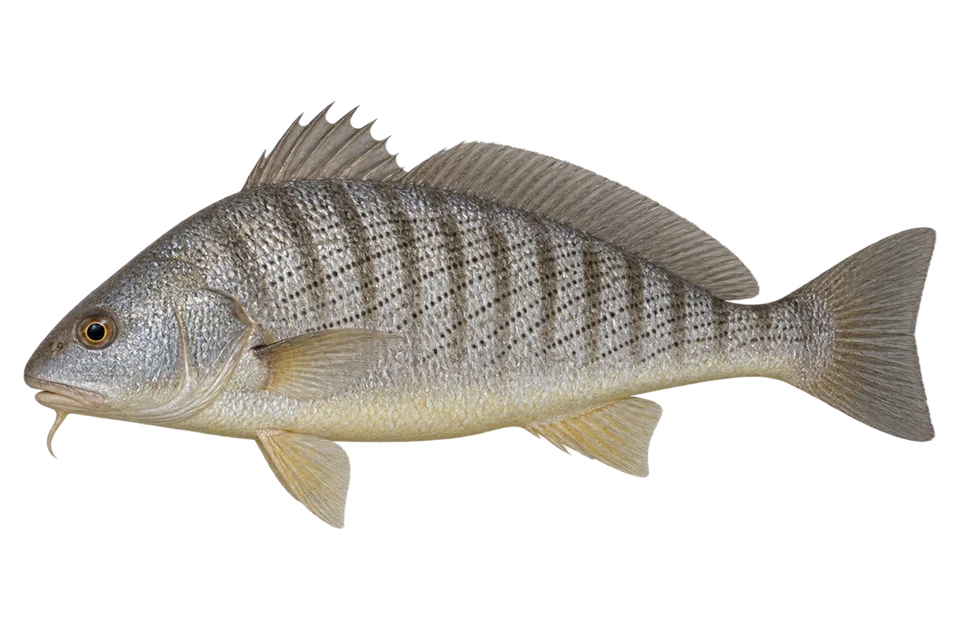
A small silver drum with a single stubby chin barbel under its downward-facing mouth.
One fun thing to know
The short chin barbel has a tiny opening at its tip, a detail more easily seen on a specimen than underwater.
How to identify it
- The back arches high behind a low, blunt head.
- Dusky bars cross the upper sides alongside wavy dotted lines that run diagonally under the front dorsal.
- Look for one short stiff filament below the chin, not a tuft of several.
Where to look
Sandy beach bottoms, mud near estuaries, and occasionally reef edges. The Lake Worth Lagoon list and a museum specimen from Boca Chica Key document South Florida occurrence.
Size
13.8 in (35 cm). reported length; measurement convention not stated in the cited field account.
What it eats
Eats small bottom crustaceans.
Behavior
Look low over sand rather than out in the water column. A steady side view makes the chin filament and line angles easier to see.
Reproduction
Eggs and larvae drift in open water. This guide does not establish a local spawning season.
Look-alikes
Other drums can have chin barbels. Use the single short barbel with the oblique lines beneath the front dorsal and the arched nape.
Can you collect or eat it?
Enjoy watching it and leave it in the water. This guide does not verify species-specific harvest or food-safety rules. Check the current rules for the exact location, species and method before taking anything, and never collect where prohibited.
Check Florida’s current saltwater rules
Field references
- REEF field survey reference 1
- Smithsonian Shorefishes reference 2
- Smithsonian Shorefishes reference 3
- Florida Museum of Natural History reference 4
- biogator.org reference 5
- fao.org reference 6
I saw this and want to share
Make your next dive happen
Dive with Stuart Scuba · Train with us · Travel with us · Shop with us



