


Sailfin Shrimpgoby
Amblyeleotris randalli
Six things worth noticing
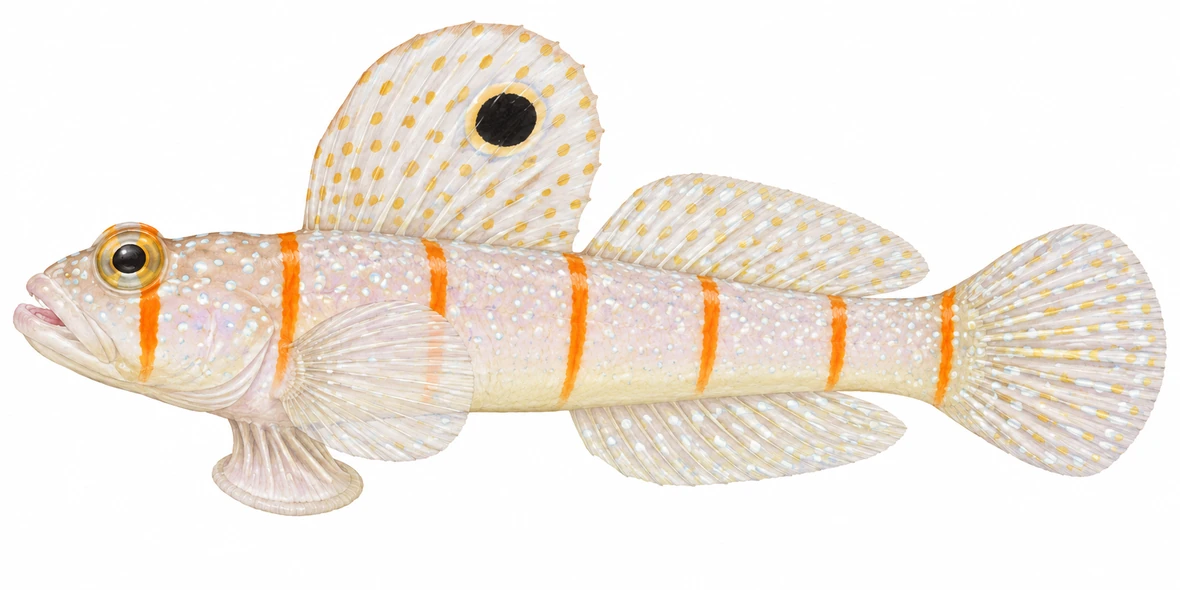
- The dark circle on the first dorsal fin is an eyespot. The fish’s real eye is up near the top of its head.
- The raised first dorsal can be taller than the fish’s body is deep. Wait for it to open rather than moving closer to make it react.
- The original description notes that the upper rays of the tail are longer than the lower rays, making the tip a little uneven.
- Even the smaller second dorsal has a pattern. One freshly examined specimen had rows of blue marks, some edged in orange.
- This goby shares a burrow with an alpheid snapping shrimp. Watch the entrance and you may get a look at both animals without moving a grain of sand.
- The 1978 description included a museum specimen collected at Augulpelu Reef in Palau. The fish is named for ichthyologist John E. Randall.
How to identify it
A whitish goby crossed by seven narrow orange bars, with small pale spots and a conspicuous black eyespot in the first dorsal fin.
Where to look
Sand and rubble adjoining reefs. The published depth range is 5–48 m; the fish reaches about 11 cm total length.
Natural history
Shares a burrow with an alpheid shrimp. Watch the entrance rather than pursuing the fish: the partnership is easiest to appreciate when both animals resume their normal activities.
Look-alikes
Other orange-barred shrimpgobies lack this particular combination of narrow bars and a large first-dorsal eyespot. Record the erect fin when it opens naturally.
What to watch for underwater
Try a quiet hover over bare sand, well clear of the entrance. That’s the sort of steady position you practice in Advanced Buoyancy Control. Stay put and let the fish or shrimp decide when to reappear.
Recorded in Raja Ampat
This species has a published Raja Ampat record. A regional record does not guarantee a sighting on a particular dive.
I saw this and want to share
Back to Raja Ampat Fish ID · Dive Raja Ampat with Stuart Scuba




