


← Back to South Florida Fish ID
Rough Fileclam
Ctenoides scaber · Limidae
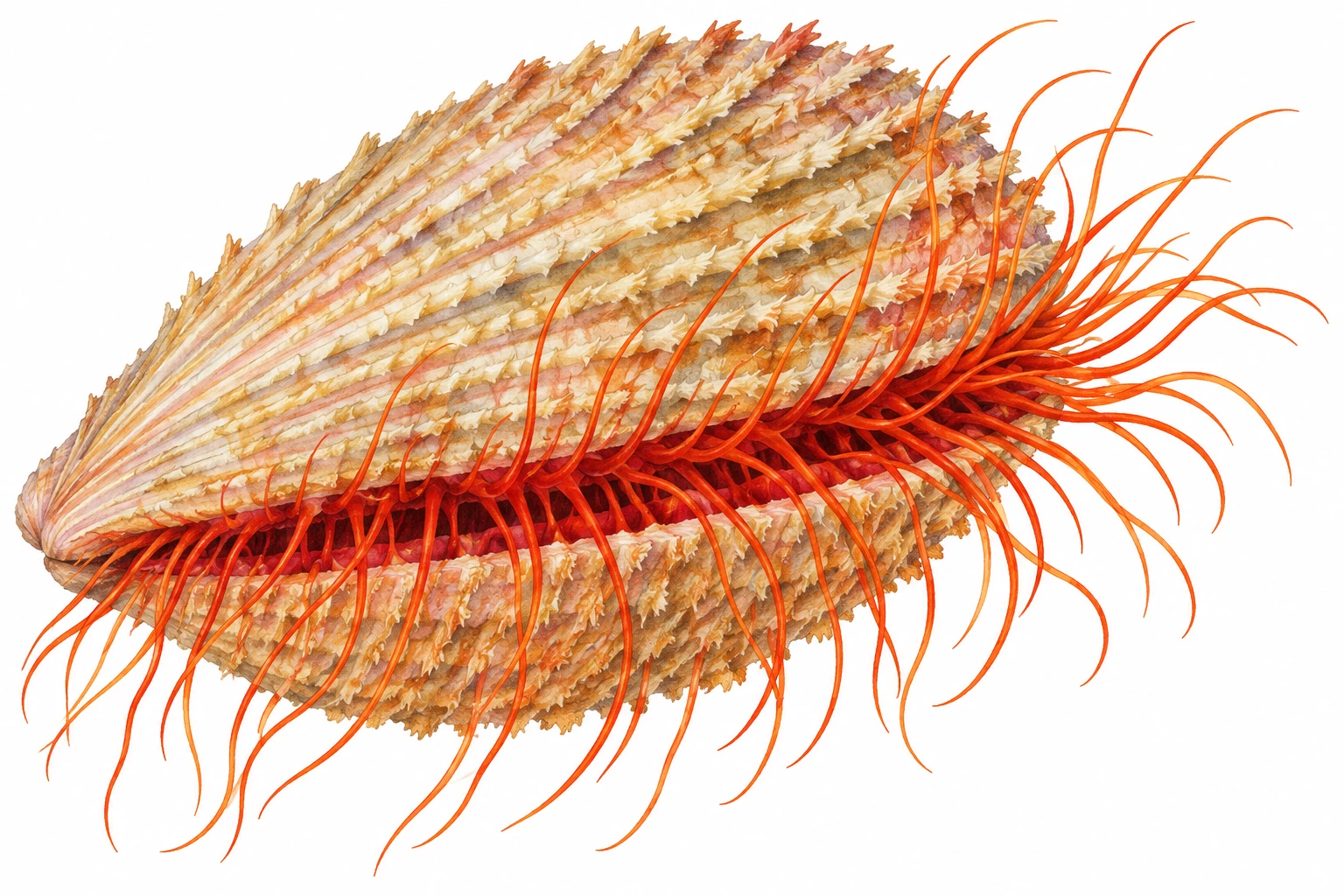
A red or orange fringe may be the only thing visible in a crack. Look for a narrow opening between two shells behind the waving tentacles.
One fun thing to know
Despite “flame scallop,” this is a fileclam, not a true scallop. It can still swim in short bursts by clapping its valves.
I saw this and want to share
To share this guide with a dive buddy, copy the page link.
How to identify it
- Long mantle tentacles around the shell opening, often red-orange in Keys specimens
- Pale, flattened shell taller than wide, with fine radial ridges
- Shell usually partly hidden; color alone cannot confirm the species
Where to look
Recorded in Florida Keys material examined by the taxonomic and genetic studies; look in reef cracks and other protected hard-bottom sites.
Size
Shell can reach about 2.6 in (67 mm).
What it eats
Filter feeder: the gills trap suspended microscopic food such as plankton and organic particles.
Behavior
Usually stays tucked into a dark recess, where its exposed mantle fringe makes it easier to see than the shell itself.
Reproduction
Marine bivalves commonly develop through free-swimming larvae before settling; Florida spawning dates for this species were not verified.
Look-alikes
The smooth fileclam (Ctenoides mitis) can look similar, and tentacle colors overlap. Shell rib counts separated samples in one study, but divers should not remove or handle an animal to count them.
Can you collect or eat it?
Observe and leave in place. Check the Florida Fish and Wildlife Conservation Commission’s shell-collecting rules and local protected-area restrictions before removing a live shell.
Check current species and site rules before collecting. This guide does not establish permission to collect.
Make your next dive happen
Dive with Stuart Scuba · Train with us · Travel with us · Shop with us



