


← Back to South Florida Fish ID
Regal Demoiselle
Neopomacentrus cyanomos · Pomacentridae
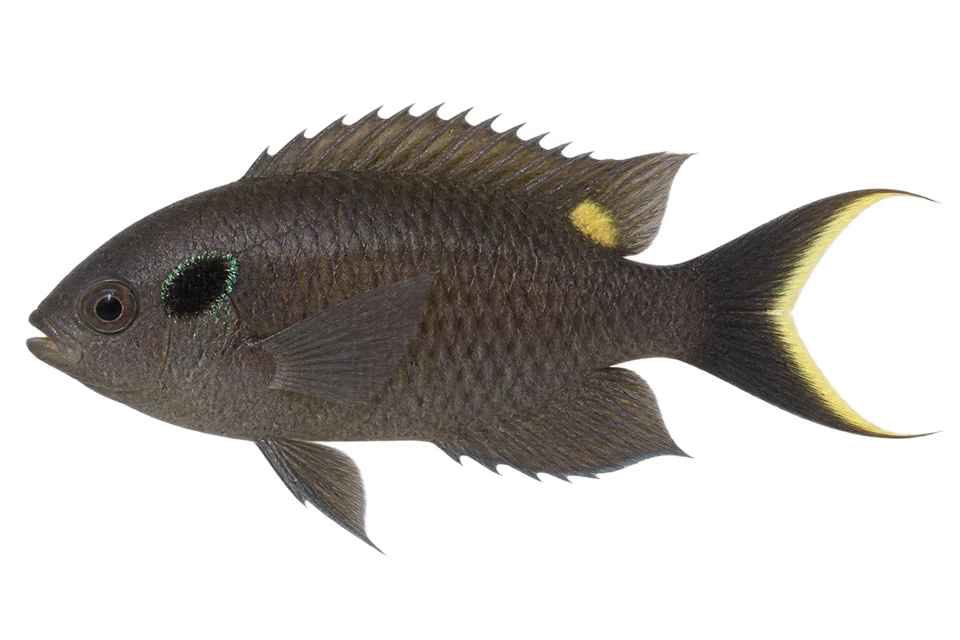
Check the shoulder and tail together: a dark spot high on the gill cover, a yellow patch behind the dorsal fin and a deeply notched pale-edged tail.
Raja Ampat field notes: facts to notice underwater
Also recorded in Raja Ampat. Neopomacentrus cyanomos appears in the regional reef-fish checklist. Regional presence does not predict a sighting on a particular dive or establish how common it is today.
A tiny fish can occupy an enormous ecological role. Regal demoiselles belong to a genus of slender damselfishes that takes zooplankton from the water rather than simply grazing the reef.
Look for the forked tail and the way a feeding group hangs above shelter. Position in the water column is part of the identification story, not just background scenery.
Try this on your dive: From a stationary position, watch whether the group faces the same direction as it feeds.
The Florida context and harvest guidance elsewhere on this page do not establish rules or permissions in Indonesia. Observe without disturbing.
Sources: Allen & Erdmann, regional occurrence; Biology reference. Raja notes reviewed November 18, 2026.
One fun thing to know
This non-native damselfish has been documented by both community divers and USGS, including repeated records at Blue Heron Bridge.
How to identify it
- Gray to dark brown with a large black oval high on the gill cover, sometimes with a greenish sheen.
- Prominent pale yellow or whitish patch at the rear dorsal base.
- Strongly notched tail with a pale to yellowish crescent, not a solid yellow tail across all fish.
Where to look
Native to the Indo-Pacific and introduced to the Tropical Western Atlantic. USGS documents records at Blue Heron Bridge, including a collected local fish.
Size
3.9 in (10 cm). Published upper size; measurement type not specified.
What it eats
Feeds on small drifting prey. No particular local diet is inferred from the sighting records.
Behavior
Look for the dark gill-cover spot and the tail shape together. Photograph sightings from a safe distance rather than trying to catch the fish.
Reproduction
Local spawning timing at Blue Heron Bridge is not established in the sources used here.
Look-alikes
Compare the native Brown Chromis and Yellowtail Reeffish. The yellowtail reeffish has a blue streak over the eye and a less deeply forked tail.
Can you collect or eat it?
Enjoy watching it and leave it in the water. This guide does not verify species-specific harvest or food-safety rules. Check the current rules for the exact location, species and method before taking anything, and never collect where prohibited.
Check Florida’s current saltwater rules
Field references
- Smithsonian Shorefishes reference 1
- REEF field survey reference 2
- australian.museum reference 3
- U.S. Geological Survey reference 4
- U.S. Geological Survey reference 5
- REEF field survey reference 6
I saw this and want to share
Make your next dive happen
Dive with Stuart Scuba · Train with us · Travel with us · Shop with us



