


Raja Ampat Reef Fish Field Notes 1
Surgeonfish, Triggerfish, Fusiliers and Jacks
Look for field marks and compare them with your dive notes. A Raja Ampat record is not a promise of a sighting at a particular dive site. Observe without touching, feeding or chasing.
Back to Raja Ampat Fish ID search
Blackspot Surgeonfish
Acanthurus bariene · Acanthuridae · Raja Ampat, Indonesia
- Look behind the eye for a round black spot nearly the size of the eye itself.
- An orange-yellow bar descends just behind the spot; the orange-yellow dorsal fin is edged in blue.
- A Raja Ampat fish survey lists a depth range of 15–50 m for this species.
Horseshoe Surgeonfish
Acanthurus fowleri · Acanthuridae · Raja Ampat, Indonesia
Also indexed as: Fowler’s Surgeonfish.
- A horseshoe-like dark mark opens toward the head above the pectoral fin.
- A white band at the tail base continues into yellow on each lobe, complementing a purplish head.
Whitelip Surgeonfish
Acanthurus leucocheilus · Acanthuridae · Raja Ampat, Indonesia
- Look for the thin white line behind the lower lip and a sequence of dark, pale, then broader dark bands under the head.
- The white tail-spine sheath contrasts with its black socket; the tail has a narrow pale base band.
Spotted-face Surgeonfish
Acanthurus maculiceps · Acanthuridae · Raja Ampat, Indonesia
- Small yellow dots on the head and nape contrast with an elongated dark shoulder mark.
- The pectoral fin has a yellow spot near its upper tip; orange-yellow and dark stripes alternate on the dorsal fin.
Whitecheek Surgeonfish
Acanthurus nigricans · Acanthuridae · Raja Ampat, Indonesia
- A small horizontal white mark sits directly beneath the eye on a dark body.
- Unlike the similarly patterned Japanese surgeonfish, it lacks the large white eye-to-lip band and orange stripe near the dorsal-fin edge.
Bluemasked Surgeonfish
Acanthurus nubilus · Acanthuridae · Raja Ampat, Indonesia
- On the blue-grey face, close-set spots become fine horizontal lines farther back.
- This surgeonfish has six or seven dorsal spines, fewer than the eight or nine in most regional congeners.
Convict Surgeonfish
Acanthurus triostegus · Acanthuridae · Raja Ampat, Indonesia
- Clean, narrow black bars cross a pale body; one bar passes through the eye.
- The small tail-base spine and shallow tail notch help separate it from strongly crescent-tailed surgeonfishes.
Yellowfin Surgeonfish
Acanthurus xanthopterus · Acanthuridae · Raja Ampat, Indonesia
- Look for yellow on the outer portion of the pectoral fin, especially on larger fish.
- The tail is distinctly crescent-shaped, and blue-grey lines parallel the borders of the orange-brown dorsal and anal fins.
Bluelip Bristletooth
Ctenochaetus cyanocheilus · Acanthuridae · Raja Ampat, Indonesia
- Look for blue lips, a narrow dull yellow eye rim and fine bluish lines following the scale rows.
- Tiny pale yellow speckles concentrate near the face and chest; the species name refers to its blue lips.
Whitemargin Unicornfish
Naso annulatus · Acanthuridae · Raja Ampat, Indonesia
- A pale border at the back of the tail is the best first cue on a large adult.
- Compare its smooth back profile with the hump of the Humpback Unicornfish; long tail filaments develop in large males.
- A Raja Ampat fish survey lists a depth range of 15–40 m for this species.
Humpback Unicornfish
Naso brachycentron · Acanthuridae · Raja Ampat, Indonesia
- Look for a conspicuous hump above the front of the soft dorsal fin and a sloping face.
- Adult males grow a long forehead horn; females instead retain a bump.
Spotted Unicornfish
Naso brevirostris · Acanthuridae · Raja Ampat, Indonesia
Also indexed as: Shortnose Unicornfish.
- The adult horn reaches well ahead of the mouth; the whitish tail has a dark patch near the base.
- Dark speckles and vertical lines can be subtle in a pale color phase, so confirm the short, steep snout beneath the horn.
Bluetail Unicornfish
Naso caeruleacauda · Acanthuridae · Raja Ampat, Indonesia
- A blue tail and absence of fine dark flank bars distinguish it from the Oneknife Unicornfish.
- Despite the name unicornfish it lacks a forehead horn and carries only one fixed keel per side at the tail base.
Elongate Unicornfish
Naso lopezi · Acanthuridae · Raja Ampat, Indonesia
- This particularly slender unicornfish does not develop a horn.
- Look for small dark spots concentrated high on the head and body and continuing onto the tail.
Squarenose Unicornfish
Naso mcdadei · Acanthuridae · Raja Ampat, Indonesia
- Adults have an angular forehead projection rather than a pointed horn.
- Two keeled bony plates sit on each side of the tail base; its upper body is often bluish to olive grey.
Blackspine Unicornfish
Naso minor · Acanthuridae · Raja Ampat, Indonesia
- Look for a yellow tail on a slender unicornfish without a forehead horn.
- A single fixed plate on each side of the tail base distinguishes it from the two-plated forms; a short oblique groove sits below the nostrils.
Oneknife Unicornfish
Naso thynnoides · Acanthuridae · Raja Ampat, Indonesia
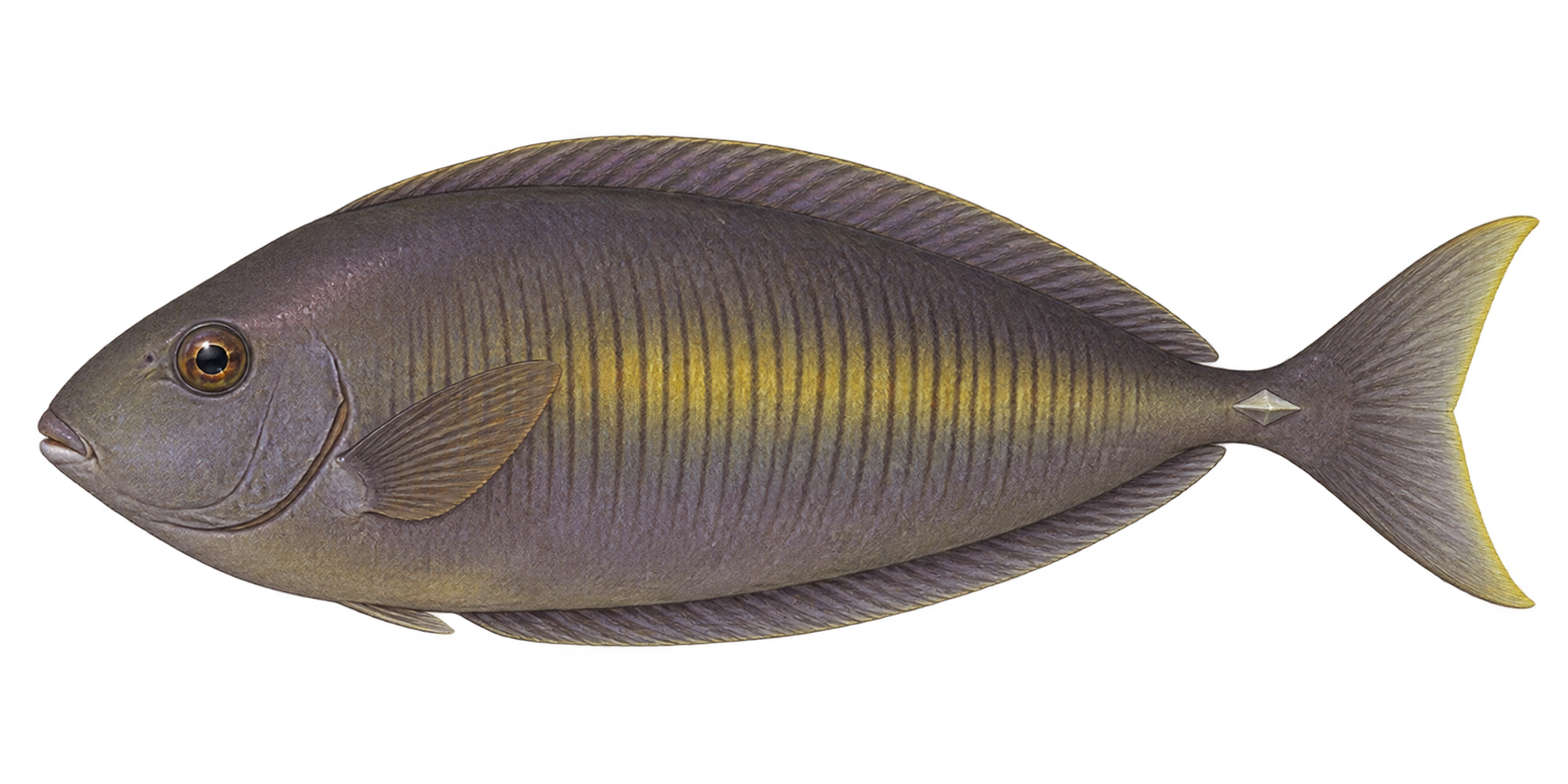
- A series of delicate dark bars crosses the body; the tail is grey rather than vivid blue or yellow.
- The name refers to one keel per side of the tail base; the head has no horn.
Humpnose Unicornfish
Naso tonganus · Acanthuridae · Raja Ampat, Indonesia
- Look for the rounded, bulbous projection on the front of a large adult’s head.
- The profile also shows a hump on the back and two bony keel plates on each side of the tail base.
Bluespine Unicornfish
Naso unicornis · Acanthuridae · Raja Ampat, Indonesia
- The adult horn does not project beyond the mouth; bright blue tail-base plates are a useful second clue.
- Adult tail corners can develop narrow filaments; the body normally lacks the conspicuous dark spots of Spotted Unicornfish.
Starry Triggerfish
Abalistes stellatus · Balistidae · Raja Ampat, Indonesia
Also indexed as: Abalistes stellaris, Flat-tailed Triggerfish.
- The flattened tail base is wider than it is deep, a useful structural clue in addition to its spotted pattern.
- Large pale spots are conspicuous along the side, beneath the regularly arranged plates of thick scales.
Spotted Oceanic Triggerfish
Canthidermis maculata · Balistidae · Raja Ampat, Indonesia
Also indexed as: Canthidermis maculatus, Rough Triggerfish.
- Small pale spots pepper the sides of the dark compressed body.
- Unlike bottom-oriented reef triggerfishes, this species is frequently seen in the open water column; the cheek lacks the pronounced naked grooves of Xanthichthys.
Yellowmargin Triggerfish
Pseudobalistes flavimarginatus · Balistidae · Raja Ampat, Indonesia
- Look for a strongly built triggerfish with yellow-orange borders on the soft dorsal, anal and tail fins.
- Unlike the Rippled Triggerfish, the soft dorsal and anal fins are not strongly raised at the front.
- A Raja Ampat fish survey lists a depth range of 2–50 m for this species.
Rippled Triggerfish
Pseudobalistes fuscus · Balistidae · Raja Ampat, Indonesia
- Adults show wavy blue lines over the body; the front lobes of the soft dorsal and anal fins are noticeably raised.
- A groove extends forward from the eye, and the tail base lacks the spiny rows seen in some other triggerfishes.
Picasso Triggerfish
Rhinecanthus aculeatus · Balistidae · Raja Ampat, Indonesia
- Look for sharp blue and dark facial markings and a tail base armed with short rows of little spines.
- The body lacks the large dark belly oval that marks the Blackbelly Triggerfish.
- A Raja Ampat fish survey lists a depth range of 0–3 m for this species.
Wedge-tail Triggerfish
Rhinecanthus rectangulus · Balistidae · Raja Ampat, Indonesia
- A wide black band slants from the eye toward the anal fin.
- A second dark mark at the tail base forms a pointed triangle reaching forward onto the side.
Blackbelly Triggerfish
Rhinecanthus verrucosus · Balistidae · Raja Ampat, Indonesia
- The large oval black patch on the lower flank distinguishes it from Picasso Triggerfish.
- The lowest of the three forward-pointing spine rows on the tail base is much shorter than the upper rows.
Halfmoon Triggerfish
Sufflamen chrysopterum · Balistidae · Raja Ampat, Indonesia
- The dark tail is conspicuously outlined in white along the back and outer rays.
- Unlike the Scythe Triggerfish, it lacks two curved dark bars next to the gill opening.
Masked Triggerfish
Sufflamen fraenatum · Balistidae · Raja Ampat, Indonesia
- The tail is uniformly dark, not bordered with prominent white as in the Halfmoon Triggerfish.
- It lacks the paired curved dark bars beside the gill opening that characterize the Scythe Triggerfish.
Bluechin Triggerfish
Xanthichthys auromarginatus · Balistidae · Raja Ampat, Indonesia
Also indexed as: Gilded Triggerfish.
- Male blue throat coloration can be conspicuous; compare the abrupt cheek color change rather than just the slender outline.
- The cheek grooves are faint and unpigmented; raised scale ridges run lengthwise on the body.
Lunar Fusilier
Caesio lunaris · Caesionidae · Raja Ampat, Indonesia
- Look for a rather deep-bodied blue fusilier without a conspicuous flank stripe.
- The forked blue tail ends in black tips and the pectoral-fin base has a small black mark.
Mottled Fusilier
Dipterygonotus balteatus · Caesionidae · Raja Ampat, Indonesia
- A fine tan stripe above the lateral line crosses the bronze upper side.
- The dorsal fin has a deep notch that sets it apart from many other fusiliers.
Slender Fusilier
Gymnocaesio gymnoptera · Caesionidae · Raja Ampat, Indonesia
- The fish has a narrow yellow or brown stripe and a bluish-green back with pale scale centers.
- Unlike many fusiliers, the dorsal and anal fins are not covered in scales.
Doublelined Fusilier
Pterocaesio digramma · Caesionidae · Raja Ampat, Indonesia
- Two stripes cross a blue-green back above the white belly.
- The lower stripe begins below the lateral line, then crosses over it on its way to the tail; this subtle position differs in Marr’s Fusilier.
Wideband Fusilier
Pterocaesio lativittata · Caesionidae · Raja Ampat, Indonesia
- Look for a broad bright yellow stripe that begins at the snout and thins markedly near the tail.
- The stripe spans several scale rows on the flank, making it wider there than the single stripe of a Onestripe Fusilier.
Marr’s Fusilier
Pterocaesio marri · Caesionidae · Raja Ampat, Indonesia
- Two very narrow stripes cross the blue-green flank above a white belly.
- Unlike the Doublelined Fusilier, its lower stripe rides on the lateral line for much of its length before rising above it at the tail base.
Randall’s Fusilier
Pterocaesio randalli · Caesionidae · Raja Ampat, Indonesia
- A variable yellow blotch above the pectoral region looks more like a slanted patch than a continuous stripe.
- The upper body can look blue-green or reddish, so the outline of the yellow marking is more useful than background color.
Onestripe Fusilier
Pterocaesio tessellata · Caesionidae · Raja Ampat, Indonesia
- Look for one narrow yellow stripe and a pale underbody.
- Uneven rows of light-centered upper scales can resemble a mosaic, a useful backup clue.
Darkbanded Fusilier
Pterocaesio tile · Caesionidae · Raja Ampat, Indonesia
- Find the thin dark side stripe and the vivid pale blue zone beneath it.
- Dark scale margins give the upper body a checkered pattern that is easiest to see in a close side view.
Yellowtail Scad
Atule mate · Carangidae · Raja Ampat, Indonesia
- Faint grey bars cross the upper sides; look for a dark mark on the upper gill cover and green-yellow tail.
- A transparent eyelid covers much of the eye, leaving a vertical slit around the pupil.
Shadow Trevally
Carangichthys dinema · Carangidae · Raja Ampat, Indonesia
Also indexed as: Carangoides dinema.
- The second dorsal fin has a drawn-out front lobe, often longer than the head.
- Small brown marks run along the base of that fin, and the upper tail lobe can be yellowish.
Yellowspotted Trevally
Turrum fulvoguttatum · Carangidae · Raja Ampat, Indonesia
Also indexed as: Carangoides fulvoguttatus.
- Look for many small brass or gold spots concentrated above the middle of the flank.
- Large adults sometimes also show three irregular dark flank blotches; the small gold spots are the more consistent cue.
Barcheek Trevally
Craterognathus plagiotaenia · Carangidae · Raja Ampat, Indonesia
Also indexed as: Carangoides plagiotaenia.
- Check the dark rear edge of the cheek plate and a lower jaw that juts forward.
- The silver sides may show a series of oblique dusky bars, mainly above the midline.
Brassy Trevally
Caranx papuensis · Carangidae · Raja Ampat, Indonesia
- A conspicuous pale spot just behind the upper edge of the gill cover helps identify adults.
- Small black upper-side spots develop with size; the back is brassy or yellow-green rather than electric blue.
Talang Queenfish
Scomberoides commersonnianus · Carangidae · Raja Ampat, Indonesia
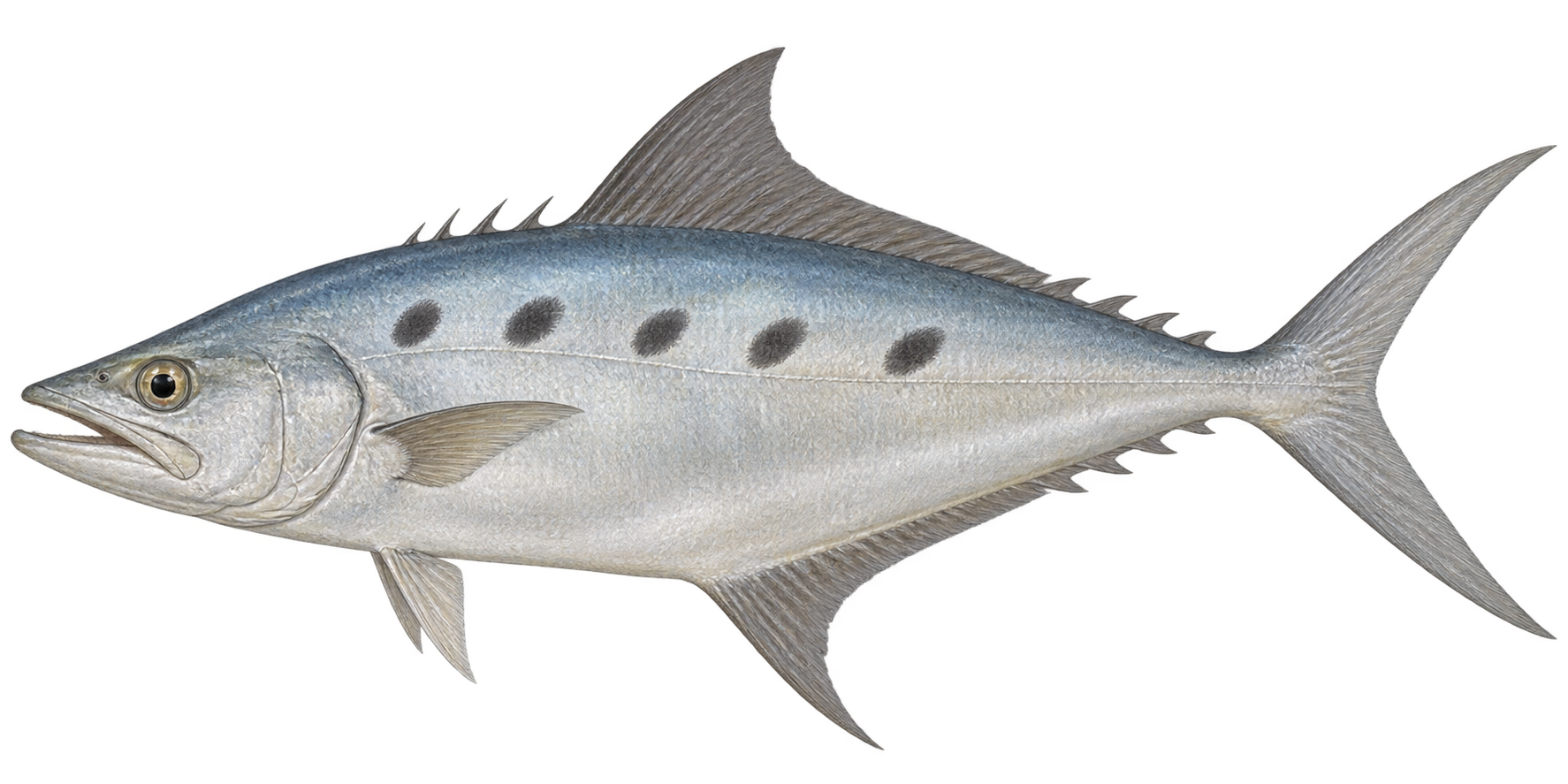
- The long, compressed body displays a single series of large dark flank marks at or above the lateral line.
- The blunt head and upper jaw extending well past the eye help distinguish adults from Doublespotted Queenfish.
Doublespotted Queenfish
Scomberoides lysan · Carangidae · Raja Ampat, Indonesia
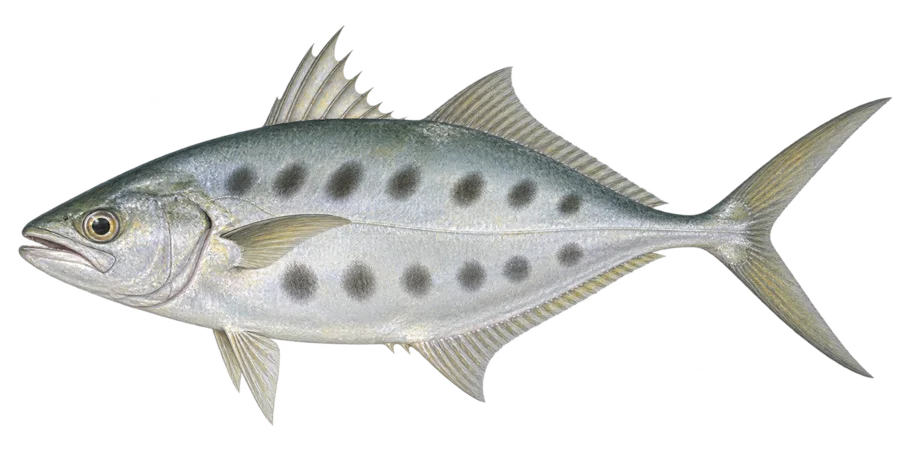
- Adults show dark spots both above and below the lateral line; younger fish may show them faintly.
- The front lobe of the dorsal fin has a dark outer half, and the head is more pointed than that of Talang Queenfish.
Oxeye Scad
Selar boops · Carangidae · Raja Ampat, Indonesia
- A very large eye has a transparent covering interrupted by a narrow vertical pupil slit.
- Look for a small dark mark on the gill cover; the flank stripe, when present, is narrower than on the Yellowstripe Scad.
Yellowstripe Scad
Selaroides leptolepis · Carangidae · Raja Ampat, Indonesia
- A broad yellow side stripe extends from the upper edge of the eye to the tail base.
- A prominent black mark straddles the gill-cover edge and shoulder; the upper jaw has no teeth.
Smallspotted Dart
Trachinotus baillonii · Carangidae · Raja Ampat, Indonesia
- Look for a row of small dark flank spots on a compressed silver body.
- Very young fish may lack the spots; on larger fish the front anal-fin lobe is longer than the front dorsal-fin lobe.
Snubnose Pompano
Trachinotus blochii · Carangidae · Raja Ampat, Indonesia
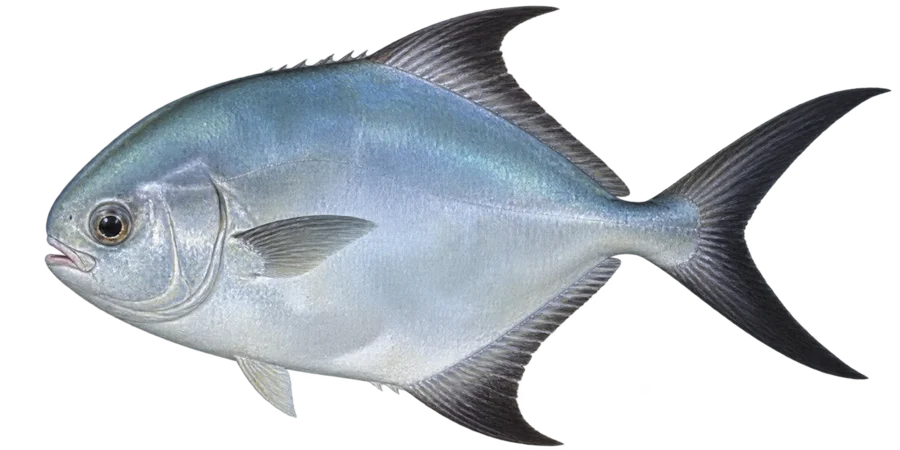
- A broadly rounded snout and tall, swept dorsal and anal lobes make a good first impression.
- The fish is silver when young; large adults may take on rich gold-orange tones, especially around the snout and lower body.
Longrakered Trevally
Atropus mentalis · Carangidae · Raja Ampat, Indonesia
Also indexed as: Ulua mentalis.
- Large adults develop a projecting chin and can show a dusky mark near the angle of the jaw.
- The extremely long, feather-like gill rakers extend into the mouth alongside the tongue, the source of its common name.
Search more Raja Ampat fish · Explore Stuart Scuba dive travel · Dive with Stuart Scuba · Shop dive gear




