


← Back to South Florida Fish ID
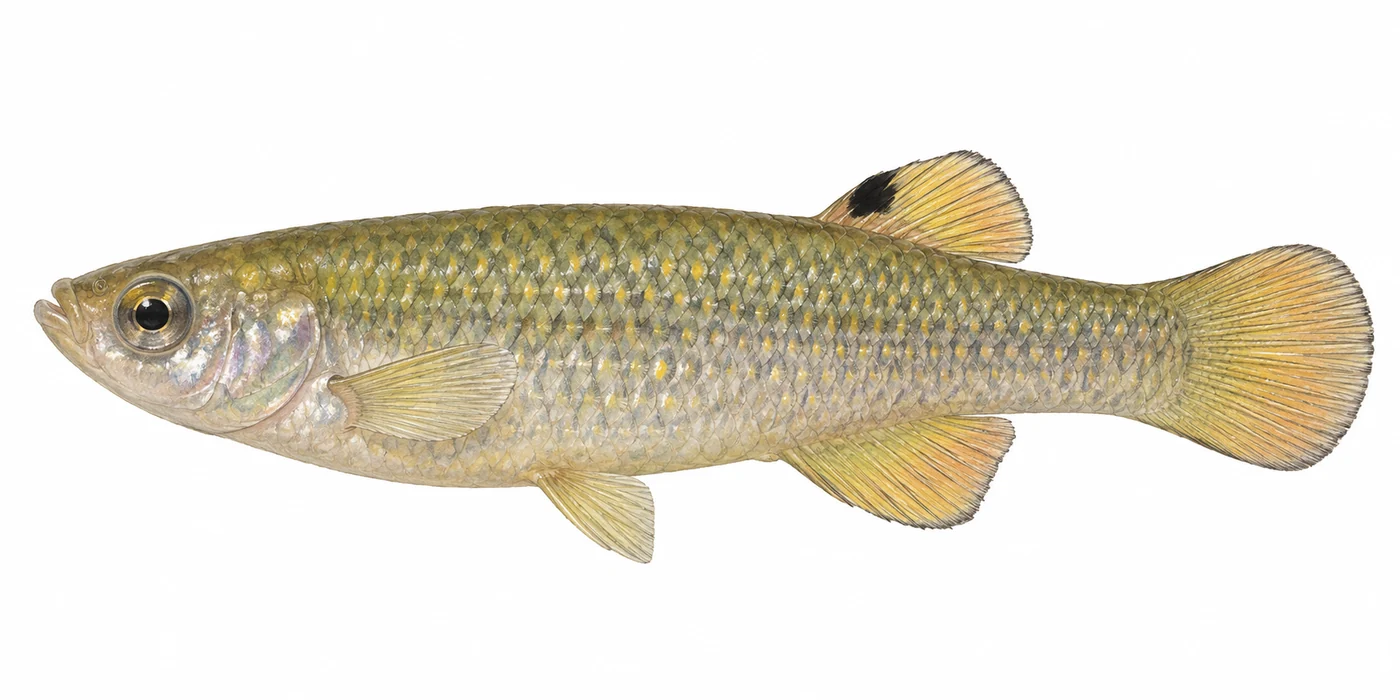
Rainwater Killifish
Lucania parva · Fundulidae
Check shallow, quiet margins with submerged vegetation for this tiny, diamond-scaled fish.
One fun thing to know
Despite its name, this killifish naturally occupies both coastal salt water and freshwater sites.
I saw this and want to share
To share this guide with a dive buddy, copy the page link.
How to identify it
- Large dark-edged scales make a faint diamond mesh
- Large males can show a dark spot at the front of the orange-brown dorsal fin
- Small slim body and upturned mouth
Where to look
Native to the Atlantic and Gulf coasts, including the Florida Keys; documented in Biscayne National Park.
Size
A small fish, up to about 6 cm (2.4 in).
What it eats
Small invertebrates, including tiny crustaceans and insect larvae.
Behavior
Often stays close to aquatic plants over sand or mud in shallow water.
Reproduction
Females lay eggs on vegetation or similar structure; they are not livebearers.
Look-alikes
Bluefin Killifish is close. In conspicuous males, compare the fin colors and front dorsal spot; use the scale pattern and habitat as supporting rather than sole clues.
Can you collect or eat it?
This is an identification guide, not a harvest determination. verify current Florida harvest rules for the species, gear and intended use before taking it; check park and sanctuary zones separately.
Check current species and site rules before collecting. This guide does not establish permission to collect.
Make your next dive happen
Dive with Stuart Scuba · Train with us · Travel with us · Shop with us



