


Fish identification archive / Raja Ampat
Raccoon Butterflyfish
Chaetodon lunula
Raja Ampat field guide
Two things to tell your dive buddy
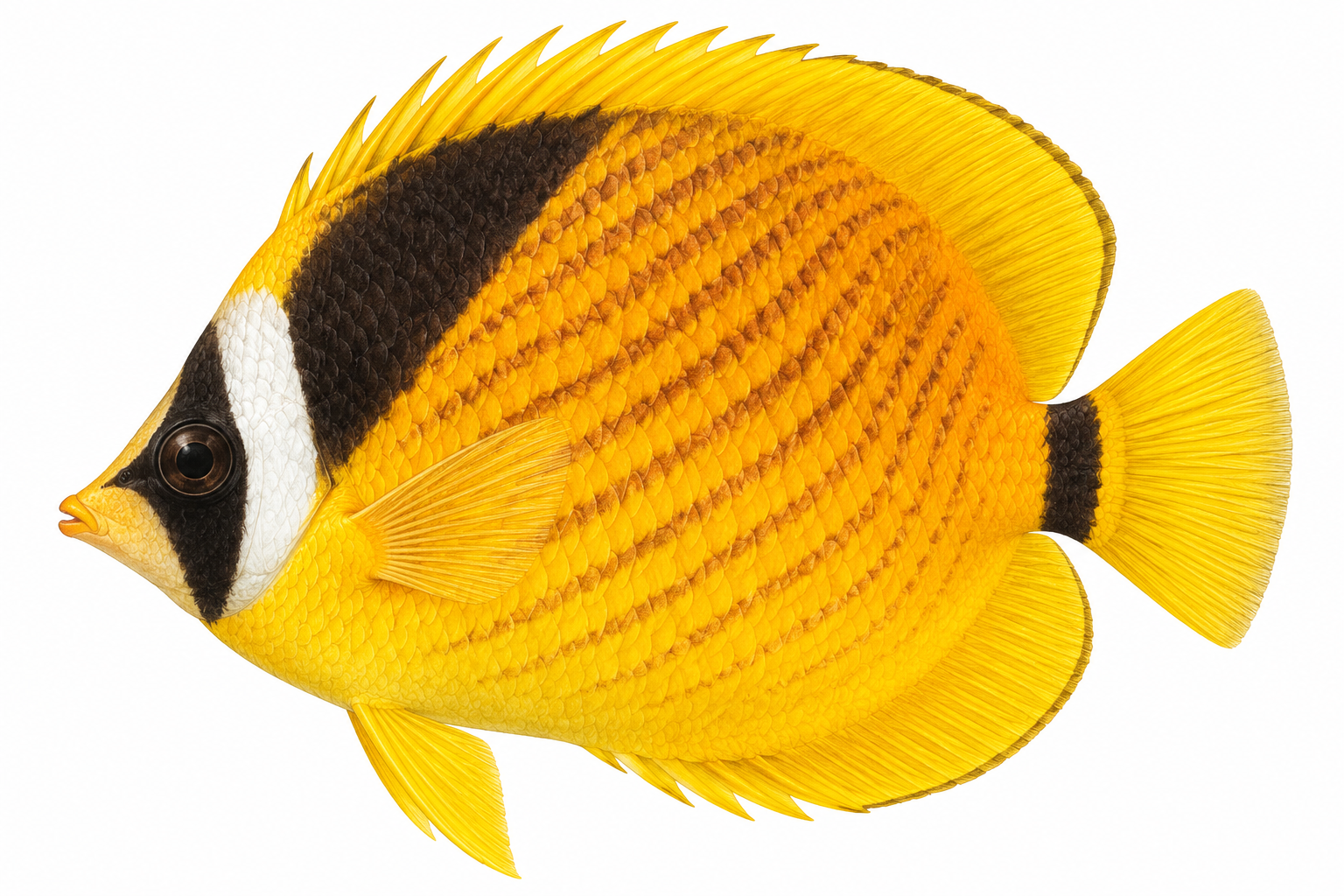
- The raccoon comparison comes from the face, not its habits: black-and-white head markings supply the name.
- The mask is only part of the pattern. Diagonal lines on the lower body and a dark patch at the tail base provide useful additional evidence.
How to identify it
Yellow-orange butterflyfish with a black eye mask, white band behind it, diagonal dark shoulder band and dark tail-base mark.
Habitat and where to look
Lagoons and outer reef slopes, including shallow reef-flat habitats.
Daily habits and behavior
Often active after dark; the face mask is a useful daytime identification feature even when the fish is not feeding.
What is on the menu?
Small invertebrates. Do not assume that every butterflyfish is exclusively dependent on live coral.
Mating and the next generation
Forms pairs to breed. Observing two fish together does not by itself establish that spawning is occurring.
Look-alikes and identification traps
Distinguish it from other masked butterflyfishes by combining the white band behind the eye mask, diagonal shoulder bar and dark tail-base mark.
Try this observation
Try identifying it first from the face, then confirm the shoulder and tail-base markings.
Raja Ampat occurrence
Recorded in Raja Ampat; regional occurrence does not guarantee an encounter on a particular dive. This guide does not imply that every site, itinerary or season offers the same chance of an encounter.
Observe, do not disturb
Keep a respectful distance, leave the animal an unobstructed route and follow your dive guide. Do not touch, feed, chase or collect wildlife. Identification does not establish permission to harvest or food safety; Florida harvest labels do not apply to this Indonesian guide.
Sources and review
Reviewed November 18, 2026.
Find the pale stripe beside the dark eye mask
A broad black stripe covers the eye, with a sharp white stripe immediately behind it. A second dark stripe angles from the gill cover toward the upper back, which helps distinguish this pattern from a simple eye bar.
Practice reading the whole facial pattern instead of stopping at one mark in SDI Reef Fish Identification.
Make your next dive happen
Dive With UsTrain With UsExplore the Raja Ampat tripShop With Us
Questions? (772) 600-8288 or info@stuartscuba.com.




