


Purple Flying Gurnard
Dactyloptena orientalis · Dactylopteridae
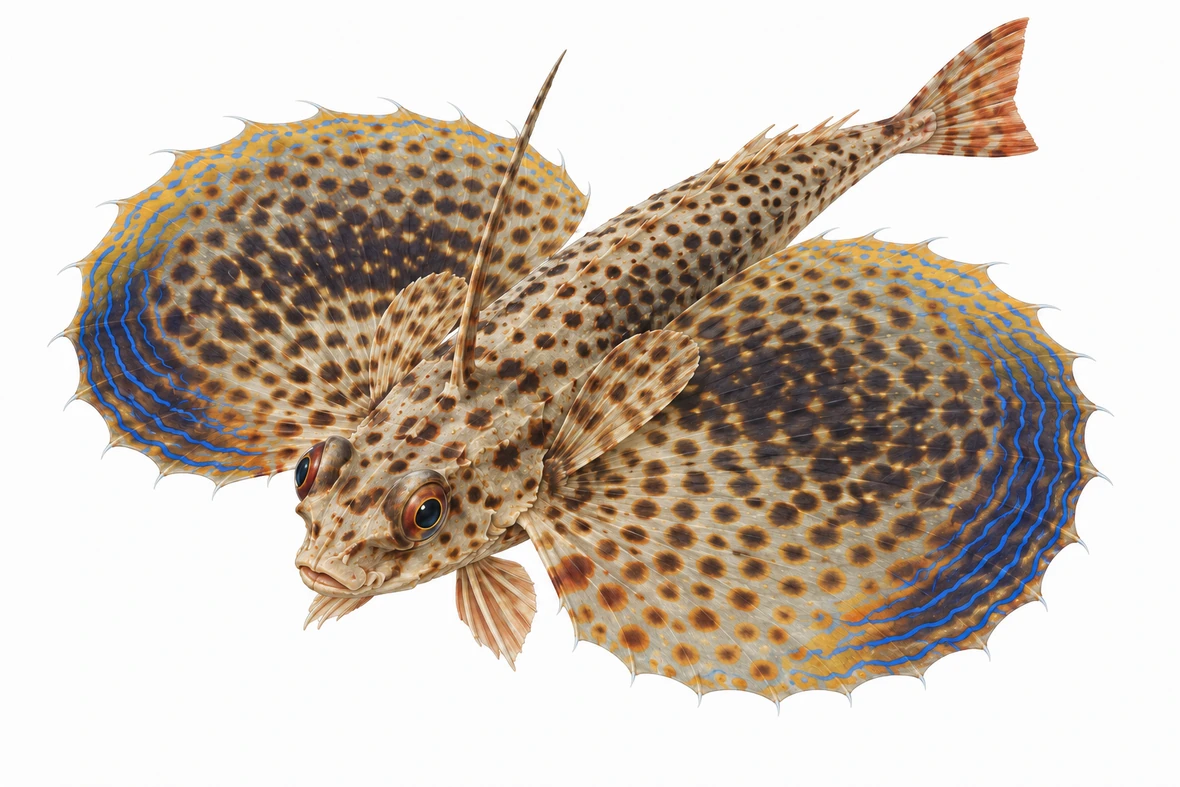
Two details worth remembering
- The wing has more than 30 pectoral rays.
- Those same fins help with slow movement on the bottom as well as changing its apparent size when spread.
How to identify it
A very broad, blunt head leads a spotted and heavily armored body. Its enormous pectorals fold tightly along the sides and can reach the tail base. When spread, the fan makes the fish look several times wider.
Where to look
Look over sandy patches near reef edges, including those around oceanic islands. The undisturbed fish moves deliberately across the bottom using pelvic and pectoral rays.
Natural history
Small crustaceans, bivalves and fish are among its prey. The dramatic pectoral display may be followed by the fish folding the fins and swimming away quickly; it does not fly into the air.
Look-alikes
A seamoth also has winglike fins but is much flatter and has a narrow projecting snout. The gurnard's large, helmetlike head is the useful first distinction.
What to watch for underwater
Notice which fins contact the sand. Do not follow or prod a resting fish to make it unfold.
Recorded in Raja Ampat
This species has a published Raja Ampat record. A regional record does not guarantee a sighting on a particular dive.
- Family
- Dactylopteridae
- Field-guide group
- Flying gurnard
- Also listed as
- Oriental Flying Gurnard, Helmet Gurnard
Sources: fishesofaustralia.net.au species reference · Regional survey record
I saw this and want to share
Back to Raja Ampat Fish ID · Dive Raja Ampat with Stuart Scuba




