


Indo-Pacific Chocolate-Chip Sea Star
Protoreaster nodosus · Oreasteridae · Sea star · Palau Fish ID
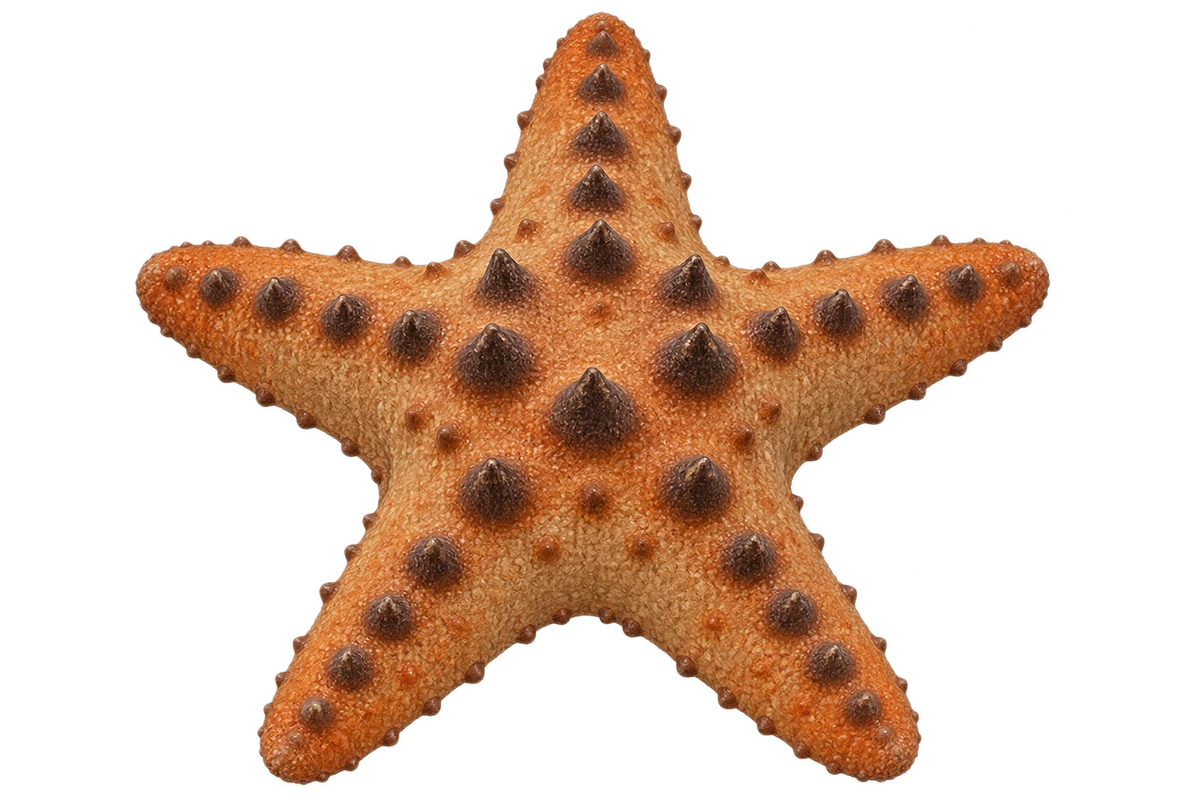
This is one sea star whose nickname makes sense from halfway across a sand patch. The broad arms are studded with raised knobs. Don’t let the resemblance to a cookie distract you from a better clue: look at the shape of the arms and where the knobs sit.
How to recognize it
The arms are fleshy and taper to rounded tips. Prominent knobs stand above the rest of the upper surface. Some individuals are orange, others closer to cream or brown; even the knobs vary in appearance. A tan animal and a redder one can be the same species.
Where to look in Palau
Palau specimens are documented from the shallows near Koror, Cocktail Cove and outside the barrier reef west of Aulong. The older field survey recorded one at Cocktail Cove at 36–39 feet (11–12 m). More recent researchers investigated populations on sandy Palau bottoms and in associated habitats.
Size and life stages
A published Cocktail Cove specimen had a center-to-tip radius of roughly 6 inches (15 cm). This is a single field specimen, not the largest size the species can reach. A photo with the whole animal in frame is more useful than guessing at the scale of two knobs.
What it does all day
Palau researchers observed this sea star feeding on material associated with sand and seagrass, including tiny organisms and surface films. The star can extend its stomach outside its body onto a feeding surface. More than half of the surveyed animals were feeding during daytime observations in that study.
The next generation
One Palau study observed several individuals spawning together in laboratory conditions around a full moon in May. The young were plankton-feeding larvae. That result doesn’t put a spawning event on a dive calendar, but it answers why a neighborhood full of adults may matter.
Look-alikes
The eastern Pacific chocolate-chip sea star in our guide, Nidorellia armata, is a separate species. The Atlantic cushion sea star is different, too. In Palau compare arm length and the distinct raised pegs rather than relying on a name from another region.
Try this on your next dive
Look for an undisturbed one on sand, then back off so your fins do not cloud the water over it. Keep it underwater and in place. A photo with the surrounding habitat helps you remember where you saw it. A slightly lower angle makes the tall knobs easy to see. Practicing that perspective in the SDI Underwater Photographer course can help you show those three-dimensional details.
Six things to notice
- The raised knobs give it the chocolate-chip nickname.
- Palau collections include several color patterns within the same species.
- Some Palau animals were seen in water shallow enough to survey on foot or by snorkel.
- This sea star can place its stomach outside its body while feeding.
- A Palau study found many animals feeding in broad daylight.
- Palau researchers raised swimming, plankton-feeding larvae after observing spawning.
Keep looking through the Palau Fish ID guide, or explore our international group dive trips.




