


Porcupine Ray
Urogymnus asperrimus
Two details worth remembering
- This member of the stingray family lacks the usual venomous tail spine. That is an identification fact, not an invitation to touch it.
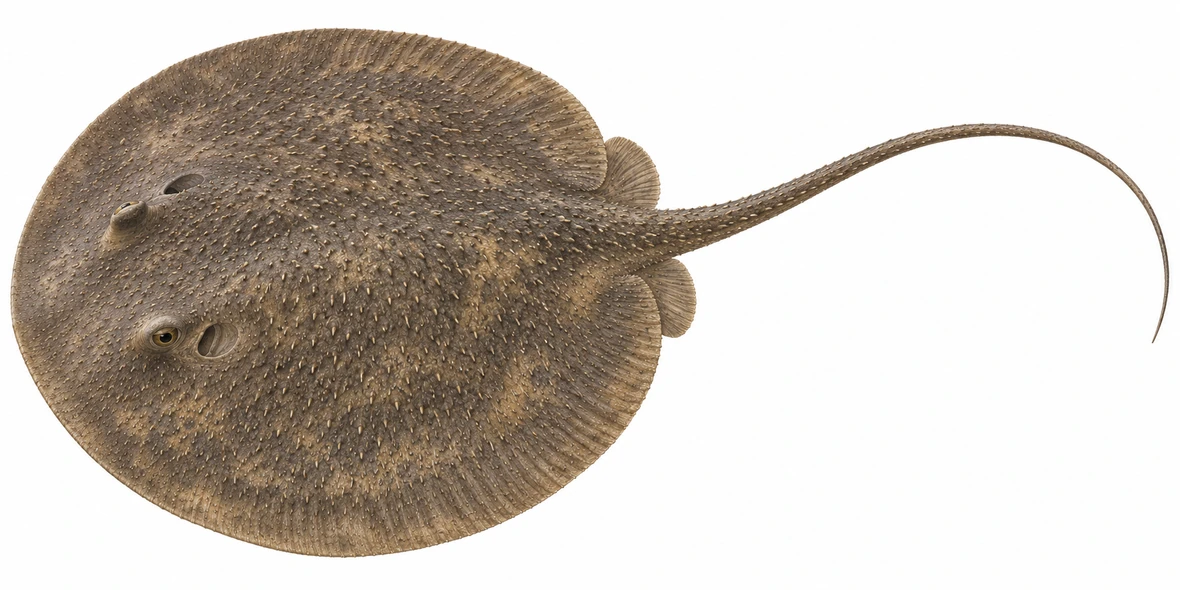
- Its armour is on its back: the rough denticles explain the porcupine name better than the long tail does.
How to identify it
A heavy, oval disc with a rounded front, conspicuously rough upper surface and a long, whip-like tail. The back is grey or brown and the underside pale. Its covering of denticles and thorn-like structures is more useful than colour alone.
Where to look
Sand, rubble and seagrass close to coral reefs, sometimes beside overhangs or mangroves. This is a bottom-associated ray, so scan open patches beside the reef rather than only the blue water.
Natural history
Benthic invertebrates and bony fishes.
Live-bearing. Embryos receive nourishment from maternal uterine secretions, often called uterine milk.
Look-alikes
Unlike an eagle ray it has a broad rounded bottom-resting disc rather than pointed wings; unlike many whiprays it lacks a tail sting.
What to watch for underwater
From a respectful distance, compare the disc outline and rough back with the smooth, spotted rays in your identification log.
Recorded in Raja Ampat
This species has a published Raja Ampat record. A regional record does not guarantee a sighting on a particular dive.
Sources: fishesofaustralia.net.au species reference · Regional survey record
I saw this and want to share
Back to Raja Ampat Fish ID · Dive Raja Ampat with Stuart Scuba




