


← Back to South Florida Fish ID
Pilotfish
Naucrates ductor · Carangidae
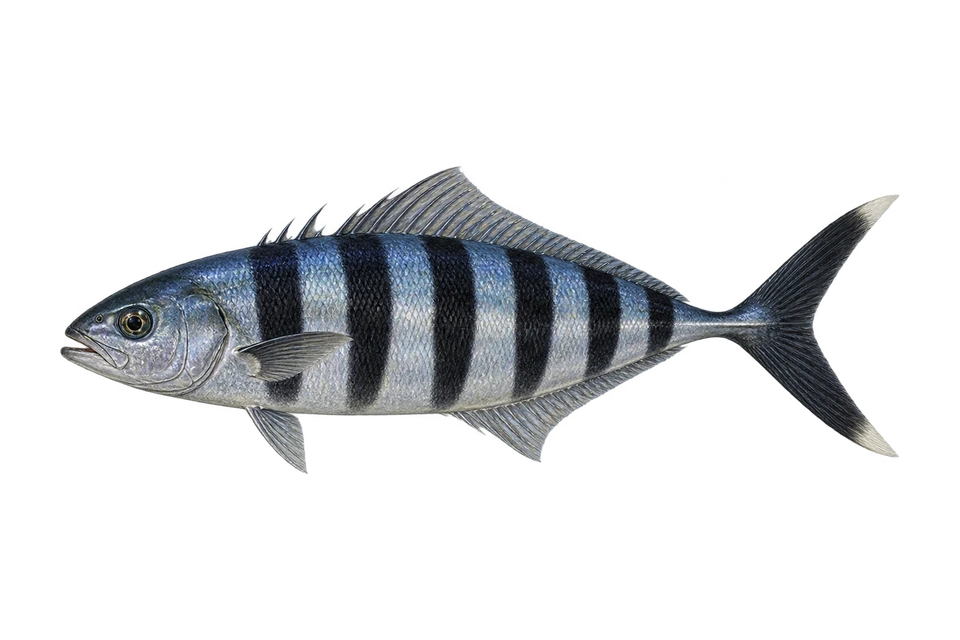
A streamlined silver fish in bold black stripes that sometimes keeps pace with a much bigger animal.
One fun thing to know
A tiny pilotfish may associate with drifting weed rather than following a shark, its familiar adult association.
How to identify it
- Six or seven upright dark bars cross the silver body.
- The tail is strongly forked, often black with white lobe tips.
- Short pectoral fins and a narrow tail base with a keel; no adhesive disc on the head.
Where to look
Open ocean and surface waters; listed in the Florida Museum’s Lake Worth Lagoon checklist and in the local REEF survey. It is an open-water animal, not a regular resident of pilings or reefs.
Size
27.6 in (70 cm). reported length; measurement convention not stated in the cited field account.
What it eats
Takes small fish, free-swimming crustaceans and external parasites.
Behavior
Often swims with sharks, rays, turtles or large fish; the young can use floating weed or jellyfish as cover.
Reproduction
Eggs and larvae drift in open water. This guide does not establish a local spawning season.
Look-alikes
Unlike a remora, the pilotfish follows under its own power and lacks a sucker. The bold bars across the body help distinguish it from other jacks.
Can you collect or eat it?
Enjoy watching it and leave it in the water. This guide does not verify species-specific harvest or food-safety rules. Check the current rules for the exact location, species and method before taking anything, and never collect where prohibited.
Check Florida’s current saltwater rules
Field references
- REEF field survey reference 1
- Smithsonian Shorefishes reference 2
- Smithsonian Shorefishes reference 3
- Florida Museum of Natural History reference 4
- REEF field survey reference 5
I saw this and want to share
Make your next dive happen
Dive with Stuart Scuba · Train with us · Travel with us · Shop with us



