


Fish identification archive / Raja Ampat
Pennant Bannerfish
Heniochus acuminatus
Raja Ampat field guide
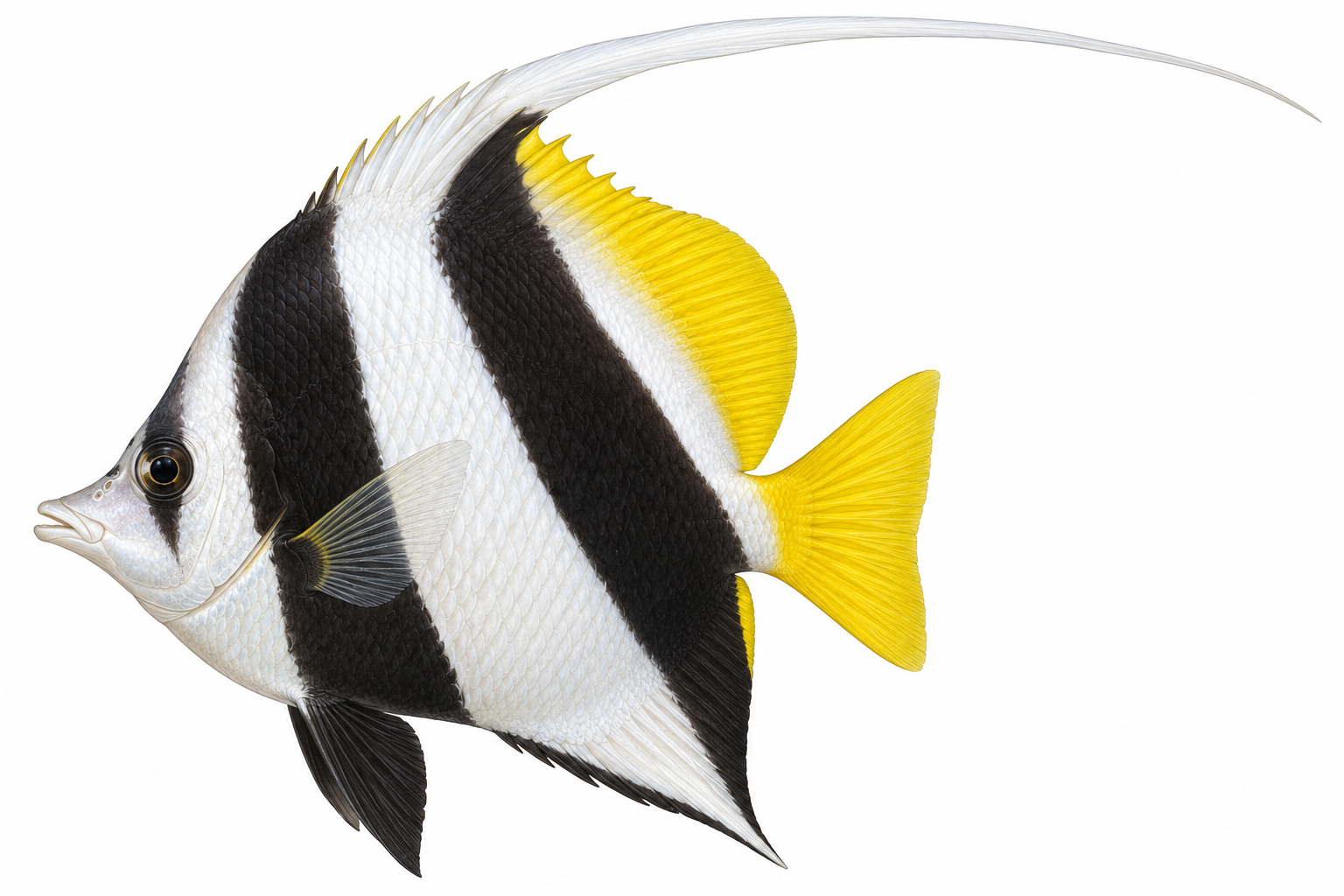
Two things to tell your dive buddy
- The long pennant is an extended dorsal-fin spine, not a separate appendage.
- Group size alone is not diagnostic: use the chest, snout and lower-fin pattern together.
How to identify it
White bannerfish with two broad black bands, yellow tail and rear dorsal fin, and a long white dorsal pennant; snout more pointed than schooling bannerfish.
Habitat and where to look
Coral reefs.
Daily habits and behavior
Seen alone, in pairs or in small groups.
What is on the menu?
Omnivorous.
Mating and the next generation
Look-alikes and identification traps
Schooling bannerfish has a shorter snout and more rounded chest; its rear black band reaches the longest anal-fin ray.
Try this observation
Seek a side view of the lower rear fin; use body shape and band placement together.
Raja Ampat occurrence
Recorded in Raja Ampat; regional occurrence does not promise a sighting on a particular dive. This guide does not imply that every site, itinerary or season offers the same chance of an encounter.
Observe, do not disturb
Keep a respectful distance, leave the animal an unobstructed route and follow your dive guide. Do not touch, feed, chase or collect wildlife. Identification does not establish permission to harvest or food safety; Florida harvest labels do not apply to this Indonesian guide.
Sources and review
Reviewed November 18, 2026.
Find where the rear black band meets the lower fin
In a side view, compare the rear black band with the pointed corner of the anal fin. On the pennant bannerfish it extends past that angle rather than ending around the corner, as on the schooling bannerfish.
Practice comparing similar species by the placement of their markings in SDI Reef Fish Identification.
Make your next dive happen
Dive With UsTrain With UsExplore the Raja Ampat tripShop With Us
Questions? (772) 600-8288 or info@stuartscuba.com.




