


Pelagic Thresher Shark
Alopias pelagicus · Alopiidae
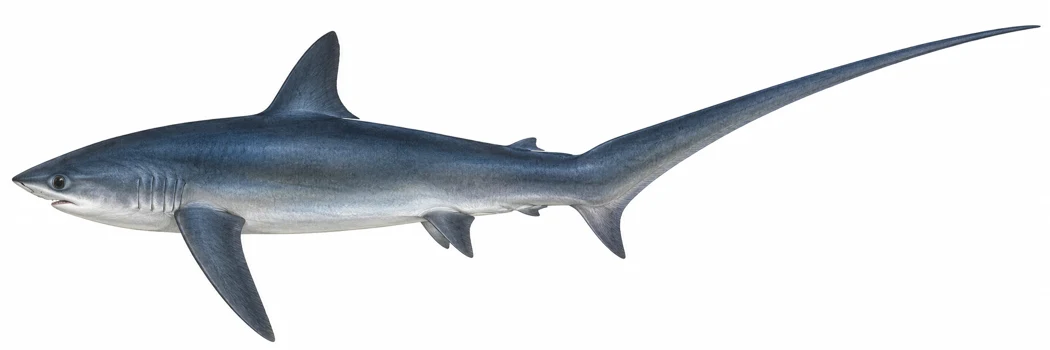
A tail as long as the rest of the shark
The first thing a diver is likely to notice is the long, narrow upper blade of the tail. It can approach the length of the head and body together. That silhouette identifies a thresher, even when most of the shark is in shadow. To identify the species, look forward. The pelagic thresher has a relatively small head, a rounded snout and dark skin above the bases of the pectoral fins. A clear side view that includes the eye and the point where the pectoral fin meets the body is more useful than a close-up of the tail.
Which thresher did you see?
The common thresher has a patch of white belly color that extends up above the pectoral-fin base. On the pelagic thresher that patch stays dark. A bigeye thresher has much larger, upward-looking eyes and conspicuous grooves running back over its head. All three have the long tail. If the shark was silhouetted and those other features were hidden, record it as a thresher shark and keep the species identification open. Florida Museum identification account.
Where it lives and what the Raja Ampat record means
This is an open-water shark of the tropical Indo-Pacific. It can come close to islands, so a reef-edge encounter makes ecological sense even though the animal spends much of its life away from the bottom. Its reported maximum total length is about 3.65 m (12 ft). Total length includes that long upper tail blade. A diver estimating the trunk alone and a diver measuring the whole silhouette could give quite different size reports of the same shark. Fishes of Australia species account.
A Raja Ampat shark survey includes the pelagic thresher in its checklist of species already recorded in the archipelago. Its baited cameras in the Dampier Strait and Penemu study areas did not record one. Those are two different observations: there is a regional record, and this particular survey supplies no encounter rate for the species. The evidence does not establish a dependable thresher dive site in Raja Ampat. Raja Ampat survey and species checklist, Appendix 2.
How the tail catches dinner
At Pescador Island in the Philippines, researchers filmed pelagic threshers attacking schooling sardines. In a typical overhead strike the shark accelerated toward the school, pitched its head down and brought the upper tail forward over its back. The researchers documented the shark turning back to collect stunned fish. One strike could put several small prey within reach. That video helps explain why a shark feeding just outside a school may point its head away from the fish it is about to hit. It documents behavior in the Philippines, not a feeding event in Raja Ampat. Oliver and colleagues, field observations and video.
How the pups develop
A study of 831 pelagic threshers caught off northeastern Taiwan found two embryos per litter. The young develop inside the mother. After using the yolk from their own egg, the embryos feed on additional eggs she produces, a process called oophagy. The researchers estimated total length at birth at 1.58–1.90 m, already longer than many adult reef sharks. A large newborn and a small litter help explain why losing breeding females matters for this species. These measurements come from the Taiwan population. Liu and colleagues, age, growth and reproduction.
If one passes your dive group
Stay with your buddy at your planned depth. Give the shark and the school of fish an open route. If it turns broadside, try to get the head, pectoral-fin base and full tail in one frame. Note the dive site, your depth, the time and what the animal actually did. A shark passing a baitfish school and a shark striking the school are different sightings, and both are worth recording accurately.
Six things worth knowing
- The smallest of three species: It is smaller than the common and bigeye threshers, though a mature shark is still several feet long.
- A tail that stuns prey: Researchers filmed pelagic threshers whipping the tail over the head to stun sardines.
- One strike can yield several fish: Video observations showed sharks collecting more than one prey item after a successful slap.
- A cleaning visit: Field cameras documented pelagic threshers visiting a Philippine seamount, where cleaner fish inspected them and fed on external parasites.
- A wide menu in open water: Herrings, mackerels and flyingfishes are recorded prey; they also eat squid.
- Embryos eat unfertilized eggs: Later in development the embryos eat eggs produced by the mother. Usually two pups are born, one from each uterus.
Build your shark ID skills
In SDI Shark Awareness, learn to compare all three thresher species and recognize a cleaning station from a distance. SDI Advanced Adventure brings together several dive skills, including navigation; follow the site briefing and keep the station clear.
Compare field guides
Compare other Raja Ampat fishes
Fishes of Australia species account and reference photographs · Regional shark checklist, Appendix 2
I saw this and want to share
Back to all Raja Ampat species · Dive Raja Ampat with Stuart Scuba




