


Fish identification archive / Raja Ampat
Peacock Grouper
Cephalopholis argus
Raja Ampat field guide
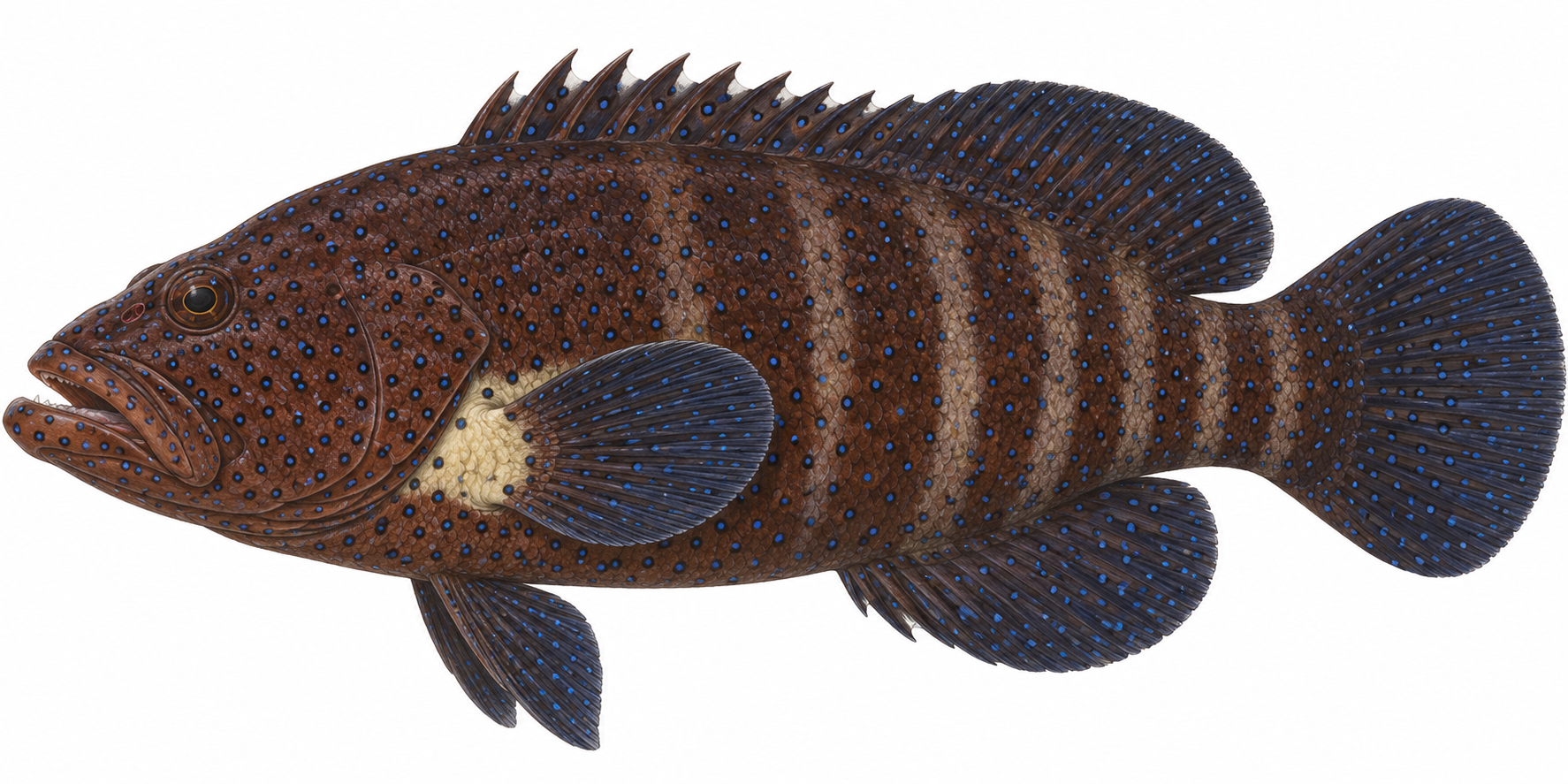
Two things to tell your dive buddy
- This grouper can change sex, so reproductive identity is not necessarily fixed throughout life.
- Juveniles often occupy dense shallow coral, while larger fish use habitats extending to outer reef slopes.
How to identify it
Brown body with black-edged blue spots and sometimes pale bars across the rear half.
Habitat and where to look
Coral habitats from shallow reef areas to outer slopes.
Daily habits and behavior
A reef predator whose juvenile habitat often includes dense shallow coral.
What is on the menu?
Mainly fishes.
Mating and the next generation
Capable of changing sex.
Look-alikes and identification traps
Coral hind typically has a brighter orange-red background; compare pale rear-body bars and the chest patch.
Try this observation
Look for the pale patch around the pectoral-fin base.
Raja Ampat occurrence
Recorded in Raja Ampat; regional occurrence does not guarantee a sighting. This guide does not imply that every site, itinerary or season offers the same chance of an encounter.
Observe, do not disturb
Keep a respectful distance, leave the animal an unobstructed route and follow your dive guide. Do not touch, feed, chase or collect wildlife. Identification does not establish permission to harvest or food safety; Florida harvest labels do not apply to this Indonesian guide.
Sources and review
Reviewed November 18, 2026.
Notice the dark rims around the blue spots
The peacock grouper has tiny blue spots edged in dark color on a brownish body. Pale bars can appear on the rear flank, but not on every fish; the light patch around the base of the pectoral fin is another clue.
Practice collecting more than one visible field mark in a side-on image through SDI Underwater Photographer.
Make your next dive happen
Dive With UsTrain With UsExplore the Raja Ampat tripShop With Us
Questions? (772) 600-8288 or info@stuartscuba.com.




