


Northern Searobin
Prionotus carolinus · Triglidae
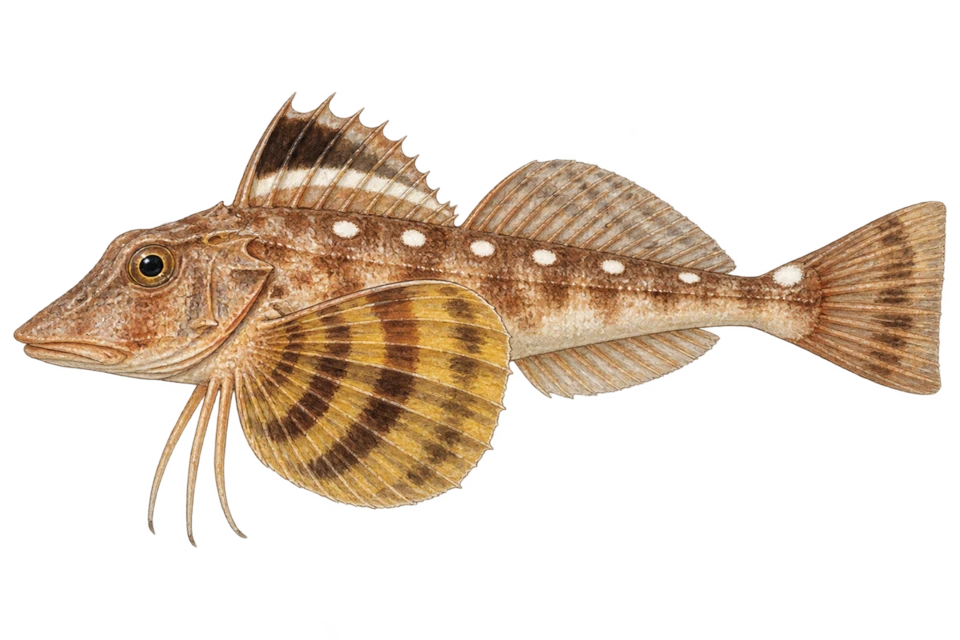
Watch for three walking rays below each wing-like fin, then check the back and tail for pale dots.
One fun thing to know
Experiments showed the walking rays can detect chemicals in sand and help locate hidden prey.
How to identify it
- Long, sloping bony snout and a small mouth slightly underneath.
- Rounded yellow-brown pectoral fins with dark crossbars and three free lower rays.
- Pale spots along the back and one on top of the tail base.
Where to look
Soft mud and sand bottoms. Most depths listed by Smithsonian are about 59–180 ft (18–55 m).
Local record: This fish has been recorded in REEF surveys at Blue Heron Bridge (Phil Foster Park), Riviera Beach. A local record is not a guarantee of a sighting.
Size: Up to about 15.0 in (38 cm) in the cited account. This is a published upper size, not what to expect on every dive.
What it eats
Small fish, worms, mollusks and crustaceans.
How it behaves
Uses the separate fin rays to walk and probe sediment for buried food.
Reproduction
Eggs float in open water; local timing is unverified.
Look-alikes
Other searobins have walking rays. Pair the white back and tail-base spots with the rounded barred pectoral fins.
Can you collect or eat it?
Enjoy watching it and leave it in the water. This guide does not verify species-specific harvest or food-safety rules. Check the current rules for the exact place, species and method before taking any fish.
Check Florida’s current saltwater rules
Field references
- Smithsonian Shorefishes species account
- REEF Blue Heron Bridge survey report
- Study: walking rays and chemical detection
I saw this and want to share
Make your next dive happen
Dive with Stuart Scuba · Train with us · Travel with us · Shop with us



