


Knobby Spider Crab
Mithraculus nodosus · Mithracidae · Clinging crab · Galápagos Islands Fish ID
How to identify it
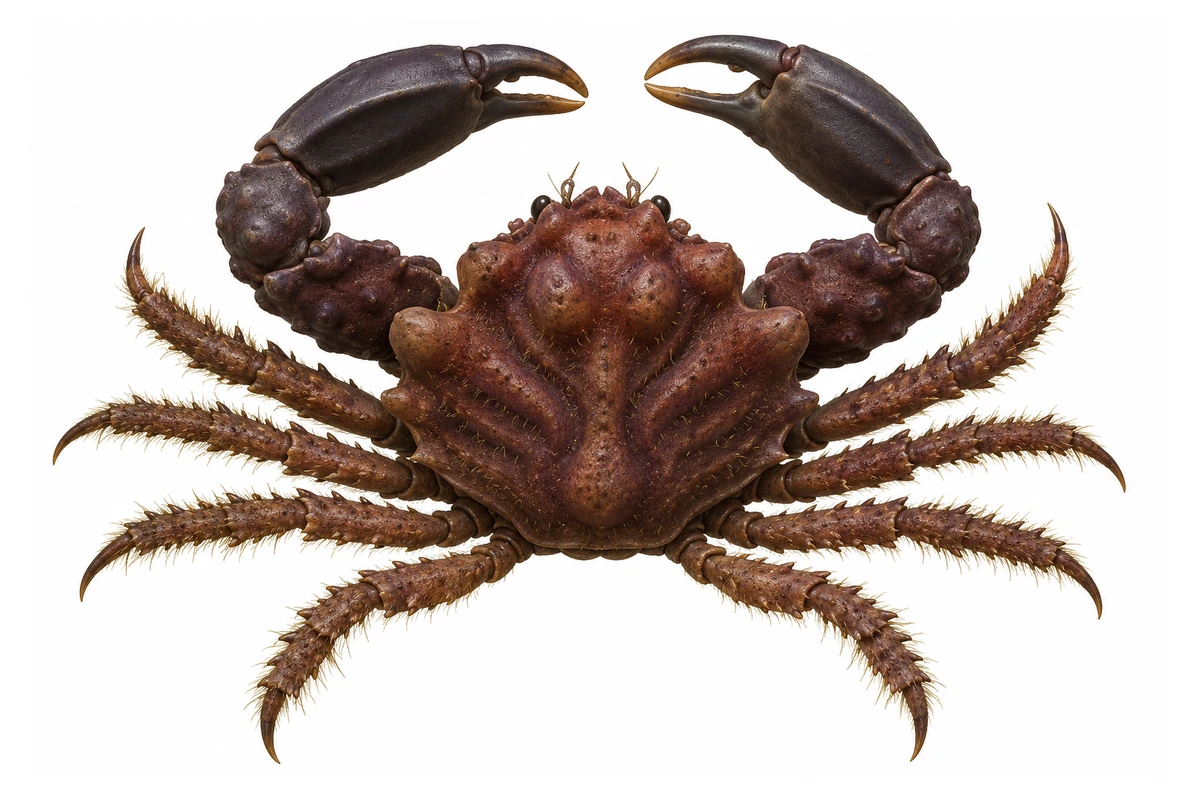
From above, look for three broad bumps along each forward side of the shell and smoother diagonal grooves farther back. Fine yellowish hairs can show against the dark body.
Don’t confuse it with the Atlantic emerald crab. The diagonal grooves plus the shape of the three broad side lobes are more useful than color.
Galápagos Islands records
Documented Galápagos record: Six specimens, including a young crab and an egg-bearing female, were collected on the rocky shore near the Charles Darwin Research Station, Santa Cruz, in February 1964. An earlier expedition documented it on several Galápagos islands. A record does not guarantee a sighting.
Fun facts
- The three large lobes along each forward side give the crab its knobby outline.
- The grooves across the side of its back run diagonally instead of forming a row of round pits.
- The inner edge of the claw-bearing limb has a thin plate-like rim.
- The early Galápagos expedition described living animals as purplish-brown, with fine yellowish hairs on the legs and near the antennae.
- The crab was documented both under rocks and in coral heads, including Pocillopora.
- One Santa Cruz male in the 1964 collection measured 23.7 mm across the shell; an older expedition measured a larger animal at 38.2 mm.
Explore and learn
An overhead photo and a clear view of the claws tell you more than an oblique flash of brown under a ledge.
Practice showing small identification details in Underwater Photography · Explore Stuart Scuba’s worldwide group dive trips




