


Mackerel Scad
Decapterus macarellus · Carangidae
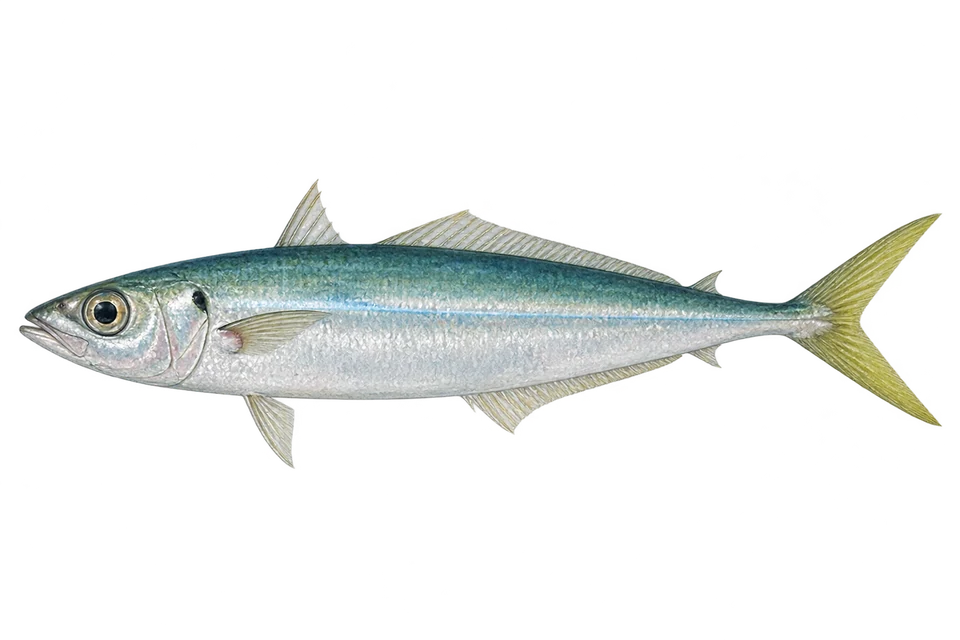
Spot a slender, silver schooler? Look for a tiny finlet just behind each long fin and a yellow-green forked tail.
One fun thing to know
Despite its mackerel-like outline, it is a member of the jack family.
How to identify it
- Long, almost cylindrical body with a blue-green back and silver flanks.
- Tiny dark spot high on the rear edge of the gill cover.
- One isolated finlet above and one below the tail wrist; tail deeply forked.
Where to look
Mostly open ocean, often away from the bottom. When it passes near a reef or bridge, look up into the water column rather than along the sand.
Local record: This fish has been recorded in REEF surveys at Blue Heron Bridge (Phil Foster Park), Riviera Beach. A local record is not a guarantee of a sighting.
Size: Up to about 17.3 in (44 cm) in the cited account. This is a published upper size, not what to expect on every dive.
What it eats
It picks tiny drifting animals and fish eggs or larvae from the water.
How it behaves
Watch for fast-moving, aligned fish in open water. A close side view is much better than a distant school silhouette for confirming the species.
Reproduction
Its eggs and early larvae drift in open water. That is not evidence of spawning at Blue Heron Bridge.
Look-alikes
Other scads can have the same finlets. Bigeye Scad has a conspicuously larger eye; use the mackerel scad’s elongated body, small gill-cover spot and finlets together.
Can you collect or eat it?
Enjoy watching it and leave it in the water. This guide does not verify species-specific harvest or food-safety rules. Check the current rules for the exact place, species and method before taking any fish.
Check Florida’s current saltwater rules
Field references
I saw this and want to share
Make your next dive happen
Dive with Stuart Scuba · Train with us · Travel with us · Shop with us



