


Fish identification archive / Raja Ampat
Longnose Hawkfish
Oxycirrhites typus
Raja Ampat field guide
Two things to tell your dive buddy
- Look inside the architecture of sea fans and black corals rather than only above the reef. This hawkfish uses their branches as perches.
- Its apparently sedentary life has a drifting chapter: pairs spawn in the water column, and the eggs and larvae are pelagic.
How to identify it
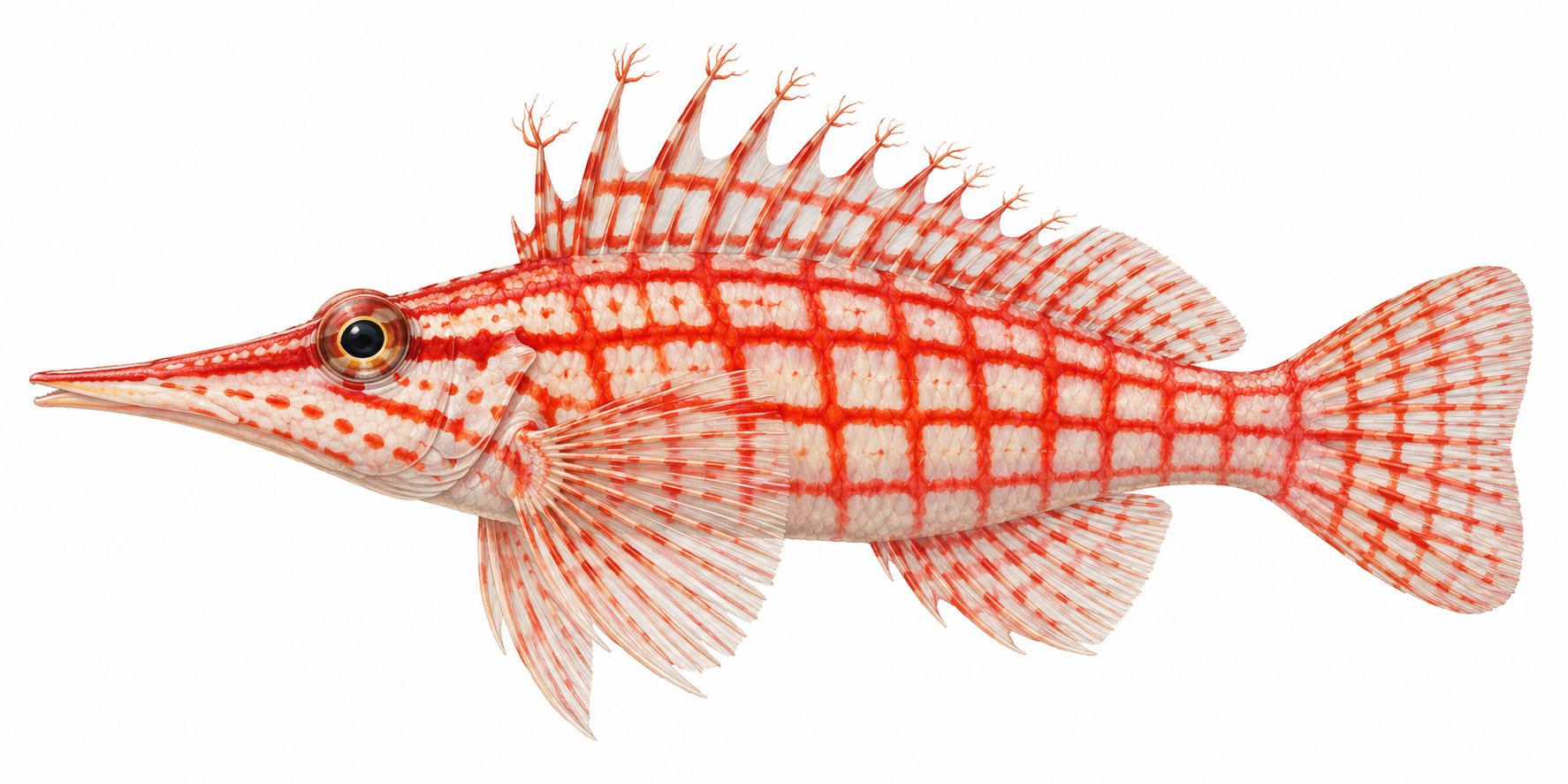
A pointed, elongated snout and red crosshatching over a pale body.
Habitat and where to look
Current-exposed outer slopes, often among sea fans and black corals; frequently deeper than 25 m.
Daily habits and behavior
Perches among branches. Seek it only within the planned dive depth.
What is on the menu?
Small bottom-living and planktonic crustaceans.
Mating and the next generation
Pairs spawn in the water column; eggs and larvae are pelagic.
Look-alikes and identification traps
The very long pointed snout and red crosshatching distinguish it from shorter-snouted hawkfishes.
Try this observation
Inspect fans from a distance without touching or bending their branches. Stay within the planned dive depth.
Raja Ampat occurrence
Recorded in Raja Ampat; regional occurrence is not an itinerary-specific sighting promise. This guide does not imply that every site, itinerary or season offers the same chance of an encounter.
Observe, do not disturb
Keep a respectful distance, leave the animal an unobstructed route and follow your dive guide. Do not touch, feed, chase or collect wildlife. Identification does not establish permission to harvest or food safety; Florida harvest labels do not apply to this Indonesian guide.
Sources and review
Reviewed November 18, 2026.
Follow the long snout and red crosshatching
The longnose hawkfish has a pointed snout and a red grid across its pale body. It can perch among the branches of sea fans and black corals, so pause and scan the branches before looking for movement.
Use SDI Underwater Photographer to practice framing perched fish without pushing in toward their cover.
Make your next dive happen
Dive With UsTrain With UsExplore the Raja Ampat tripShop With Us
Questions? (772) 600-8288 or info@stuartscuba.com.




